
High fares keep passengers away from new taxicabs
Jubair Hasan | Wednesday, 30 April 2014
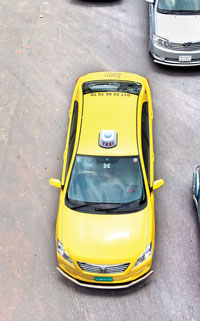
The newly-introduced luxury taxicabs are yet to attract users in significant numbers due mainly to 'improper' fixation of their fares coupled with insufficient cabs, users and experts said.
The taxicab users observed that the new fare had made the service much costlier with the rate going beyond the reach of middle-class people.
They also said the fresh rate was double the fare which they had paid previously, and it was discouraging the passengers from hiring the new cabs.
On April 22 last, the Prime Minister and the Communications Minister in two separate functions inaugurated the new taxicab service operated by Trust Transport Services under Army Welfare Trust and Toma Group.
Following the inauguration, the premier urged the authorities concerned to fix Tk 85 as fare for the first two kilometres instead of the previously fixed Tk 100.
Kamrul Islam, a private banker, said he had travelled to Shahbagh from Banani with Toma AC cab and paid Tk 410, which was much higher since he used to spend around Tk 200 earlier for travelling the same distance.
The passenger was very critical of the new fare rates, saying the meter starts vibrating when the passengers call a cab over
mobile phone sets. He was informed of this by the driver.
"That means the meter starts charging fares even before the passengers step into the vehicle. The improper rate should be reduced to an affordable level to make the cabs popular among the commuters. Otherwise, people will lose their interest in using the service," he added.
Shamim Ahmed, a lawyer who waited for 20 minutes in front of National Press Club to avail the service, said it was very difficult to get the cabs as only 47 taxis were now in operation in the city.
After finding a brand new Toma AC (air conditioned) taxicab of Toyota Premio 2013 model, which was parked beside the UNICEF Bangladesh Country Office on Ruposhi Bangla Hotel premises, the FE correspondent made a short trip to Dhaka South City Corporation (DSCC).
Immediately after the correspondent got into the brand new car, driver of the cab Md. Masum Billah informed the control room about the latest booking over his mobile phone and the phone set was shifted to the correspondent.
The control room operator said over the phone they contact the passengers concerned to know if they have left something inside the car before leaving it. The control room also asked for this correspondent's cell phone number.
A close-circuit camera for monitoring activities of the driver and the passengers was also found inside the car, which also has the most sophisticated technological facilities including GPS systems, vehicle tracking systems and wireless technology to track down and trace the cabs of this type running around the country.
It took 17 minutes to reach the destination following a trip of 3.283 kilometres and the driver handed over to the correspondent a fare receipt of Tk 170. The fare included charges against 7.57 minutes in the form of waiting.
Talking to the FE, the driver said people interested to hire the cabs had been increasing gradually because of the security and services offered to them.
"My monthly salary is Tk 12,000 and we also receive commission of 5.0 per cent, 8.0 per cent and 10 per cent if our earnings go up to Tk 3,000, Tk 4,000 and Tk 5,000 respectively," he said.
Communication experts disapproved of the high fare structure, saying that the rate was much higher than that in other countries in South and Southeast Asia.
When contacted, Chief Executive Officer of Toma-operated taxicabs Brigadier-General (retd) Mustafa Kamal said they have already slashed down the fare by Tk 15 following suggestions of the Prime Minister.
"We cannot compare the rate with countries like India as the low-cost taxicabs in those countries are operated by diesel, and our cars, the financial value of which ranges from Tk 1.8 million to Tk 2.6 million, are driven by octane," he said.
He added the rate was not much higher "if we incorporate things like service and security."
Mr. Kamal said they sat in a meeting with the high-ups of Bangladesh Road Transport Authority (BRTA) on Tuesday afternoon. "There we requested them to form a special committee for reviewing the fare rate."
The two companies will operate 600 taxicabs in Dhaka and Chittagong. The Trust Transport Services is expected to introduce 400 new taxicabs, while the Toma Group will introduce 200 units.
Out of the 400, the Army Trust will operate 100 taxis in Chittagong.