
High-level of protection 'goes against export-diversification'
Global impact analysis required to assess functionality of WTO rule-based system
FE Report | Sunday, 14 August 2022
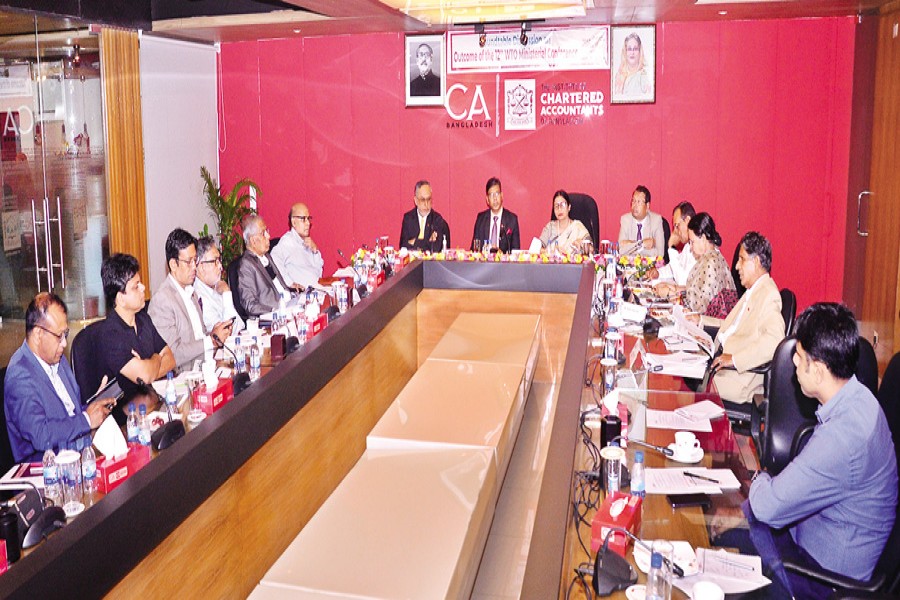
A global impact analysis is required to assess whether the rule-based system of World Trade Organization (WTO) is properly functional, the secretary of the Economic Relations Division (ERD) said on Saturday.
Sharifa Khan said it should be looked into whether there was any game behind undermining the rule of WTO
Speaking at a roundtable on 'Outcome of the 12th WTO Ministerial Conference', she said politics was getting preferences to trade at the WTO.
It should be studied how Bangladesh would be affected due to non-functioning of the rule-based system of WTO, she said.
She, however, appreciated the Bangladesh delegation's success in MC12 where all members reached consensus that graduating Least Developed Countries might need some sort of support to face challenges after graduation.
The Institute of Chartered Accountants of Bangladesh organised the programme at its premises.
Md Humayun Habir, past president and council member of ICB, moderated the session.
Shubhashish Bose, Chief Executive Officer (CEO) of ICAB, delivered the opening remarks.
Md Shahadat Hossain, president of ICAB, addressed the programme focusing on some key outcome of MC12.
Dr Zaidi Sattar, Chairman of the Policy Research Institute of Bangladesh (PRI), Md Hafizur Rahman, Director General of the WTO cell at the Ministry of Commerce (MoC), Manzur Ahmed, advisor to the Federation of Bangladesh Chambers of Commerce and Industry (FBCCI), Ferdous Ara Begum, Chief Executive Officer (CEO) of BUILD, Shishir Kumar Dev, former CEO of Bangladesh Foreign Trade Institute (BFTI), Khairuzzaman Mazumder, additional secretary of Ministry of Finance (MoF), and Dr Mostafa Abid Khan, former member of Bangladesh Trade and Tariff Commission (BFTTI), spoke on the occasion.
Dr Zaidi Sattar said the existing tariff structure remained a barrier for the country's export-diversification due to the high-level of protection for domestic industries.
He said national interest means long-term national interest where any short-term benefit might have a different impact in the long-run.
Hafizur Rahman gave details of the outcome document of MC12 in Bangladesh's perspective.
He said Bangladesh would place a revised proposal in the next WTO ministerial, accommodating TRIPS waiver, market access and the basis of the country's bilateral trade agreements that time.
Ferdous Ara said the government would have to focus on the domestic front for survival of local industries along with continuation of negotiation at the WTO.
She said how the country's domestic industry could be facilitated to continue their business after discontinuation of trade benefits should be worked out.
She cited a study of World Bank (WB) pointing out that reduction of time and cost in three areas including delivery time at the Chattogram port, logistic cost and road congestion could help increase export growth by 19 per cent.
Dr Mostafa Abid said if Bangladesh graduates to a middle income country it will have to achieve the self-sufficiency to run without subsidy from other countries.
Manzur Ahmed suggested making the dispute settlement body of WTO functional.
Khairuzzaman Mazumder said imposing customs duty on e-commerce goods was necessary as the country was losing a substantial amount of revenue in the sector.
The ERD secretary said the MC12 decisions came as outcome documents rather than ministerial declarations without any concrete decision.
She said the country's domestic industries would have to sustain based on their productivity and competitiveness as the trade benefit would not exist after graduation.
She said waiver on services has to be accredited to get access to other markets. Waiver on services is not a major issue as quality and efficiencies matter for this, she added.
doulot_akter@yahoo.com