
Higher direct taxes could reduce poverty, income inequality in Bangladesh: Study
Poorest households would benefit most, it notes
FE REPORT | Thursday, 20 November 2025
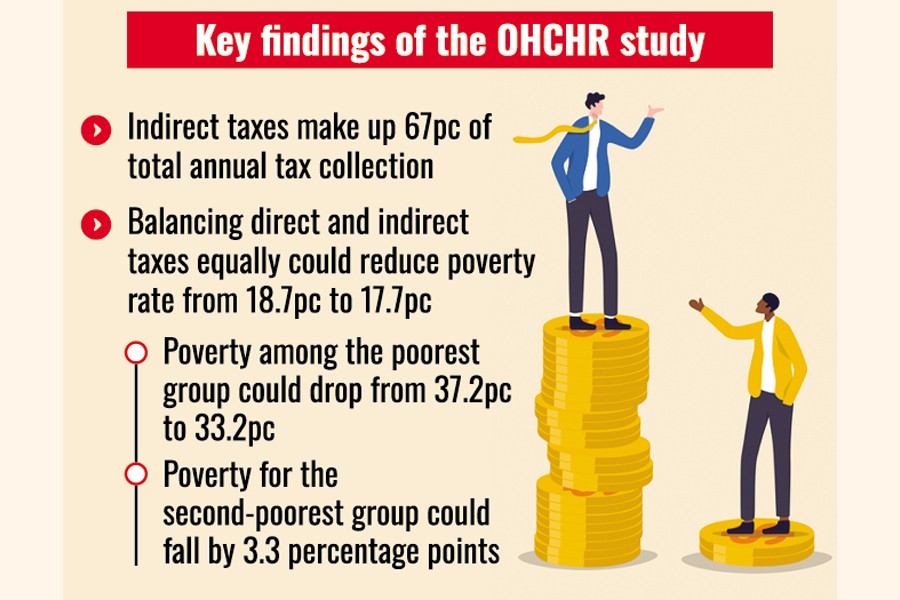
Bangladesh has significant potential to reduce poverty and narrow income inequality by increasing revenue from direct taxes while reducing its heavy reliance on indirect taxes, which currently make up 67 per cent of total annual tax collection, according to a new study.
The study estimates that if direct and indirect taxes were balanced equally, the overall headcount poverty rate could fall by 1.0 percentage point, from 18.7 per cent to 17.7 per cent. The gains would be particularly notable among the poorest households: poverty among the lowest-income group is projected to decline from 37.2 per cent to 33.2 per cent, while the next poorest group would see a reduction of 3.3 percentage points.
The findings were presented on Wednesday at a discussion titled "Taxation to Realise Economic, Social and Cultural Rights in Bangladesh", held at a city hotel and organised by the Office of the United Nations High Commissioner for Human Rights (OHCHR) Mission in Bangladesh.
OHCHR Consultant Md Salay Mostofa, who authored and presented the study, said that shifting towards direct taxes also reduces income inequality. The income Gini coefficient -- a key measure of disparity -- falls from 0.4999 to 0.490 under a more progressive tax system. Consumption inequality also declines moderately, with the consumption Gini coefficient dropping from 0.334 to 0.327.
Mr Mostofa added that progressive tax reforms could positively impact employment. A 2-percentage-point increase in the tax-to-GDP ratio is projected to raise the overall employment rate by about one percentage point, with the largest gains in the service sector, followed by agriculture and industry.
He emphasised the need to align the taxation system with human rights principles to protect the economic rights of low-income and marginalised populations. "However, most of our revenue comes from indirect taxes, which undermines the economic rights of marginal communities," he said.
The study also noted that Bangladesh's revenue potential remains underutilised due to persistently low tax effort. "Bangladesh ranks only ahead of Congo and Iran globally and remains the lowest in South Asia -- far below the world average. Despite two decades of effort, tax efficiency has barely improved, and the country has yet to reach its potential tax-to-GDP threshold," Mr Mostofa added.
Speaking as chief guest, NBR Chairman Md Abdur Rahman Khan acknowledged the challenge of expanding the taxpayer base. "While we now have 1.20 crore TINs, many more people -- especially in remote areas -- must enter the formal system," he said, adding that poorer citizens often pay a disproportionate share of taxes, while exemptions are widely granted to investors and large businesses, undermining fairness and limiting direct taxation.
Special guest Dr Sayema Haque Bidisha, pro-vice chancellor (administration) at Dhaka University, said taxation is not merely a revenue tool but a mechanism to promote economic and social justice.
She urged expanding the tax net to include high-income earners and businesses, digitisation, and improved digital literacy to ensure fairer revenue collection. She also advocated diversifying taxes -- especially property and non-traditional taxes -- over continued reliance on indirect taxes to reduce inequality more effectively.
Prof Abu Eusuf, executive director of the Research and Policy Integration for Development (RAPID), said Bangladesh could raise its tax-to-GDP ratio to around 14 per cent -- almost double the current level. However, the ratio has fallen sharply from 8.0 per cent two years ago to just 6.6 per cent this year.
He warned that heavy reliance on indirect taxes limits fiscal space for spending on education, health, and social protection, calling for a coordinated "big push" across government and stakeholders.
The event was presided over by Dr Zaidi Sattar, chairman of the Policy Research Institute of Bangladesh. Former NBR chairman Mohammad Abdul Mazid, BUILD CEO Ferdaus Ara Begum, and Huma Khan, head of the OHCHR Mission in Bangladesh, also spoke.
newsmanjasi@gmail.com