
Hindu-Muslim riots expose risk at major Indian business hub
Indian court allows survey of mosque to see if it was built over temple
Friday, 4 August 2023
GURUGRAM, Aug 3 (Reuters): Hindu-Muslim clashes just outside the Indian capital this week have worsened religious fault lines in the region and exposed a booming business hub to threats of violence and disruption, authorities and analysts said.
Seven people were killed and over 70 injured in rioting in Nuh and Gurugram districts of Haryana state after a Hindu religious procession was targeted and a mosque attacked in retaliation.
The 48-hour cycle of violence which was put out on Wednesday has brought to the fore Hindu-Muslim tensions brewing in the region since 2015, a year after the Hindu nationalist Bharatiya Janata Party (BJP) captured power nationally and in Haryana.
The lynching of two Muslim men in the region earlier this year by suspected Hindu vigilantes and the failure to nab the main suspect had worsened tensions, with the main suspect saying on social media that he would participate in the Hindu procession this week.
Ultimately he did not show up, police said.
"It has been shocking to see how distrust between two communities spilled onto the streets," Haryana's home (interior) minister, Anil Vij, told Reuters.
"Security has been restored...bringing relief and social harmony will take time," Vij said, adding that authorities understand safety concerns of businesses in Gurugram.
Gurugram, formerly known as Gurgaon, is a city of over 1.5 million people that shares a border with New Delhi.
A new urban centre with glitzy high-rises, luxury hotels, malls and gated condominiums, it is home to multinational firms, large Indian corporates and start-ups, with 250 of the Fortune 500 companies having offices here.
Among the multinationals with offices here are Google, American Express, Dell, Samsung, Ernst & Young and Deloitte. Suzuki's main India plant is also located near Gurugram.
Because of the violence, many companies allowed employees to work from home on Tuesday while schools and colleges were shut before resuming classes on Wednesday.
In the past, Gurugram has witnessed tensions over Muslims holding Friday prayers in public spaces and meat sales during Hindu festivals, which Hindu groups wanted banned to respect Hindu sentiment.
Clashes between India's majority Hindus and minority Muslims break out occasionally, but have been less frequent since Prime Minister Narendra Modi's BJP government took power in 2014.
But tensions between the communities have risen, with many Muslims saying they live in fear as Hindu activists have become emboldened by the BJP's politics.
"Muslim men attacked the Hindu procession and killed many of our people," said Praveen Babbar, a leader of Hindu Yuva Vahini (Hindu Youth Force).
"Every action will have not just equal, but sometimes even more brazen reaction," he said.
Aftab Ahmed, Nuh's state lawmaker from the opposition Congress party, blamed local police for not acting fast enough even though he had alerted them about "provocative statements" being made by Hindu leaders. Indian court allows survey of a 17th-century mosque to see if it was built over a Hindu temple
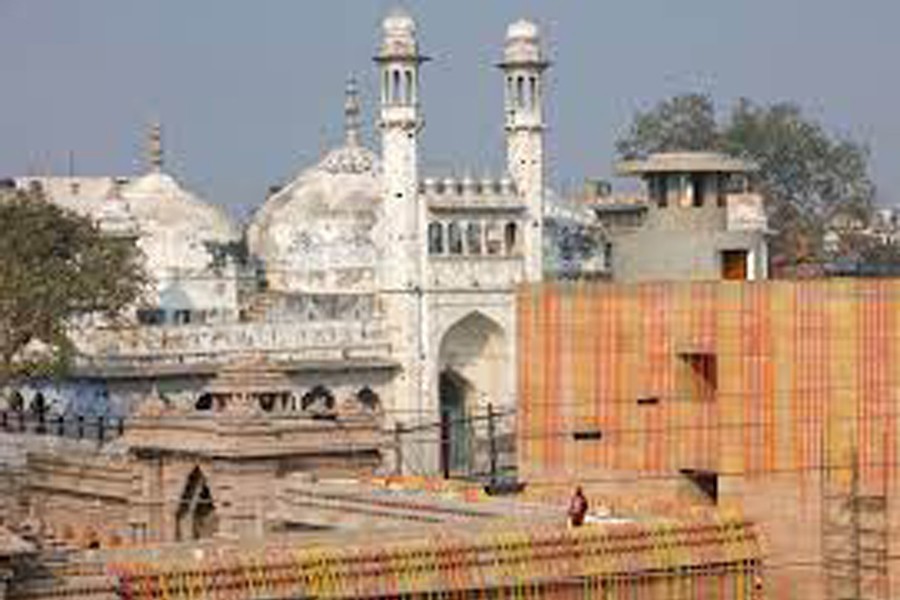
Another AP report adds from lucknow, an Indian court on Thursday ruled that officials can conduct a scientific survey to determine if a 17th-century mosque in the country's north was built over a Hindu temple.
The Gyanvapi mosque in the holy Hindu city of Varanasi, an area Prime Minister Narendra Modi represents in India's parliament, is one of several mosques in northern Uttar Pradesh state that some Hindus believe was built on top of demolished Hindu temples.The dispute over land ownership had been one of India's most heated issues between India's 80% majority Hindu community and Muslim minority, which makes up nearly 14% of the country's 1.4 billion people.
Vishnu Shankar Jain, an attorney representing the Hindu petitioners, said the High Court in the state on Thursday allowed the state-run Archaeological Survey of India to survey the structure without causing any damage to it.
"Scientific survey is necessary in the interest of justice," Live Law, an online portal for Indian legal news, cited Chief Justice Pritinker Diwaker as saying.
The Muslim petitioners objected to the survey saying it would damage the structure.