
Holding perpetrators of genocide to account
Mohammad Amjad Hossain | Friday, 24 July 2015
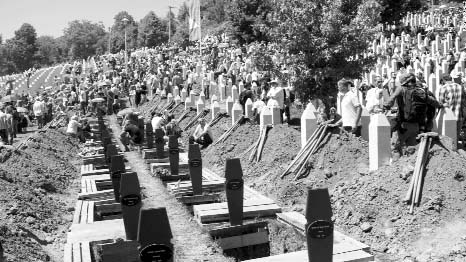
Twenty years ago on July 11, Bosnian Serb forces swept into eastern Srebrenica of Bosnia-Herzegovina enclave which the United Nations had declared as 'safe haven' for ethnic Muslim community. They executed 8,000 or more ethnic minority Muslims, including boys, dumped their bodies into pits to take revenge against their movement for separation from former Yugoslavia. These killings were a part of war against Kosovars, majority community of Muslim ethnic group, launched by Bosnian Serbs.
"Kosovo was an impoverished and ethnically charged enclave of Serbia that had been brutally cleansed by Slobodan Milosevic's armies", stated Condoleezza Rice, former Secretary of State under President George W. Bush, in her book, No higher honor.
The Russian Federation exercised its veto power in the UN Security Council on July 08 this year on a resolution of the Council to condemn the Srebrenica massacre as genocide to mark the 20th anniversary of the killings of 8,000 Muslim men and boys. By exercising veto power, the Russian Federation was placed on the wrong side of history.
Munira Suibasic, president of the Mothers of Srebrenica Association, has described the Russian Veto as a shame. Russia showed that it backed the crimes instead of justice. Munira had lost her husband during the massacre launched by the Bosnian Serbs.
Samantha Power, US ambassador to the United Nations, witnessed the massacre in Srebrenica as a journalist. She said Russia's veto was heartbreaking for those families who had lost their near and dear ones and it is a further stain on the Security Council's record. Such crimes of huge magnitude did take place in Srebrenica after the Second World War in Europe.
The International Criminal Tribunal for former Yugoslavia, established on the basis of the Security Council resolution of 827 on May 25, 1993, declared the killings of 8,000 Bosnian Muslim prisoners were acts of genocide beyond any reasonable doubt. The former Yugoslav President Slobodan Milosevic went on trial in the court in The Hague on 66 counts of crimes including genocide, crimes against humanity and grave breaches of the Geneva Convention on Croatia, Bosnia and Kosovo. While on trial, Slobodan Milosevic met his natural death on March 11 of 2006. However, two fugitives, Ratko Mladic and Goran Hadzic, were apprehended in mid-2011 while Gen Karadzic, Mladic and Hadzic, both commanders in Srebrenica, were on trial in the International Criminal Tribunal for committing crimes against humanity in Srebrenica and indicted in November of 1995. In 1994, the first indictment was issued against Bosnian Serb concentration camp commander Dragan Nikolic.
Ethnic cleansing went to such a level that NATO decided to intervene while Germany decided to change its constitution to participate with NATO troops outside their territory for the first time since the end of Second World War.
The army crackdown from 1996 to 1997, which was ordered by Slobodan Milosevic, was so ruthless that it had caused deaths of many ethnic Kosovars who are originally Albanians while 300,000 fled Kosovo to neighbouring Macedonia, Albania, Greece and Germany.
This writer was observing the development from Bonn where he was serving on a diplomatic assignment in the Bangladesh embassy. German Socialist Party, in coalition with the Green Party, was in power at that time. US President Bill Clinton was bitterly criticised for his initial inaction to stop the massacre of thousands of civilians during the first three years of war. On humanitarian grounds, NATO carried out the operations in Kosovo and Belgrade without the backing of the Security Council because a resolution in the Council was vetoed by Russia.
As a result of ethnic cleansing by the Serbian leader Slobodan Milosevic, Kosovo made unilateral declaration of independence on February 17 of 2008. Here again, Serbia and Russian President Vladimir Putin opposed the declaration of independence while the United States, Great Britain, France and Germany recognised Kosovo. It was the result of ruthless oppression and suppression of the majority by minority Serbs which had strengthened their resolve to become independent. In July 2010, the International Court of Justice rejected Serbian appeal that Kosovo's move had violated its territorial integrity and concluded that the declaration of independence did not violate general international law. Until 2011, a total of 83 countries out of 193 members of the world body recognised Kosovo. Bangladesh should consider recognising Kosovo on humanitarian consideration, apart from religious point of view.
To mark the heinous attacks by Serbian army on Kosovars, hundreds of people from Kosovo's various ethnicity marched through Prizren of Bosnia-Herzegovina on July 11 this year. Children released doves to commemorate thousands of Kosovars from Srebrenica killed by Bosnian Serb forces on this day in 1995. Former US President Bill Clinton, Dutch Prime Minister Mark Rutte and Serbian Prime Minister Aleksandar Vucic and European Union's chief foreign policy adviser Federica Mogherini attended the ceremony but the Serbian Prime Minister was booed out after mourners and attendees "hissed and threw stones and bottles" at him. This incident was, however, condemned by the United States and the European Union. On return to Belgrade, the Serbian Prime Minister said," I regret that some people have not recognised my sincere intention to build friendship between Serbia and Bosniak people."
Although Bill Clinton was viewed with mixed feelings but it was he who had eventually ended the war and then brokered peace talks at Dayton, Ohio. Both Bill Clinton and the foreign policy chief of the European Union addressed the gathering. Federica Mogherini spoke about Srebrenica's massacre: "Europe is faced with its shame. Europe failed to stand up to the promise of our founding fathers and to the dreams of their grandsons: no more war in Europe, no more murders in the name of race or the nation. No more genocide."
While remembrance of Srebrenica's genocide was taking place, another 136 coffins of people massacred 20 years back arrived to be buried in the graveyard. In a statement, US President Barack Obama had this to say: "Only holding the perpetrators of the genocide to account can we offer some measure of justice to help heal their loved ones. And only calling evil by its name can we find the strength to overcome it."
Serbia has not succeeded yet to join the European Union while most of the breakaway countries from former Yugoslavia did join the bloc.
It is high time for the Russian PresidentVladimir Putin to understand the feelings of the people around the world towards genocidal acts of the Serbian government 20 years back and accept the reality by according recognition to Kosovo.
The writer is a retired diplomat
from Bangladesh.
amjad.21@gmail.com