
Homrich: A great humanitarian
M G Neogi | Saturday, 12 July 2014
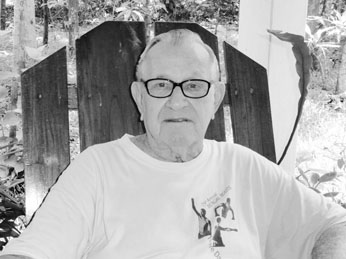
Eugene E Homrich, who is very much known in the Madhpur community, is sacrificing his whole life for the development of disadvantaged and indigenous poor people of Madhupur jungle. A native of Michigan from the United States started his humanitarian activities in the erstwhile East Pakistan (Bangladesh) in 1955, when he was only 27 years old and is still serving in his 85 years to the disadvantaged people of Madhupur jungle to improve their livelihood. When he was 27 years old, he left USA saying good-bye to his colourful life and decided to work for the disadvantaged, ill-nourished and hungry people. He started his life in Madhupur jungle for the disadvantaged and indigenous community, when there was no electricity, and that's why no electric fan, no refrigerator, no air-conditioning, nothing else and even there was no medical centre, nor any transport facilities, except only bi-cycle and bullock cart, where life was really difficult for him.
Homrich is the son of Bernard and Ella Homrich from Muskegon, Michigan in the United States. He was born in Muskegon at Mercy Hospital on 8th December 1928. In his boyhood, he studied at St Joseph's Primary High School up to class 8 and then went to Holy Cross Seminary at Notre Dame University from class 9 to 12. He passed BA majoring in Philosophy from Notre Dame University. Then he studied theology in Washington, DC and was ordained priest on 8th June 1955. He studied Bengali, Hinduism and Islam at the foreign Mission Seminary during theology studies. After ordination, he went to East Pakistan and studied Bengali for one year under a local teacher named Abdul Hamid. Then he was assigned to Golla Parish for three years, and then to Biroidakuni Mission in Haluaghat for one year.
Archbishop Graner, CSC, assigned him to Jalchatra Mission under Madhupur upazila of Tangail district in 1959 and at that time 2,500 indigenous people were living in the Madhupur jungle. There was a lot of wildlife in the dense jungle of sal trees, whose wood is considered second to teak in value. At that time, the forest contained leopard, deer, monkeys, snakes, peacock, wild chickens, and hundreds of different colourful birds in the thick gazari jungle. There was 250 square miles of forest land belonging to the Raja of Natore who used tribal community to harvest the sal or gazari trees. Immediately after joining, Homrich found that the community people were very poor, sick and had almost no food at their houses, and most importantly that they had no basic education. They lived off the forest roots and cultivated some rice lands. There was no school and the literacy rate was about 5 per cent. The health condition of the Garo community was terrible. There were no toilets or tube wells.
He realised that education is the key component for the development of indigenous community for their sustainable development. Based on this concept, he opened a number of primary schools in different villages and then he opened Jalchatra High School in the community. After that he took the responsibility to improve the health and hygiene of this community. He was trained in Cody Institute in Canada, University of Wisconsin, University of Florida and Baldwin College in Georgia in development and tropical horticulture. Then he returned to the community and started making toilet slabs, tube wells and made the people wear shoes to protect them from worms and other infections. In order to make the community people aware, he organised huge awareness campaign, so that people could be habituated to using toilets and other hygienic facilities.
Then he realised the importance of agricultural practices, as agriculture is the main component in Bangladesh to ensure food security at household level. As he was not an agriculturist and as he understood that rice is the staple food in Bangladesh which covers more than 80 per cent of agriculture, he communicated with International Rice Research Institute (IRRI) and then he studied on rice production at IRRI. This training opened his eyes and he understood that there is a huge opportunity to work on modern agriculture with improved rice varieties which can improve the food security of the community people. Then he returned to the community people with latest technologies and modern high yielding rice varieties from IRRI. Though he had no proper equipment, he made use of what was available. He selected the community leaders in each village and provided the latest technologies and seeds of modern high yielding rice varieties while he ensured his follow-up to crop fields in each village, resulting in bumper production. Not only the rice technology, he communicated with the local agricultural expatriates from different government and research agencies and collected the latest affordable technologies for the jungle people which were appropriate for them and provided such technologies and seeds of modern high yielding vegetables, maize, wheat, jutes, etc for the community people. Still, he is practicing the same in such a way.
He formed COOPS and village councils to control corruption and pagan sacrifice. He along with the community leaders had to drag the children to school and today 90 per cent of the indigenous people locally called Garos (or Mandis, as they refer themselves) are educated and are getting good jobs with good health. Homrich founded the Holy Cross Catholic Mission at Pirgacha in 1960 as a new mission with many primary schools and a number of high schools. Right now, he developed 27 primary schools where 1,700 students are studying, another 550 attended high schools, and many of them have graduated from colleges mostly coming from indigenous communities. Now, the literacy rate is above 90 per cent through which a stable community has been made in the society and the tribal people are now getting good jobs and enjoying better livelihoods.
The Garo tribes are a gentle community isolated from the rest of the nation by their lush and forested jungle homeland. In the predominately Muslim country of Bangladesh, the Garo society is matriarchal where the women own the family land and pass on the family name. A huge number of educated Garo women are now working as excellent teachers and dedicated nurses. The Garos are now getting education at higher level also. Honesty is the part of their culture and they are hard working and peaceful. Homrich pointed: "I am happy with the results of my development, faith and the respect for girls and women. They have the faith and are respected as good citizens. For the past 50 years, they have been in the company of The Holy Cross Mission whose purpose has been giving the tribal people opportunities to flourish both culturally, economically and spiritually". The Holy Cross Foreign Mission Center is a charitable organisation, whose work is to provide funds and other support and assistance for overseas missions of the Congregation of Holy Cross, particularly in Bangladesh and East Africa. Education has transformed this traditional society and allowed them to thrive in a very unique environment. Supporting the programs of The Holy Cross Mission in Pirgacha is essential to the safety, survival and growth of the tribal people.
During the liberation war in 1971, Homrich was arrested by Pakistani army and ordered to be shot as he protested to killing the general civilians, students and minorities. He raised strong objection about rape to the women and girls by the Pakistani army and rajakars. On different occasions and international dialogues, Homrich expressed his opinion about the incidents and against the genocide on the liberation war of Bangladesh. He emphasised the inhuman situation of civilians and violation of human rights. His raised voice and write-up served to build public opinion around the foreign community and especially in USA against the war in Bangladesh.
Hundreds of women and girls took shelter on his mission campus during liberation war to save themselves from Pakistani army and Bangladeshi rajakars. During liberation war, he brought the young women from different villages and provided shelter on his mission campus to save them from Pakistani army and rajakars. On humanitarian grounds, he helped and provided medical treatment to the freedom fighters who were wounded in liberation war. During the liberation war, he provided foods to thousands of distressed households and after the war, he conducted huge relief works and provided foods, clothes, blankets, housing materials, agricultural equipment, fishing nets, etc to millions of all communities. The Bangladesh government honoured Homrich as a foreign friend of liberation war at the ceremony for his invaluable contributions to the country's liberation war in 1971. The President and the Prime Minister of Bangladesh government handed over the award and expressed their deep gratitude to him and recognised the contributions of Homrich to the country's war of liberation as invaluable, inspiring and precious.
Homrich seems unstoppable. Still he is continuing his work among the poorest of the poor in his 87 years. He is respected by the whole community for his humanitarian work while he is treating as the second God for the jungle people by heart. He wishes to be buried in Madhupur jungle after his death and decided not to return to USA. He had never thought of being a priest, but a great humanitarian person, who extended his cordial hands not only to the indigenous Garo community, but also to the Muslims, Hindus, Buddhists and others. His endless generosity will remain in our hearts forever.
Dr M G Neogi is associated with International Rice Research Institute Banani, Dhaka, Bangladesh. Email: mgneogi@gmail.com