
STOLEN ASSET, EVADED TAX RECOVERY
Hopes fade for legal hurdles, interagency conflicts
Govt not willing for out-of-court settlement, says BB Governor
DOULOT AKTER MALA | Wednesday, 5 November 2025
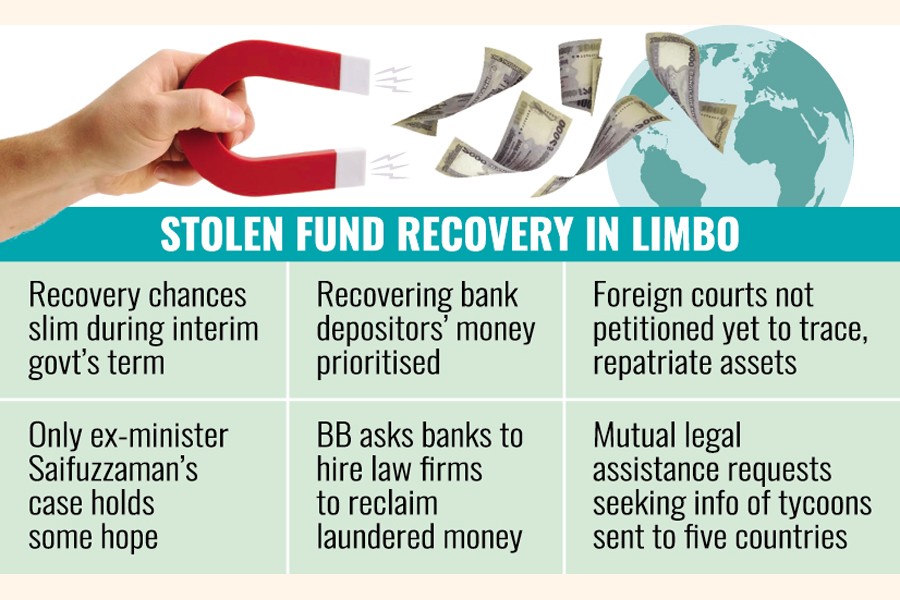
A much-hyped drive by the post-uprising interim government to recover a cache of stolen assets may not see success during its term as intelligence-insiders find no hope yet for formidable hurdles.
Even evaded tax-recovery steps have stagnated as legal barriers restrict the realisation of such taxes from the bank accounts frozen by courts in line with the Anti-Corruption Commission's (ACC) petitions.
Interagency disagreements appear as one of the major bottlenecks for stolen-asset and- evaded-tax recovery, officials say.
The tax authorities find it easily possible to recover evaded taxes from bank accounts, but legal barriers stand in the way.
Earlier, the Central Intelligence Cell (CIC) under the revenue board lodged an appeal with the court through the attorney-general's office to de-freeze the bank accounts of the suspects to realise evaded taxes.
Eventually, the court issued an order allowing the de-freezing, but that was challenged by other parties.
Following the interception, the court issued a stay order.
"We are trying to recover the assets, but it may not be possible since the interim government is not willing to pursue out-of-court settlement," says Bangladesh Bank Governor Dr Ahsan H Mansur, who is leading the asset-recovery hunt.
These are politically sensitive cases, he says.
"Political parties perceive such settlement as granting state funds to the accused," he tells The Financial Express.
However, the recovery initiatives send signals to the popular destinations that these investors are facing legal action in Bangladesh, he says, referring to the asset freeze by the UK's National Crime Agency (NCA).
"The fact is that we may never recover the stolen assets. Only Saifuzzaman's case shows some hope," says the governor of the central bank, on an apparent note of despair.
Dr Mansur also makes it clear that recovering bank depositors' money is the priority, not tax recovery.
Officials say a dozen mutual legal assistance (MLA) requests seeking information about tycoons have been sent to five countries.
However, no country has responded with details and rather sent another letter seeking more details.
"We had no experience of drafting such MLA requests. Now the process is on to train officials," says a senior official of the Bangladesh Financial Intelligence Unit (BFIU).
The Joint Investigation Taskforce (JIT), formed last year targeting 11 tycoons, consists of the ACC, CIC, BFIU, Criminal Investigation Department (CID), and Customs Intelligence and Investigation Directorate (CIID).
On October 7 this year, the central bank instructed banks to hire law firms signing non-disclosure agreements to recover their laundered money.
The government itself cannot file civil suits. Only banks can do so, Dr Mansur explains the onus.
Managing Director and Chief Executive Officer of Mutual Trust Bank Syed Mahbubur Rahman says recovering stolen assets is like "hoping on hope".
"A single private commercial entity may find it difficult to take the challenge as there is no significant success story of asset recovery," he says.
However, Mr Rahman, also a former Association of Bankers, Bangladesh (ABB) chairman, finds it logical if deals could be signed with law firms on sharing a part of the stolen money if recovery succeeds.
The central bank governor says Bangladesh is exploring options to appeal to the UK government on humanitarian grounds to return the stolen funds belonging to Bangladeshi depositors.
Earlier, Bangladesh returned stolen assets to the UK in two cases after the latter had appealed on humanitarian grounds to give pilgrimage funds back to senior citizens.
In Saifuzzaman's case, the UK authorities have already appointed administrators to repay the owner's loans.
"Once that process is complete, there is a possibility of recovering the remaining amount as our stolen assets. The UK government will not compromise its own funds," says Dr Mansur.
There are allegations that the tycoons have moved their assets. However, the governor finds such claims absurd.
"Movable property cannot be transferred or sold overnight. Even if they are sold, there will be evidence," he says, adding that no one within the country will be interested in purchasing assets owned by individuals currently under investigation.
"We have received replies to some of our MLA requests, though most of them have sought additional information. The process takes time."
Dr Mansur says the government cannot focus solely on collecting taxes from the tycoons. "Our priority is to recover depositors' money and return it to them. The funds must be distributed proportionately."
Tax claims on inflated profits are not justified as most of these tycoons manipulated their financial statements to secure larger loans, he also says. "Let the ACC carry out its investigations, freeze the bank accounts, and confiscate the properties."
A senior BFIU official says the unit does not have a binding authority over banks.
"It is banks' responsibility to recover their own assets," he says, adding that the BFIU can assist banks centrally.
The BFIU plans to prepare a comprehensive report summarising the findings of various investigations, he also says.
"I am not hopeful about recovering the laundered money during this regime," he adds.
Bangladesh has not yet filed any petition with foreign courts to trace and reclaim the siphoned-off assets.
The process is still at a premature stage.
No bilateral agreements have been signed, and no visible progress has been made so far.
Among the 11 tycoons, Gemcon Group has been excluded and replaced by HBM Iqbal.
The JIT has no fixed timeframe to complete its work.
As nearly half of ACC officials are involved with JIT, the anti-corruption watchdog faces a manpower vacuum when the latter operates at full capacity, and vice versa, officials say.
doulotakter11@gmail.com