
Hotel business yet to develop to its potential
Sarwar Md. Saifullah Khaled | Tuesday, 15 September 2015
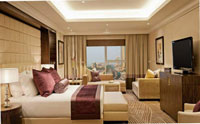
In the recent years, Bangladesh has witnessed a growth of five-star hotels, resorts and guest houses in Dhaka, Sylhet and Chittagong along with their surrounding areas. According to Ashwani Nayar, the general manager of Le Méridien Dhaka, hospitality businesses have been developed concurrently with the country's economic growth. Bangladesh's hospitality sector foresees a bright future as it successfully garnered local investments in the last ten years. Already, the country's leading businessmen and entrepreneurs invested more than Tk.30 billion to establish new hotels, motels, guest houses and resorts in Dhaka, Chittagong and Sylhet divisions.
However, Mr. Nayar opines that the shortage of skilled and experienced manpower leads to unhealthy competition among hoteliers on the recruitment of employees. He stated that Bangladesh has a number of attractive tourist spots - the world's longest natural beach in Cox's Bazar, the ancient Buddhist monasteries at Mahasthangarh and Paharpur respectively in Bogra and Naogaon, and the world's largest mangrove forest at Sundarbans in southwest of the country.
According to a World Bank report, Bangladesh has been declared a lower middle-income country. In fact, exponential growth of the hospitality sector is an index which confirms that the Bangladesh economy is growing soundly and on the right track. This explains that the country's hospitality industry holds tremendous potentials to grow in the coming days.
Tourism or hospitality sector is considered as one of the principal sources of earning foreign exchange in countries like India, Malaysia, Thailand, Maldives, Spain, Switzerland, Nepal, UAE, Indonesia, Singapore and Sri Lanka. In Bangladesh, a large number of five-star hotels have been opened in the recent years - Radisson Blu Water Hotel and The Peninsula Chittagong in Chittagong, Du Sai Resort & Spa and Grand Sultan Tea Resort & Golfing in Maulvi Bazar, Amari Dhaka, Long Beach Suites Dhaka, Le Méridien Dhaka, Six Seasons Hotel, Four Points by Sheraton in Dhaka, Rose View Hotel, Hotel Valley Garden and Nazimgarh Garden Resort in Sylhet, and Long Beach Hotel in Cox's Bazar. This indicates that Bangladesh is gradually becoming a 'success story' in relation to the hospitably industry.
Bangladesh needs a skilled, experienced and dedicated pool of young talents having motivation to work in the hospitability sector. Currently, the existing units such as The Westin, Dhaka Regency Hotel and Resort, Le Méridien Dhaka, Radisson Water Garden and Hotel Sarina can offer more than 1,000 five-star rooms.
A number of hurdles challenges the growth of the country's hospitality sector - frequent political turmoil, violence, image crisis and poor infrastructure stand in the way of flourishing tourism. Kelly Lewis, the new general manager of Amari Dhaka, has demanded a cut in heavy duty on the liquor consumed by foreign tourists - Bangladesh's government has imposed more than 100 per cent duty on such items. Compared to the countries like India, Thailand, Nepal, Sri Lanka and Malaysia hotel rents are higher in Bangladesh, particularly in the posh hotels.
In 2013, the total contribution of travel and tourism to Bangladesh's gross domestic product (GDP) was Tk 460.3 billion which comprised about 4.4 per cent of the GDP that directly created 1.33 million jobs. The growth in the sector's job rate was about 7.9 per cent in 2014. These figures confirm the bright prospect of tourism and hospitality industry in Bangladesh. It is usually opined that a thriving tourism sector will simultaneously create job opportunities and increase its share in the country's GDP.
Furthermore, Bangladesh Tourism Board (BTB) stated that thousands of tourists have been visiting the country in recent years - a total of 4,77,026 tourists in 2009; 5,27,316 in 2010; 5,93,722 in 2011; 5,86,333 in 2012; 2,76,583 in 2013. Notably, the tourism figure for the year 2013 is almost half of the previous four years because Bangladesh witnessed severe political turmoil and violence in 2013. India tops the list of inbound tourists in Bangladesh followed by the British citizens of Bangladeshi origin, Chinese, Australians and Canadians. In addition, BTB reveals that a total of 1,60,230 Indian nationals visited Bangladesh in 2012 followed by 83,100 British nationals of Bangladeshi origin. Bangladesh Parjatan Corporation (BPC) admitted that roughly 5,00,000 foreigners arrived in Bangladesh in the same year.
It has been observed that the number of outbound tourists from Bangladesh is much higher than the number of inbound tourists. Annually, over 1,00,000 Bangladeshis visit Malaysia; 5,00,000 visit India; 80,000 visit Singapore; 70,000 visit Thailand - spending more than $1 billion a year. The World Travel and Tourism Council (WTTC) once predicted that the total contribution of travel and tourism sector to Bangladeshi GDP would rise up to 7.9 per cent by 2014. Political stability, congenial infrastructure and improved situation of law and order in Bangladesh will ensure higher number of inbound tourists for the country.
The writer is a retired Professor of Economics, BCS General Education Cadre.
sarwarmdskhaled@gmail.com