
How City Bank got entangled in Sea Pearl's artificial rally
Mohammad Mufazzal | Sunday, 21 June 2026
City Bank's latest financial portfolio bears signs of institutional influence in an artificial market rally of the stock of Sea Pearl Beach Resort & Spa in 2023.
Not only did the act, which was illegal under the securities rules, cost general investors heavy losses following a sharp decline in the share price in the secondary market, but it also caused a deep erosion in the lender's portfolio.
Shares worth Tk 580.71 million of Sea Pearl Beach Resort were bought at abnormally high prices, averaged at Tk 204.15 per share, at a time when the overall market was bearish, with blue chips stuck at floor prices. The price graph of the stock indicates that the bank injected money into the stock between January and August of 2023.
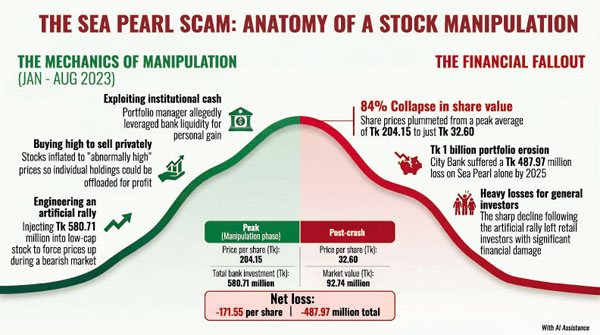
Later, the stock slid gradually to Tk 32.60 per share by December last year, as much as 84 per cent down from the average price at which City Bank bought shares of Sea Pearl Beach Resort.
As The Financial Express reached out for answers to its queries, Md. Mahbubur Rahman, Chief Financial Officer (CFO) of City Bank, confirmed the artificial rally of the stock.
"All organisations have to depend on their portfolio managers. The bank was not aware of the ill motive of its portfolio manager," he said, adding that as soon as the bank learnt about the incident, it fired the portfolio manager.
The lender's portfolio shrank by a loss of Tk 487.97 million incurred in the stock of Sea Pearl alone by the end of last year. Losses in other stocks rendered an aggregate erosion of around Tk 1 billion in the portfolio as of December last year.
According to the lender's financial statement, City Bank had investments worth Tk 4.08 billion in the shares of 38 listed companies, including four OTC companies. At the end of 2025, the market value of the investments dwindled to Tk 3.07 billion.
Did the portfolio manager act alone?
Institutional investors usually have large amounts of cash available for investments.
Industry insiders say portfolio managers have the scope to take advantage of the cash available to them and inflate stock prices. They may commit illegal acts following negotiations with market players for personal gain, leading to losses for the institutions.
Also, stocks may be inflated to abnormally high prices so that individual holdings can be offloaded at hefty profits.
However, Md. Ashequr Rahman, managing director of Midway Securities, said portfolio managers could make a certain volume of investments at their discretion - Tk 20 million to Tk 25 million, for example.
When the threshold is exceeded, they must seek approval from an investment committee, he said, adding that investments of more than Tk 500 million must have required such approval.
Requesting anonymity, an official linked to banking affairs said any large investment needed approval from the company's board.
Asked whether the termination of the portfolio manager was enough punishment for the scam, Mr Rahman said it might have been considered the best way to handle the problem, avoiding legal hassles or to hide others involved in the financial fraud.
Md. Abul Kalam, spokesperson of the Bangladesh Securities and Exchange Commission (BSEC), said the regulator had probably penalised City Bank for the misconduct.
"Other actions were left to the bank itself."
Apart from Sea Pearl, the lender made investments in companies including Taufika Foods, Beximco, British American Tobacco Bangladesh Company Ltd. (BATBC) and Marico.
Astonishingly, the bank's portfolio still holds shares of four OTC (over-the-counter) companies - Raspit Inc. (BD), Rangamati Food Products, German Bangla Joint Venture Foods and Perfume Chemical Industries.
A market operator said the bank might have injected funds into those companies anticipating high returns after the companies' relisting on the main board of the prime bourse.
"But it is unexpected that the portfolio of such a bank includes OTC shares. The bank could offload the shares even at a loss for the sake of its reputation," he said, preferring not to be named.
Why is an artificial rally suspected?
City Bank's investment - Tk 580.71 million - in Sea Pearl was around half of the latter's paid-up capital worth Tk 1,207.50 million. It was easy to manipulate the share price of the low-cap stock with such an investment.
Sea Pearl was at the centre of significant market controversies, primarily involving a share price manipulation scheme and a dispute over debts owed to the state-run Investment Corporation of Bangladesh (ICB).
In 2017, Sea Pearl issued bonds worth Tk 3.25 billion at a 10 per cent interest rate to pay off its bank loans, and the ICB fully subscribed to these bonds. Later, the company failed to make payments to the ICB, and the former also received court orders in its favour to delay the payments.
mufazzal.fe@gmail.com