
\\\'Human development makes economic growth sustainable\\\'
FE Report | Tuesday, 24 February 2015
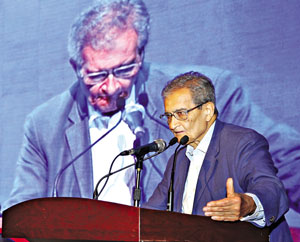
Economic development and progress in human development must complement each other to help reach the fruit of development to under as well as less privileged segments of the society, said Nobel laureate economist Amartya Sen in Dhaka Monday.
And to facilitate human development, the state needs to play a critical role in ensuring education and health service to the people, he said while delivering an open lecture titled, "Economic Development and Human Progress".
"No country in the world was successful in ensuring universal education and health services through private sector," Sen said adding "It is the basic function of the state."
Drawing examples of India's growth story, he also said that India's per capita GDP doubled over the last three decades compared to that of Bangladesh, while the life expectancy in Bangladesh is now three years more than that of India.
Sen was also of the view that the pace of economic development couldn't be sustained in longer term, if there was no improvement in human development indicators.
"How can one expect continuous higher growth with a big chunk of the population remaining uneducated and ill-healthy workforce?" he questioned.
In his lecture, Professor Sen also shed lights on linkage between development and democracy and stressed on enlightened debate and discussion to overcome any crisis.
"Discussion is must in a democracy," Sen said. "And it is not important to search for perfect democracy. Nothing can be perfect. So, we need to focus and work on different areas of democracy for betterment."
The special lecture was organised as a part of the launching ceremony of the book, titled, 'Bharat: Unnoyan O Banchana', the Bengali translation of 'An Uncertain Glory: India and Its Contradictions', jointly authored by Amartya Sen & Jean Drèze.
In this book, they highlighted Bangladesh's achievements in human and social indicators which Mr Sen mentioned in his lecture.
The book also shows that despite enjoying a higher growth rate of 8 per cent, India's performance on most social indicators has been laclustre. In many such indicators, the country is lagging behind its poor neighbour Bangladeh.
For example, half of Indian homes remain without toilets, forcing half of all Indians to practise open defecation while only 5.0 per cent of Bangladeshis has to go for such very unhygienic practice.
"We must give credit Bangladesh for her achievement in women empowerment and immunization, and also government's effort to improve social indices," he said.
Leading vernacular daily Prothom Alo and local think-tank Centre for Policy Dialogue (CPD) jointly organised the programme.
Presided over by the CPD chairman Professor Rehman Sobhan, Editor of Prothom Alo, Matiur Rahman delivered the welcome speech. CPD executive director Mostafizur Rahman conducted the question and answer session.
Mr Sen also said that while discussion on poor state of education and health service is more important, Indian media sometimes ignore these and put emphasis on the interest of privileged sections.
Amartya Sen is now Thomas W. Lamont University Professor and Professor of Economics and Philosophy, at Harvard University. He was awarded Noble prize in economics in 1998. His ancestry is in Manikganj district of Bangladesh.
The Bengali translation of the book has been published by Kolkata-based Ananda Publishers while Dhaka-based Prothoma, a book publishing wing of Prothom Alo, becomes the sole distributor in Bangladesh.
After the lecture, the book was formally unveiled for Bangladesh market.
At the core of Sen and Dreze's 'An Uncertain Glory: India and its Contradictions' is the argument that economic growth has little to do without redistribution of its benefits to the underprivileged. They also strongly argue for public expenditure on education, healthcare and employment for better capabilities and opportunities of underprivileged sections. This will ultimately accelerate economic growth, they opine in the book.
asjadulk@gmail.com