
ICB's turnaround gets tougher as govt refuses fresh loan-repayment funds
MOHAMMAD MUFAZZAL | Friday, 21 November 2025
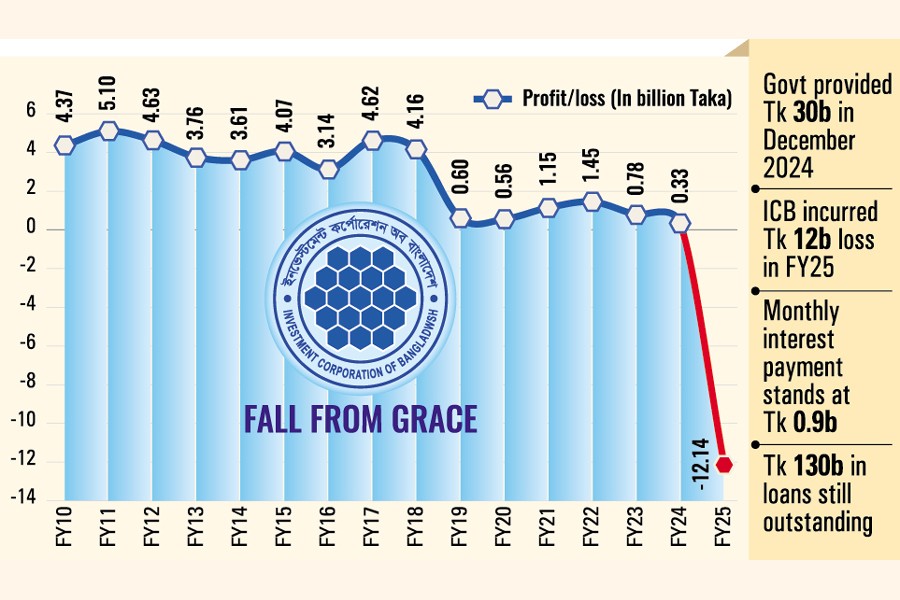
The finance ministry has decided that it will not provide any more funds to the state-run Investment Corporation of Bangladesh (ICB) for loan repayment purposes.
The decision has been reached following the ICB's disclosure of a record annual loss of over Tk 12 billion in FY25, even after the organisation received Tk 30 billion in fund support from the government. Two-thirds of the funds disbursed in December last year were used for loan repayment, while the rest were injected into the equity market. The ministry's decision was conveyed as the investment bank sought fresh funds of Tk 130 billion to recover from its financial woes. The amount is as much as the loan burden facing the loss-making entity.
The new appeal was made in May this year in an attempt to ease the burden by paying off costly loans from banks and other financial institutions.
As per the condition set by the ministry, the ICB will have to invest whatever funds it gets now from the government in the market.
"We have committed to the government that its funds will be injected into the market," said ICB's Managing Director Niranjan Chandra Debnath.
"The situation was very severe [before the receipt of Tk 30 billion], as almost every creditor showed up at the office of the corporation for money. However, the loan burden has been reduced a bit with the government's funds," he said.
The ICB is likely to get new funds very soon.
It has already been paying interest amounting to around Tk 900 million per month, which is almost double its monthly income.
The ICB gets loans from the government at a 4 per cent interest rate, whereas it has received loans from different financial institutions at much higher rates - up to 12 per cent.
Low-cost government funds could relieve the ICB of high loan repayment pressure, but currently there are demands for similar financial assistance from many other financial institutions, mainly banks.
Squeezed by a heavy load of non-performing loans and scams, the financial sector overall has been undergoing a major overhaul.
In such a situation, the next fund that the ICB is expecting is unlikely to be significant.
Mr Debnath, however, said, "The actual financial position of the ICB is now clear to all. It has a positive side in the sense that there is no way other than finding a way out of this through performance."
Under the previous regime, the corporation injected funds into junk stocks along with facilitating scamsters at the expense of its own losses.
"Now, we are committed to ourselves that no funds will be misused," said the ICB'smanaging director.
Meanwhile, the investment bank and ICB Unit Fund, a mutual fund launched by the ICB in the 80s, had to subscribe preference shares of National Tea Company Limited under the pressure of the incumbent government to gain back the state's majority stake in the loss-making company.
Asked how the ICB will turn around if it has to repay loans on its own, Mr Debnath said his organisation had drawn up strategic plans for financial and operational restructuring.
The implementation of those strategic plans will help reduce the loan burden.
"We will also get support from the market following its revival," he added.
mufazzal.fe@gmail.com