
IDRA pushes deep reforms to strengthen insurance sector
Its chairman tells the FE
JASIM UDDIN | Sunday, 8 February 2026
The interim government has launched a sweeping reform agenda for Bangladesh's insurance sector, targeting long-standing governance failures, weak regulation and eroded public trust that have driven insurance penetration to historic lows.
The reforms aim to stabilise troubled insurers, protect policyholders and rebuild confidence in an industry critical to economic resilience, Dr M Aslam Alam, Chairman of the Insurance Development and Regulatory Authority (IDRA), said in an interview with The Financial Express (FE).
He said reform lay at the heart of the interim government's mandate, with IDRA working intensively over the past year to deliver legal, institutional and technological changes across the sector.
As part of the reform drive, IDRA has initiated amendments to three existing laws - the Insurance Act 2010, the IDRA Act and the Insurance Corporations Act 2019.
At the same time, proposals have been made for three new laws: the Insurers Resolution Act, the Actuaries Act and the Chartered Insurance Institute Act.
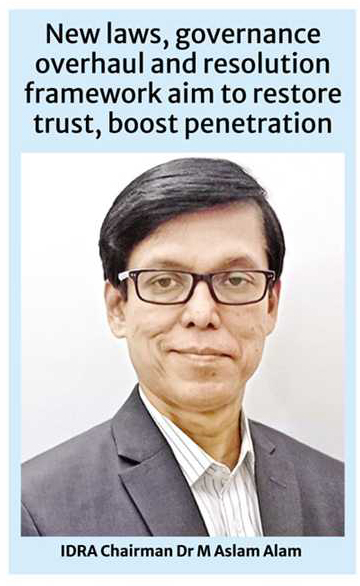
"Stakeholder consultations on these draft laws have already been completed. The process is now with the ministry for further action," said Dr Alam.
He said the overarching objective of the reforms is to establish sound governance in the insurance sector. "Without governance, there can be no trust. And without trust, insurance penetration cannot increase," he noted.
According to him, five to six defaulting insurance companies currently lack the capacity to settle claims, affecting around 1.5 to 1.6 million policyholders. This has severely eroded public confidence, causing insurance penetration to fall to about 0.30 per cent, compared to nearly 0.90 per cent in 2010.
"Insurance claims must be settled under any circumstances," Mr Alam said.
To address financially distressed insurers, IDRA has proposed an Insurers Resolution Law, similar to the bank resolution framework, allowing for acquisition, merger, restructuring or resolution of failing companies.
"Outright liquidation is often not feasible because of the large volume of outstanding claims," he said.
"That is why we have proposed an Insurance Sector Crisis Management Council and provisions for recovering money from those responsible for mismanagement."
One of the biggest challenges in the non-life segment, Mr Alam said, is reinsurance - particularly the long-standing deadlock between insurers and Sadharan Bima Corporation (SBC), the state-owned reinsurer.
"SBC says insurers do not pay premiums, so claims cannot be settled. Insurers say claims are not settled, so they do not pay premiums. This deadlock must be broken," he said.
To resolve the impasse, IDRA has proposed making the mandatory 50 per cent reinsurance cession to SBC optional. "Insurers with sufficient capacity should be allowed to reinsure abroad. Those who come to SBC should do so by choice, not compulsion," he explained.
Addressing concerns over foreign currency outflows, he said SBC already sends premiums abroad for its own reinsurance.
"The difference is only the route. In reality, foreign reinsurance often results in net inflows, as claims are settled promptly and recoveries exceed premium payments," he added.
Another major concern is the prevalence of abnormal commissions, which in some cases range from 40 to 70 per cent. "After paying such commissions, how can a company settle claims?" Mr Alam asked.
Following consultations with the Bangladesh Insurance Association (BIA), IDRA has moved to discontinue commissions in the non-life sector.
"This practice has long been a source of black income, corruption and bribery. Eliminating it will benefit companies, though enforcement will be challenging," he said.
Mr Alam also pointed to serious delays in reinsurance recoveries. "SBC is currently processing files from 2021 in 2026, despite regulations requiring settlement within 90 days. Insurers also allege that SBC demands 18 to 19 documents, compared to four or five required by foreign reinsurers."
On legal reforms, he said amendments to the Insurance Act are critical. "Ad hoc measures like fines or suspensions cannot fix structural problems. We are addressing the issues at their foundation."
Currently, IDRA can approve the appointment of CEOs, CFOs and board members but lacks the authority to remove them.
"Unlike Bangladesh Bank, we cannot reconstitute boards or remove chairpersons. These legal gaps have allowed malpractice, harming millions of policyholders," he said.
Proposed amendments would empower IDRA to approve and remove key management, expand inspection authority, regulate subsidiaries, strengthen audits, conduct special investigations and introduce search-and-seizure powers to tackle fraud.
Institutional reforms also include enactment of the Actuaries Act to support IFRS 17 implementation, establishment of an actuarial institute, and preparation of a Chartered Insurance Institute law to address manpower shortages.
Digital initiatives include mandatory linkage of insurers' databases with IDRA and a proposed National Core Insurance Solution.
Mr Alam said revising regulatory fees is essential for IDRA's capacity-building. "With the current fee structure, institutional strengthening is impossible," he said. Previously, the registration fee stood at Tk 3.0, which was later reduced to Tk 1. IDRA has proposed increasing it to Tk 2.50, which would still be the lowest in South Asia and effectively function as a regulatory levy.
Unlike many countries, Bangladesh does not impose charges on reinsurance or investment income. While insurance companies spend 15-50 per cent on management expenses, IDRA currently receives only Tk 0.10, which has now been revised to Tk 0.25. The revised fee structure will take effect from 2026.
IDRA's annual income is about Tk 120 million, compared with Bangladesh Bank's Tk 220 billion.
"Even after revision, our income will rise to around Tk 250 million, which is still modest. But without adequate funding, an independent regulator cannot function effectively," he added.
"Our ultimate goal," Mr Alam said, "is to protect policyholders, restore confidence, and increase insurance penetration through governance-driven reforms."
newsmanjasi@gmail.com