
IMF, WB to tackle climate goals among reforms at annual meets
Friday, 6 October 2023
WASHINGTON, Oct 05 (AFP): The World Bank (WB) and International Monetary Fund (IMF) will tackle the thorny issue of institutional reform at their upcoming annual meetings in Morocco next week.
The two international financial institutions are looking to scale up and retool to pursue ambitious global climate goals, while continuing to support emerging market and developing economies struggling to service rising debt levels.
This year's annual meetings will take place in the city of Marrakesh, just weeks after a devastating earthquake in the region left close to 3,000 people dead.
It will be the first such event to take place on the African continent for half a century, and will focus on building economic resilience, securing structural reforms and reinvigorating global cooperation, according to the IMF.
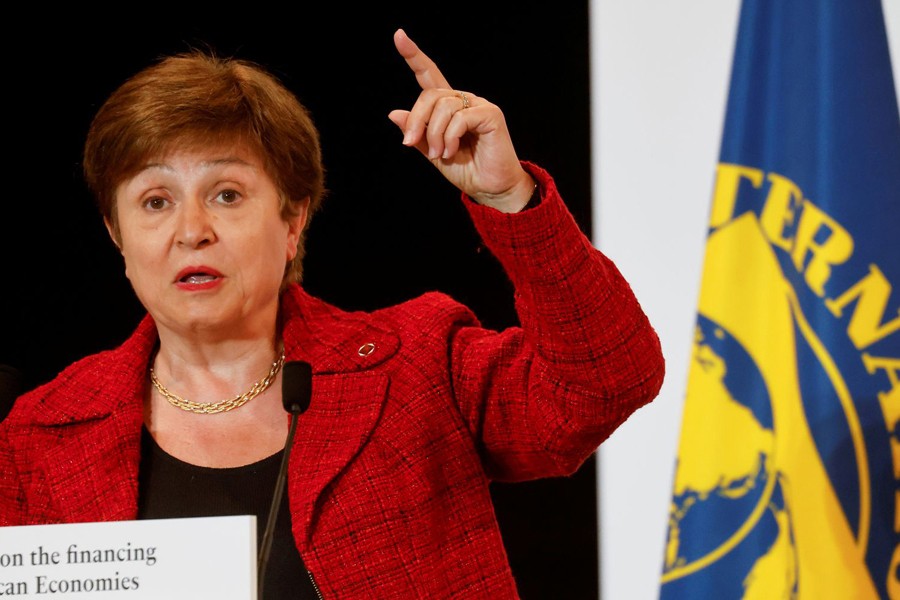
To kick things off, IMF Managing Director Kristalina Georgieva will give a speech Thursday in the city of Abidjan in Ivory Coast, outlining her policy priorities for the upcoming meetings.
The IMF is locked in negotiations to raise funding levels through an increase in the quotas paid by member countries.
The United States, which has a blocking minority at the Fund, has indicated it would back an across-the-board increase in quotas-a move which would leave the overall voting power of member countries unchanged.
While this is popular in the US, such a move would prevent other countries, including India and China, from increasing their own voting shares at the IMF despite significant economic changes in recent years.
The Fund is also looking to replenish popular concessionary lending facilities for low- and middle-income countries which have been exhausted by the pandemic and the war in Ukraine.
It may also consider changes to the its management structure to elevate the voices of developing economies, including those from sub-Saharan Africa.
This year's annual meetings will be the first for new World Bank President Ajay Banga, a former Mastercard chief executive who was elected on a pledge to boost private sector financing for the transition to renewable energy.
Since taking office, Banga has indicated he plans to reform the bank's current twin mandate of poverty alleviation and boosting shared prosperity to include climate change.
"I think the twin goals have to change to being elimination of poverty, but on a livable planet, because of the intertwined nature of our crises," he told a conference in New York last month.
He added that proposals to reform the World Bank's balance sheet from countries including the US and Saudi Arabia could add as much as $125 billion in extra lending capacity if they come to pass.
This would mark a significant increase for the development lender, which mobilized just over $100 billion in financing last year.
But the process is likely to take a long time to bring about, according to Danny Scully, a policy advisor at the climate change think tank E3G.
Banga's plans "certainly won't happen next week, as he needs to prove this concept first," he told AFP.
Even if these changes come about, they will likely be insufficient to meet the scale of funding needed for the climate transition.
The World Bank estimates that developing countries will need $2.4 trillion every year for the next seven years just to address the costs of climate change, conflict and pandemics.