
Importance of Chittagong in national economy
Pankaj Dastider | Sunday, 30 November 2014
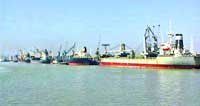
Chittagong is the economic nerve-centre of the country. Its vast potential that could have created a treasure of wealth for the people is still largely untapped. In the last 43 years, no strategy has been formulated to make the best use of the country's only natural port which is very alike Singapore as a round-the-year port.
According to history, this old port had sufficient trade and shipbuilding industry and was important enough to attract fleets from the Middle East ports, China and other south-eastern countries. By 1910, four berths had been constructed. With the Partition of India in 1947, Chittagong Port was suddenly subjected to heavy pressure of growing commercial activities, being the only port in the eastern zone of the then Pakistan.
The Railways and Port immediately undertook short-and long-term plans. And during the fifties, nine jetties, including seven new, and a number of pontoon berths and moorings were constructed. Such rapid development necessitated reorganization of the port management. Chittagong Port Trust was formed in July 1960. Later, it was felt that more autonomy be given to the management for better administration and rapid development of the seaport. So by an ordinance of the government the Chittagong Port Authority came into being in September 1976.
Chittagong Port functions today as the prime maritime gateway for Bangladesh as it is the only port that still survives the ravages of time. It handles 92 per cent of the country's total export and import cargos.
Economists, analysts and marine experts have through their studies underscored the importance of using Chittagong Port as a regional hub and transit port for its immediate and distant neighbours. Public opinions about the transit issue, which remained politically sensitive over the years, have also been weighed.
Professor Shahnaj Husne Jahan of the Department of General Education at the University of Liberal Arts, Bangladesh (ULAB) says she has long been engaged in examining 'The Trade and Technology of the Early Mariners of Chittagong' and found that all the geographical treatises and travel accounts clearly testify that Chittagong was a commercial centre of high repute.
At a roundtable organized by national English daily The Daily Star in 2012 distinguished personalities from across the country vowed: "Let's know Chittagong and the whole country. Let's love Chittagong and the country. Come and learn about the thousand years' rich history of Chittagong. This will inspire us for a prosperous future. The development of Chittagong means the development of the country. Let's make Chittagong more prosperous; thus the country will prosper."
And that Chittagong is still fighting for its due importance. It must be given the importance it deserves. Concrete steps need to be taken to convert it to the real commercial capital of the country, demand trade-body leaders of Chittagong.
Dr Hossain Zillur Rahman of Chittagong Research Initiative and advisor of the former caretaker government in his paper on 'Regional Hub: Prospects, Catalyzing Chittagong as Potential' said Chittagong has the connectivity potential and has unique advantages of geographic location, a port with a history, river and seaport potential, Karnaphuli River without upper-riparian issues and already a growth zone with 25-billion-dollar regional economy as estimated in 2010.
Chittagong is the gateway to landlocked southern Asia: northeast India, southern China, Nepal, Bhutan and northern Myanmar. It's also a bridge between ASEAN and SAARC and general boost to maritime trade through the lowering of cost and time.
He said that although some technical improvements have been made over the years in terms of cargo-handling time and automation, it has the governance setbacks as the CPA (Chittagong Port Authority) runs with a compromised operational autonomy and bears the blame for rampant corruption.
Professor Abdul Mannan Chowdhury of Economics Department of Chittagong University said the CPA must be an autonomous body for quick and timely decisions.
"Working within the framework, and with clear guidelines of the Government of Bangladesh's overall national transport policies the CPA should be responsible for the policy, safety, security and overall strategic planning for the port, with the authority to contract of the private sector for those areas of activity which, from time to time, are considered appropriate," he said.
Businesses allege that Chittagong is the most expensive and time-consuming seaports of the world. Port procedure and complexity in container stuffing and un-stuffing make the importers, exporters, consignees suffer. As a result, garment exporters cannot export their goods within their stipulated time. Various hidden and open costs along with normal charges augment the overhead cost and the garment manufacturers ultimately suffer.
Its regional-hub potential will remain unrealized until a complementary development of Chittagong as a global city. Chittagong hosts 40 per cent of the country's total heavy industries. It is the second RMG (readymade garment) heartland and has two internationally competitive export-processing zones (EPZ), one of the fastest-growing cities with a population of 5.0 million, emerging industrial hub with shipbuilding, steel and tourism, a rich hinterland and Dhaka-Chittagong growth corridor.
There are ample opportunities for the regional countries to use the Chittagong Port as only 60 per cent of the port's facility is now used while 40 per cent remains unutilized, according to a joint Indo-Bangladesh survey conducted in 2002.
Businesses have opined that there should be at least three banks and two insurance companies with their head offices in Chittagong so that the business community here does not have to fly to Dhaka to get decisions and approvals.
Bangladesh Bank has given licences to some new banks on condition that at least a few of them would have head offices in Chittagong, but the guardian of the banks did not stick to that principle, businesses lamented.
To ease the present cargo load it is important to build an outer circular road that could be used to transport goods from Chittagong Port to different destinations of the country.
The writer is FE correspondent in Chittagong. Email: pankajdastider@gmail.com