
In Turkey, taking on West wins elections
Howard Eissenstat writing for Reuters | Sunday, 30 March 2014
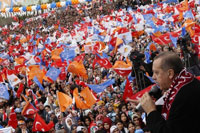
Is Turkish leader crazy, or crazy like a fox? Confronted by a series of revelations involving corruption, Turkey's Prime Minister Tayyip Erdogan countered by banning Twitter by court order on March 21. He has now moved onto other social media networks - blocking YouTube on Thursday (March 27).
Though a court ordered Erdogan's Twitter ban to be lifted last week, his repressive regime looks intent on lashing out at social media as part of a broad policy aimed at controlling the important municipal elections on Sunday (March 30).
This is all part of Erdogan's calculated effort, as Amnesty International describes, to "silence and smear those speaking out against the government's crackdown on the protest movement, including doctors, lawyers and journalists." This crackdown has, not surprisingly, resulted not only in massive protests within Turkey, but exasperation from Turkey's allies in the West.
"It doesn't fit with our idea of freedom of expression," huffed a spokesperson for German Chancellor Angela Merkel.
In the face of this opposition, we could be asking if the prime minister's actions are rational. Erdogan, however, did not become the most powerful Turkish political leader in more than 60 years by being either stupid or crazy. In Turkey, picking a fight with the West is smart politics.
Erdogan not only expected the international condemnation, he wanted it. Hours before Twitter was blocked, he told a friendly crowd in Bursa, "The international community can say this, can say that. I don't care at all. Everyone will see how powerful the Republic of Turkey is."
Turks across the political spectrum believe that Western allies secretly conspire to undermine their country's power. Many secularists believe it was the United States that helped bring Erdogan to power. Islamists blame the West for the Gezi protests. Nationalists believe that the British and Americans are to blame for Kurdish dissent.
Only 21 per cent of Turks in the latest Pew Survey expressed favourable opinions of the United States, its most consistent Western ally. (In the same poll, slightly more than half of all Russians voiced positive opinions of the United States.)
Picking a fight with the West can help a Turkish politician - particularly given the electoral conditions of 2014. Erdogan doesn't enjoy the popular support that he once did. A series of leaked recordings revealed shocking levels of corruption and have significantly damaged the AK Party's "brand" as a clean political machine.
Erdogan has good reason to be confident going into the March 30 municipal elections. The opposition is lacklustre and divided, and he has maintained solid support from his base. This election is particularly important for him because a strong performance will prove key in advance of proposed presidential elections this summer, while a weak performance is likely to embolden both the opposition and rivals within his own party.
Erdogan's supporters seem only mildly shocked by the corruption accusations. Meanwhile, the public is grateful for what his AK Party's rule has meant for Turkey over the past decade: better social services, a stronger economy, and, perhaps most important, a sense that the government respects the values of a still deeply conservative country. If he holds the support of his base, he wins.
To rally support, the continuing crackdown on dissent has been re-fashioned as a necessary attack on an immoral "them" who want to win in the streets what they are unable to win at the ballot box. Western condemnation actually helps by confirming that Erdogan is standing tall for Turkish interests against "friends" who secretly want Turkey to remain weak and divided.
This formula appears to be working. If polls are correct, the AK Party will almost certainly do as well on Sunday as it did in the 2009 municipal elections. The cost, however, is that AK Party rule is becoming ever narrower and meaner.
Wary of these internal tensions, international investors are growing cautious. The signs of social unrest in Turkey are reminiscent of the political violence that swept the country in the 1970s.
The promise and excitement that marked Erdogan's rule a few years ago has been swept away. His power remains. But he seems to be leading his country into a colder, darker future.
The writer, an assistant professor of history at St. Lawrence University, New York, is an expert on Turkey and its
influence in the region.