
India: New government, old challenges
B K Mukhopadhyay | Wednesday, 28 May 2014
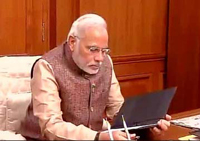
For the Indian economy the way ahead is difficult and thorny. But it is possible to achieve better.
According to Crisil, the decisive electoral mandate of Narendra Modi government has created the best environment in a long time to bite the bullet on government finances. The rating agency has listed five important tasks which the new government has to do on a priority basis. The tasks are: taming inflation, fiscal consolidation, improving asset quality at banks and their re-capitalisation, encouraging debt markets and boosting manufacturing and employment.
"Such an agenda will improve the country's competitive efficiencies and pave the way for its re-entry into the orbit of 6.5-7 per cent GDP (gross domestic product) growth in the years to come," according to Crisil.
For taming inflation, the report said, the new government will require to have a better coordination between monetary and fiscal policies and to take steps such as dismantling the Agricultural Produce Market Committee (APMC) Act for reduction of food inflation.
There is also a need to bring in a sea-change in storage and distribution capacities for fruits and vegetables. Crisil believes this will entail reduction in subsidies and curbing expenditure and ensuring that the money spent on social welfare schemes creates durable assets than remain just cash handouts.
GROWTH RECOVERY: Morgan Stanley opined in its latest report that in the coming 12 months, growth recovery will remain slow, but will pick up from FY16 onwards. The report noted that the worst is over and the effects of policy measures over the past 12 months are beginning to show improving macro stability indicators.
THE TOPSY TURVY GOINGS IN THE RECENT PAST: Meanwhile, factory production has remained in negative territory, contracting 0.5 per cent in March 2014 due to declining output in manufacturing, especially capital goods. Output as measured by the index of industrial production (IIP) remained almost flat in 2013-14 and declined 0.1 per cent compared with an expansion of 1.1 per cent in 2012-13. The IIP showed growth of 3.5 per cent in March 2013.
In fact, factory output started to decline in October, when the IIP contracted 1.2 per cent, and continued till December. It entered the positive zone in January and slipped into negative territory again in February, 2014. Manufacturing [constituting over 75 per cent of the index], declined 1.2 per cent in March against growth of 4.3 per cent a year earlier.
During the April-March period of 2013-14, the sector's output contracted 0.8 per cent compared with 1.3 per cent growth previously. Production of capital goods, a barometer of demand, shrank 12.5 per cent, in sharp contrast to an expansion of 9.6 per cent in the same month in 2013. The segment declined 3.7 per cent in 2013-14 over a contraction of 6 per cent in the comparable period. In the overall sense, 12 of the 22 industry groups in manufacturing showed negative growth in March, 2014. Output of consumer goods also declined 0.9 per cent in March compared with growth of 1.8 per cent a year ago. During 2013-14, consumer goods output contracted 2.6 per cent as against growth of 2.4 per cent in 2012-13.
FCCI REPORT: Projecting a weak outlook for the manufacturing sector in April-June quarter of financial year 2014-15 (Q1), a recent Ficci (Federation of Indian Chambers of Commerce and Industry) survey has indicated moderation in manufacturing activity in Q1 of fiscal 2014-15 as compared to Q4 of fiscal 2013-14. The survey gauged expectations of manufacturers for this quarter for 14 major sectors: textiles, capital goods, metals, chemicals, cement, electronics, automotive, leather & footwear, machine tools, food processing, paper, tyre, textiles machinery, ceramics and others. The demand seems to have slowed down as a result of which moderation in manufacturing activity is expected. The survey observed that this time it is not just domestic factors but more importantly, on the export front that the outlook seems to be weakening as a result of which manufacturing growth is likely to be pulled down. In terms of investment, it remained subdued in manufacturing sector as was the case for previous quarters also, the survey pointed out. In terms of investment though the outlook seemed to be slightly better than the previous quarters, it remained pessimistic.
INFLATION FRONT: In April 2013, the WPI inflation was 4.77 per cent. Build-up in inflation in fiscal 2013-14 was 0.22 per cent, compared to 0.71 per cent in the previous fiscal. Though encouraged by the declining inflation, it is hoped that the trend would continue, yet the government will have to remain cautious about impact of possible deficiency in monsoon. Driven by a drop in the prices of major food items, including vegetables, the WPI (Wholesale Price Index) based inflation for April 2014 fell by 0.5 per cent to 5.2 per cent. Inflation in the overall food segment eased to 8.64 per cent in April, 2014 from a high of 9.9 per cent in March, 2014. WPI data further showed easing of inflation in fuel and power segments as well as the manufactured items group, which include sugar and edible oils. The rate of price rise in the fuel and power segment was 8.93 per cent, as against 11.22 per cent in March, 2014. The current trend is expected to influence forthcoming RBI's (Reserve Bank of India) economic policy review in as much as the apex bank considers the inflation data, along with other economic indicators, while deciding monetary policy.
There has already been a demand for reduction in key interest rates to boost economy. In April, 2014, RBI chose to keep the policy rate (repo) unchanged at eight per cent as retail inflation was "sticky".
For the banking sector situation is not discouraging. Pitching for greater operational flexibility to public sector banks, Reserve Bank Governor Raghuram Rajan said recently that they can become more competitive by distancing themselves from government influence. "If public sector banks (PSBs) become competitive, and especially if they do so by distancing themselves from the influence of the government without sacrificing their 'public' character, they will be able to raise money much more easily from the markets."
There are well-managed public sector banks across the world - and even in India today. "So, privatisation is not necessary to improve the competitiveness of the public sector. But a change in governance, management, and operational and compensation flexibility are almost surely needed in India to improve the functioning of most PSBs, as the PJ Nayak Committee has just reiterated," accordingly. Mr Rajan.
Can we expect, again, India's current account deficit (CAD) to narrow to 2.3 per cent of GDP this fiscal as the new government is expected to focus on exports and reduce dependency on imports?
CITIGROUP REPORT: According to the very recently published Citigroup report, the FY 2013-14 CAD is expected to be within $36 billion or 2.0 per cent of GDP, and this fiscal year CAD is likely to be slightly higher but contained at 2.3 per cent of GDP. The report noted that oil, coal and iron ore sectors are likely to impact CAD in FY 2014-15.
Current account deficit is the excess of foreign currency outflows over inflows. The country's net oil import bill is likely to come in around 10 per cent lower in FY 2014-15, given moderation in crude prices and likely moderation in demand due to fuel price reforms.
The Citigroup report further said that the new government is likely to be growth-supportive given its economic emphasis but the recovery in growth numbers would be gradual.
Citigroup has retained India's FY 2014-15 GDP target at 5.6 per cent, and has upgraded the FY 2015-16 estimate to 6.5 per cent. The report said a full-fledged recovery will be realized only in FY 2015-16 and FY 2016-17 as governance and institutional reforms will start reflecting in the numbers with a lag and high inflation and interest rates could impede growth in the short-term.
On price rise, the report said a renewed political will is likely to bring down inflation.
The CPI target of 6.0 per cent is achievable if structural issues are addressed, provided the government implements measures such as offloading excess food stocks and calibrating MSP (Minimum Support Price) with market prices.
So, there is a possibility that the new government of Prime Minister Narendra Modi would deal with the ailments with an iron hand and ensure better growth in the coming years.
Dr. B K Mukhopadhyay, a Management Economist, is attached to West Bengal State University. m.bibhas@gmail.com