
Indian govt inks peace accord with Naga militant group
Tuesday, 4 August 2015
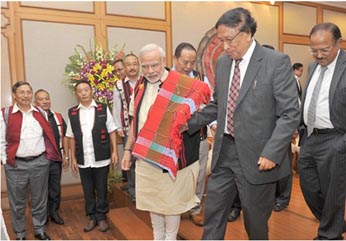
The Indian government has signed a peace accord with the National Socialist Council of Nagalim (NSCN-IM) in New Delhi in an attempt to bring an end to the decades old insurgency in India’s north-eastern states. Although details of the accord have not been disclosed immediately, a government statement spoke of an “honourable settlement” and a “framework agreement”.
“Details and execution plan would be released shortly,” said a government release after the signing of the peace accord at Prime Minister Narendra Modi’s residence at 7 Race Course Road on Monday. Modi was present when the accord was signed by NSCN (I-M) General Secretary Thuingaleng Muivah and interlocutor in the peace process RN Ravi. Home Minister Rajnath Singh, National Security Advisor (NSA) Ajit Doval and Army chief General Dalbir Singh were also present. Describing the accord as “historic”, Modi said, “Today, we mark not merely the end of a problem, but the beginning of a new future. We will not only try to heal wounds and resolve problems, but also be your partner as you restore your pride and prestige.”
Modi told the Naga delegation, “Today’s agreement is a shining example of what we can achieve when we deal with each other in a spirit of equality and respect, trust and confidence; when we seek to understand concerns and try to address aspirations…“You will not only build a bright future for Nagaland, but your talents, traditions and efforts will also contribute to making the nation stronger, more secure, more inclusive and more prosperous. “You are also the guardians of our eastern frontiers and our gateway to the world beyond.”
The peace talks between the government and the NSCN-IM had started in 1997 and it was lingering for last several years. “The Government of India and the National Socialist Council of Nagaland (NSCN) successfully concluded the dialogue on Naga political issue, which has existed for six decades, and signed an agreement today,” the government statement said.
Analysts feel the accord can hardly bring peace to the region, as several other Naga militant outfits including NSCN-K were not part of the agreement.
The NSCN was formed by Isak Chishi Swu, Thuingaleng Muivah and SS Khaplang in January 1980 opposing the Shillong Accord signed by the then Naga National Council (NNC) with the Indian government.
Although the objective of the group was to establish a sovereign nation “Nagalim” through insurgency, it suffered a spilt in 1988 over the issue of talks with the government of India with Khaplang forming NSCN (K) and Swu and Muivah heading NSCN (IM), according to bdnews24.com.
- mbz