
Indian LBA ratification—a step in the right direction
Muhammad Zamir | Monday, 25 May 2015
Sir Cyril Radcliffe was obviously in a hurry to complete his task and depart from the Sub-continent as the Sun of the British Empire set on its shores. The fact that his haste might create suffering for a large body of people and continued social injustice and deprivation for many, for more than six decades, was inconsequential for this official.
It may be recalled that the British government appointed Radcliffe to chair two Boundary Commissions in June 1947, one for Bengal and the other for Punjab. Superficial in his approach, he was, to say the least, casual and haphazard in completing the process. Villages were divided indiscriminately and their occupants left to taste bitterness. On August 16, 1947, at 5-00 pm, the day after independence had been granted to India and two days after Pakistan's independence, the Indian and Pakistani representatives associated with the Commission were given two hours to study the hastily drawn Award before its publication the next day. This underlined the lack of commitment with regard to review.
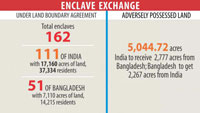
One of the unwarranted blunders resulting out of this Award was the creation of enclaves or 'chitmahals' of India in the erstwhile East Pakistan (Bangladesh) and that of Pakistan in India. There were 51 Bangladesh enclaves in India - four in Jalpaiguri and 47 in Cooch Bihar. There were 111 Indian enclaves inside Bangladesh - 36 in Panchagarh, four in Nilphamari, 59 in Lalmonirhat and 12 in Kurigram. A census carried out recently indicated that 51, 549 people lived in these 162 enclaves. The 111 Indian enclaves in terms of area consisted of 17,160 acres and had a population of 37, 334 persons. The 51 Bangladeshi enclaves in terms of area consisted of 7,110 acres and had a population of 14,215 persons.
What exacerbated the situation was the absence of a suitable mechanism whereby control could be exercised over them by the concerned countries.
Lack of clarity in defining possession of land in certain bordering areas of the two neighbouring countries also created land in adverse possession. These were located in the bordering areas of West Bengal, Tripura, Assam and Meghalaya. In the Assam sector, there was confusion in demarcation in - the Lathitila-Dumabari sector in Karimganj; in Kalabari area in Dhubri District and in the Pallathal area in Karimganj District. The total area involved was about 982.40 acres, of which Assam's claim was for 714 acres. In the context of West Bengal, the disputed land mass was 4355 acres of which West Bengal's claim was 2398 acres. In the context of Meghalaya, the total disputed land was 291 acres of which Meghalaya's claim was for 250 acres.
The first attempt to settle the enclave problem in the two bordering areas of India and the two wings of Pakistan and to sort out the question of adverse possession was undertaken in 1958 through the Nehru and Noon Agreement. This was, however, challenged in the Supreme Court of India which ruled that constitutional amendment was required to complete the process of transfer of land. The government of India, consistent with this directive, decided to introduce the Constitutional (Ninth Amendment) Bill in parliament for implementing the Agreement. It could not be passed due to objections to the transfer of the South Berubari enclave. The subsequent deterioration in bilateral relations between India and Pakistan put an end to this dynamics.
This state of suspended animation continued until May 16, 1974 when Bangabandhu Sheikh Mujibur Rahman and Indira Gandhi, the two Prime Ministers of Bangladesh and India, signed the Land Boundary Agreement (LBA). Bangladesh, on its part, subsequently took all necessary steps towards legalisation of the process. India, unfortunately, failed to live up to expectations. The assassination of Bangabandhu on August 15, 1975, consequent deterioration in bilateral relations and legal problems created through the filing of cases in Indian courts, created a complex paradigm where the knots on the part of India suffered due to internal politicisation.
Another factor continued to sustain tension between the two countries. Bangladesh and India, it may be mentioned, share 4,096 km of international border, which is the fifth-longest land border in the world. The state of suspended animation in resolving the land boundary between the two countries did not help in the resolution of questions related to completing the demarcation of 6.1 kilometers of the Bangladesh-India border - 1.1 km in Nilphamari District with West Bengal, about 2.0 km in Feni district with Tripura and about 3.0 km in Moulvibazar adjoining Dumabari in Assam. The length of the un-demarcated border was miniscule but failure to reach an agreement created its own connotations.
It was hoped that the Indira-Mujib LBA agreement of 1974 would resolve existing problems. This, unfortunately, did not happen. Politicians of certain political parties both in Bangladesh and India used this failure as a whipping horse to stir public opinion against each other.
This situation continued for more than three decades - with the Congress Party in India willing to consider the ratification of the LBA by the Indian Rajya Sabha and the Lok Sabha but opposed by different parties including the Bharatiya Janata Party (BJP), the Trinamool Congress in West Bengal and certain political groups in Assam. The efforts made by our government during Prime Minister Sheikh Hasina's term of office from 1996 to 2001 and again from 2009 to 2014 and, in Indian side, by the Congress president Sonia Gandhi, former Prime Minister Manmohan Singh and former Finance Minister and now President Pranab Mukherjee proved to be less than successful. There were assurances but no light at the end of the tunnel.
The scenario changed with the BJP coming into office with a huge majority in New Delhi in May 2014. Contrary to dire predictions, it turned out that Mamata Banerjee was not the huge problem that she had become during the Congress years. The splinter groups in Assam were also taken on board. It took a year, but after due process - as we have witnessed in the recent deliberations in the Indian Rajya Sabha and the Lok Sabha in May, this year, and the unanimous approval of members, present and voting - it has been decided to ratify the LBA and the Additional Protocol (signed on September 06, 2011). Senior members, during the discussions on the floor of the two houses, recalled the role of Bangabandhu and Indira Gandhi and the deep-rooted bilateral friendship that has existed over the years. They voted together, irrespective of political affiliation. This was also seen as a reflection, although belated, of Prime Minister Modi's 'Neighbourhood First Policy'.
This was also an example of how persistence brings dividends. Prime Minister Sheikh Hasina richly deserves felicitation for having stuck to her task and for completing the dynamics started by her father Bangabandhu Sheikh Mujibur Rahman. At this point, one needs to reiterate that because of Sheikh Hasina, we today finally have a demarcated maritime boundary as well as a land boundary. The map of Bangladesh is finally complete and beyond dispute.
We have solved a major issue but there still remain several aspects that will need careful monitoring and execution if the LBA is to be implemented to the satisfaction of those who were residents in these enclaves or those who will now have to accept change because of transformation in the ownership of adverse possession. Most unfortunately, people of these enclaves have led inhuman lives for nearly seven decades. They have suffered the absence of many social and civil rights that we take for granted- education and healthcare facilities. They have also been denied the right to participate in any political representative process. It has been a tough grind.
Today, in this new dawn, they can finally see hope in their midst. Nevertheless, within this fresh matrix, some have already started expressing their anxiety over certain factors that might influence their future. As expected, some of the inhabitants residing in enclaves belonging until now to India or Bangladesh, might due to turn of events want to migrate to their preferred homeland. Those who stay on in their enclaves will now have a new identity and will be citizens of a particular country. They will need ID cards and passports. They will require funds for their re-settlement, creation of employment opportunities and also a fair method by which they can sell their property and transfer the sale proceeds to their new homes. Such an effort on their part can easily be affected due to bureaucratic delay or corruption. That must not happen. Both countries must facilitate the process. Setting up joint committees for this purpose with members from the relevant agencies at the grassroots level might help. One understands that our Prime Minister has already started the ball rolling. So has India. According to media reports, the Indian government has already set aside a reasonable sum of money for this purpose. One hopes that our government will also do so.
Our bilateral relation with India has started a new journey. Modi's forthcoming visit to Bangladesh will be the foundation for us to move together in resolving some of the other outstanding issues - better water management of cross-border rivers and sharing of waters of Teesta, addressing the question of border killings and the para-tariff and non-tariff barriers in bilateral trade.
One can only hope that the political goodwill generated from the passing of the LBA in the Indian parliament will act as a catalyst in improving trust and connectivity, and promote investment for further economic development. This will, in turn, generate stability for the sub-region and the region. It will also contribute towards the fulfilling of the aspirations encapsulated in the concepts of SAARC, BICM and BIMSTEC concepts.
The writer, a former Ambassador, is an analyst
specialised in foreign affairs, right to
information and good governance.
muhammadzamir0@gmail.com