
India\\\'s sixteenth tryst with destiny
Muhammad Zamir | Monday, 7 April 2014
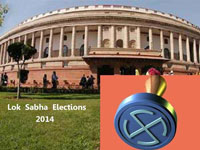
Voting for the 543-member Lok Sabha, the lower house of Indian parliament will take place in nine phases, starting from April 07, 2014. This will last until May 12. The results will be announced on May 16. The biggest election in history - the sixteenth, since the first election held in 1951 - will see 814 million adults eligible to vote, approximately 100 million more than the last national election that took place in 2009. The Indian Election Commission has explained that it has arranged sufficient security forces to guard the nearly one million polling booths. The Indian Chief Election Commissioner V.S. Sampath appealed on March 05 for 'high standards of political discourse and fair play in the course of the campaign' consistent with the comprehensive code of conduct already in place.
It is clear that there are several factors that will influence the polls. One thing is, however, very clear. The real tussle would be between Narendra Modi and Rahul Gandhi. Modi, from Gujrat, is leader of the Bharatiya Janata Party (BJP) and the coalition known as the National Democratic Alliance (NDA). Rahul, the Harvard and Cambridge educated scion of the Nehru dynasty, is leader of the Congress-led left-of-the-centre coalition, the United Progressive Alliance (UPA).
Several polls have forecast a clear victory for Modi. The exact situation is however slightly fluid, quite complex and not so simple. The BJP in the meantime has been basing their efforts on the principle that India today 'wants development, progress, low inflation' and that the people 'want to rid themselves of corruption'. Modi in a Twitter message has urged voters to seize this opportunity 'to lay the foundation of a developed India'.
Perceived as a pro-business reformer, Modi has risen from the grassroots Hindu extremist organisational framework and emerged as a leader with unsavoury anti-Muslim linkages. Consequently, the prospect of a Modi victory is sending its own jitters within the minority Muslim community in India.
The gravitational pull of the perceived winner has seen frontrunner BJP becoming a magnet for small parties all over India. In this context, one reasonable achievement has been BJP's ability to position itself as a credible player even in Tamil Nadu, bargaining with DMDK chief Vijaykanth and PMK's Ramadoss. If the PMK and the DMDK alliance does happen, then BJP along with MDMK's Vaiko will be in the reckoning for around seven to ten seats, an unheard-of development in the southern state long dominated by Dravidian giants DMK and AIADMK.
On the other hand, the flow forward does not appear to be similar with the Congress-led UPA. On March 10, Congress announced their first list of 194 candidates for the Lok Sabha and has since then decided on the remaining constituencies. It however suffered immediate embarrassment when its nominee for the Bhind seat in Madhya Pradesh, Bhagirath Prashad, jumped ship and joined the BJP. This prompted widespread criticism among Congress followers about the ability of their leadership to judge the merits of its prospective candidates. Serious efforts are now underway within this alliance to reach an understanding with the Mayawati-led BSP but that has also not come through. This means that in this important state there will be a four-cornered fight among SP, BSP, Congress and the BJP.
Developments in the forthcoming Indian election, particularly in the State of Pashchimbango, are being watched very carefully in Bangladesh - more so, because of the efforts being undertaken by the chief of the All India Trinamool Congress Party (TMC) Mamata Banerjee. An ambitious person, she has chalked out plans that include opening up units in all 70 assembly seats of Delhi and sharing of seats with Asom Gano Parishad.
The TMC is hoping to win most of Lok Sabha seats from its home turf in Paschimbango. It is also projecting its national ambitions by relying on support received from Team Anna in Delhi. In this regard, Mamata is hoping that her efforts will be agreeable with ex-bureaucrats, former judges, armed forces officers and lawyers not only in Delhi but also in Maharashtra and the Punjab. Mamata understands that they constitute a very important national lobby.
The fortune of Aaam Aadmi Party (AAP), which created a big stir in India in general and in Delhi State in particular, does not appear to be however on the rise. Arvind Kejriwal's decision to voluntarily quit the Delhi state government has been interpreted as being the party's inability to be able to implement their key election pledges regarding good governance and corruption. This party is being viewed by the general public as one with good intentions but without the necessary national infrastructure and following required for making any special difference in the national context. Besides, their efforts have been dampened by the fact that their one-time supporter Anna Hazare declined to sponsor their efforts and instead moved towards Mamata Banerjee of the TMC.
Another factor in the complex equation that characterises India's date with destiny is the potential role that may be played within the electoral paradigm by Bihar Chief Minister Nitish Kumar. A politician with experience as Union Minister and also Chief Minister, he is regarded with a degree of respect for the development efforts undertaken during his tenure in Bihar. Under his guidance and pro-active engagement, according to most analysts, Bihar has been able to overcome not only serious law and order problem but has also moved forward in poverty reduction through the use of the Right to Information process and transparency in decision making. This has markedly reduced corruption in local governance and enhanced accountability.
NOTA CONCEPT: It is relevant here to mention an important factor that has been introduced in the Indian electoral system. In the forthcoming election, the Election Commission (after massive lobbying by the civil society) has introduced the NOTA (None of the Above) concept. This will give the voters the right to vote but they can also reject all the candidates on the ballot paper. By taking this step, the Election Commission in India has enhanced participatory engagement.
Writing about the Indian election would remain incomplete without mentioning the continuing importance of the election symbol of different political parties. We in Bangladesh have the 'boat' and the 'sheaf of wheat' that characterise the two biggest national parties - the Awami League and the BNP respectively. Jyotsna Singh writing in the Financial Times has underlined the critical importance of the symbol in the rural Indian hinterland. The functional literacy percentage has gone up in India over the last two decades but the election symbol continues to exercise its own impact on the imagination of the people, especially because of the proliferation of television channels in that country. The Hindu divine pantheon is also in evidence in the polls campaign - signifying the potential impact of religion on susceptible voters. The goddess Lakshmi upon a lotus (BJP's symbol) helps to strengthen that party's position, particularly in the rural areas.
Some interesting facts have emerged from different polls carried out by both Indian and foreign think-tanks. The University of Pennsylvania's Centre for the Advanced Study of India, along with the Lok Foundation, after a careful survey covering 70,000 respondents across 24 States has pointed out that, the alliances led by the Congress and the BJP can expect about 54 per cent of the votes between them, a situation that has changed little over the past two decades.
The Oxus Research and Investments have mentioned that their study indicates that Indian democracy was moving towards a modern, two-party system in which economic policies count for more than region, religion or caste.
It has been suggested that India's next government, whatever the hue, will have the serious challenge of reviving investment, keeping inflation and interest rates down and re-launching long-delayed reforms to liberalise the economy.
These revelations seem to have had an impact on the manner in which BJP and the Congress have gone about lobbying for votes during the last week before the election. Modi has assured the voters that if his alliance is elected to the office, then he will ensure greater capital expenditure and facilitate private sector investment projects. He has also sought to allay fears about his communal credentials by going to Kashmir and pledging harmony and equality in treatment irrespective of religious background
Rahul's embattled ruling Congress, on the other hand, has promised the creation of millions of jobs and revival of a sliding economy. Reaching out to Congress's traditional constituency of low-income voters, he has pledged 'growth for all' and providing of skills needed for employment to 100 million young people over the next five years. In this regard, the Congress has not forgotten that more than half of the population in the country is under the age of thirty.
The next few weeks will decide for India and also for South Asia which way India and this region will travel for the next five years. It will be strategically important for Bangladesh with regard to finding solutions to some of the outstanding problems that have continued to affect good neighbourly relations - water management and sharing of water of the Teesta and the Ganges Rivers, the ratification of the Land Boundary Agreement, ending of border killings and removal of para-tariff and non-tariff barriers within the paradigm of bilateral trade.
Muhammad Zamir, a former Ambassador,
is specialised in foreign affairs, right to
information, good governance.
mzamir@dhaka.net