
Indo-Chinese relations enter a new phase
Mohammad Amjad Hossain from Virginia, USA | Wednesday, 27 May 2015
There is hardly any possibility of the revival of Chini-Hindi Bhai Bhai fervour that existed in the relations between China and India in the 1950s. The war between the two countries in 1962 over uninhabited Ladakh area had spoiled the warmth in their bilateral ties. Since 1962 there have been ups and downs in the relations between the two countries, the main irritant being the disputed border in the Himalayas where a Line of Actual Control (LAC) demarcates an effective boundary. The LAC runs along the southern part of the Aksai region of China, the northern part of Sikkim state and northern part of Arunachal Pradesh of India. China, however, does not accept LAC as final demarcation of border between the two countries.
Relations between the two countries nosedived in 1971 when China sided with the US-Pakistan alliance. President Nixon's policy of appeasement towards China via Pakistan caused serious suspicion in the Soviet Union and India. This US-China-Pakistan axis was looked upon by India as a threat against it. This prompted the then Prime Minister of India Indira Gandhi to sign an Indo-Soviet Treaty of Friendship and Cooperation on August 08, 1971.
The Soviet occupation of Afghanistan from 1979-89 dominated political climate in South Asia. The withdrawal of Soviet forces from Afghanistan in 1989 altered the situation in the region.
Meanwhile, Indian Prime Minister Rajiv Gandhi took an initiative to improve relations of his country with China. He visited Peking (now Beijing) in December, 1988. This was the first visit to China by any Indian prime minister in 30 years after Jawharlal Nehru, the first prime minister of the country. There have since been several attempts by both China and India to improve their relations. Relations, however, remain normal.
In May 2013, Chinese Premier Li Keqiang paid a visit to New Delhi to signal China's interest to develop relations with India against the backdrop of a border standoff between the Chinese People's Army and the Indian troops. Indian Prime Minister Manmohan Singh reciprocated the visit in October of the same year. Relations did not, however, register any significant improvement. Visits by the Indian premier to Arunachal Pradesh, one of the seven landlocked states of India, in October, 2009 and December of 2013 were looked upon by China as provocation. China was on record as having said that the Chinese authorities were 'deeply upset' by the visit of Prime Minister Manmohan Singh to Arunachal Pradesh.
China and India had several rounds of talks over disputed territories of Arunachal Pradesh in the recent past but no solution is yet in sight.
With the change of government in India following the general elections of 2014, Narendra Modi of the Bharatiya Janata Party (BJP) took over as Indian premier defeating Congress-led coalition. The BJP won an absolute majority in the Indian parliament and formed a government of its own.
Modi visited China at the invitation of Chinese President Xi Jinping from May 14-17 this year. Earlier, President Jinping visited India from September 17-19, 2014. Two main reasons had actually inspired Modi to visit China. Firstly, India needs investment and secondly, India plans to forget the irritants in its relationship with China, including border conflict, as a matter of the past and wants to rebuild friendly bilateral relationship.
Modi undertook the visit to China against the backdrop of his visit to Arunachal Pradesh in February of this year which drew criticism from Beijing. The Chinese Foreign Ministry's spokesperson Hua Chunying reportedly said, "The visit runs counter to the settlement of India-China border dispute. We urge the India side to take China's solemn concerns seriously". But Modi government has taken up the issue of development of Arunachal Pradesh seriously.
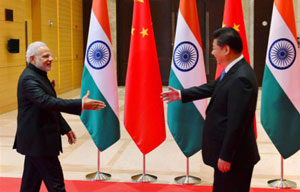
On May 20, 2015, Modi met the Chinese President in Xian, capital of Xi Jinping's home province of Shaanxi, to reciprocate the visit of the Chinese president to Ahmedabad, the home town of Modi, in September of 2014. The Chinese president began his three-day visit to India from Ahmedabad. It was the first visit by a Chinese president to India in 60 years. This is the third time that the Indian premier met the Chinese president in a year.
Narendra Modi had a wide range of discussions with the Chinese Prime Minister Li Keqiang in Beijing on India-China relations. In course of the discussions, the Indian prime minister insisted that China reconsider its approach on contentious issues that strained relations between the two neighbours. The prime minister of India also sought clarification on the Line of Actual Control that divides the two nuclear-power neighbours. Both sides agreed to open more meeting points for security personnel across the frontier and activate hotlines between the military headquarters in New Delhi and Beijing. Both sides also agreed to continue to explore a 'fair, reasonable and mutually acceptable solution' of the border disputes. Another significant development is that both countries agreed to open consulates in Chengdu in China and Chennai in India.
Another important factor to develop relations between the two neighbours is trade. China has become India's biggest trading partner. Trade between the two countries stood at $ 71.0 billion in 2014. Both countries agreed to reduce trade deficit as far as possible.
Modi also visited Shanghai and addressed students at Tsinghua University. India's participation in China-sponsored Asian Infrastructure Investment Bank (AIIB) that plans to aid regional development projects, is a positive movement towards improved relations with China. While Modi was having exclusive talks with the Chinese president for 90 minutes, an announcement was made that an Indian banker was confirmed as the first chief of the Shanghai-based AIIB. Brazil, Russia, India, China and South Africa are the founding members of the bank.
Modi, who is not unknown to the Chinese administration and the Communist Party of China because of his interaction with them when he was Chief Minister of Gujarat state, is optimist about a positive impact of his visit to China. His visit has created an environment conducive to improving bilateral relations between India and China. But in view of misunderstandings and mistrust existing between the two countries for decades, it will be a Herculean job to restore the idyllic friendship of the past between the two Asian giants.
The writer is a retired diplomat of Bangladesh.
amjad.21@gmail.com