
Stress on R&D investment, new manpower rearing
Industry tech up-skilling urgent for throughput boost, luring FDI
Manufacturers averse to foreign tech use: CPD findings
FE REPORT | Monday, 23 October 2023
 Industry up-skilling is deemed urgent for production boost and luring foreign direct investment (FDI) in Bangladesh as manufacturers were found averse to using latest foreign-innovated technologies.
Foreign-technology use is very low in the country's manufacturing industry across all sectors as per a Centre for Policy Dialogue (CPD) study. It found the lowest of all in the textile industry--only 2.0 per cent of the firms using technology licensed from a foreign-owned company.
Food and garment industries have the second smallest share of foreign-technology use as 5.0 per cent of the firms in the food and garments sector use technology licensed from a foreign company, the study revealed Sunday.
This share of foreign-technology use is lower in Dhaka and Greater Dhaka manufacturing industries with the figure being 4.0 per cent and 2.0 per cent respectively, the data show in the study disseminated at a dialogue titled 'Technology Use in the Manufacturing Industries of Bangladesh' at BRAC Centre Inn in Dhaka.
However, the share of licensed foreign technology is about 23 percent of manufacturing firms' use of technology, followed by Cox's Bazar where only about 10 per cent of the firms use foreign technology.
In Khulna and Chattogram, around 7.0 per cent of the manufacturing firms use technology licensed from foreign companies.
The findings also show that most industries spend less than Tk 500 per year on research and development (R&D) for a worker, which is "alarming" as it stymies advances of the economy in this hi-tech era.
They spend Tk 23,735 per worker annually.
The CPD study shows the manufacturing industry in Bangladesh is recovering from the COVID-19 pandemic but has not yet reached its peak pre-pandemic growth level.
The growth rate of the manufacturing industry fell from 12.33 per cent in 2019 to 1.68 per cent in 2020. However, industry has recovered well since then and generated 24.29 per cent of the GDP in FY22, more than double the 11.20 per cent produced by the agriculture industry.
The CPD survey also has found that the beverage manufacturing industry has the highest gross value added per worker per month while the repair and installation of machinery industry has the lowest gross value added per worker per month.
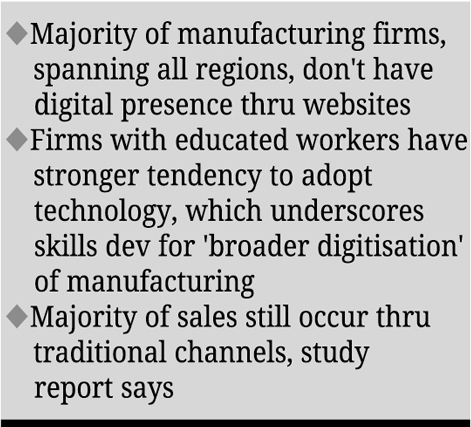
The think-tank says majority of manufacturing firms, spanning all regions of the country, do not have a digital presence in the form of websites.
"This highlights the potential for growth and the need for further digitization efforts, particularly among small-and midsize enterprises," it says, adding that firms engaged in international trade are more likely to embrace digital tools, reflecting the necessity of a robust online presence for global business engagement.
The study found that Chittagong had the largest share of firms with websites, with 39 per cent of the manufacturing firms having websites, followed by Khulna and Sylhet at 33 per cent, and Barisal at 31 per cent.
On the other hand, in all regions across the country, the majority of the firms in the manufacturing industry did not have their own website.
The RMG industry takes the lead as 43 per cent of the firms surveyed in it had their own websites--the highest compared to other industries.
The RMG industry accounts for the largest share of exports of the country which is why this industry outperformed the others when it comes to website presence.
The CPD survey notes that the firms with a higher share of educated workers exhibit a stronger tendency to adopt technology which underscores the significance of investing in education and skills development to facilitate broader digitisation in the manufacturing sector.
"The majority of sales still occur through traditional channels," the study report says, adding that it presents an opportunity for firms to expand their digital footprints and capitalize on the growing e-commerce trend.
As such, the study highlights the importance of technology adoption in the manufacturing industry.
Firms that have invested in technology are better positioned to improve their efficiency and productivity, the report says to underpin the suggestion for going digital in production and business processes.
Speaking as the chief guest, Industries Minister Nurul Majid Mahmud Humayun said a collective effort from the private sector is needed to spend on R&D as "it's not a waste of money".
He said private firms should come forward, especially for R&D, so that FDI comes more in volume.
He said in the changing world, big countries have given up many opportunities.
"We have to grab it now. And for this, there is no substitute for a skilled labour force," the minister said.
"But here we will have some new problems with the old-skilled manpower. We have to think for them. Diverting them into new industries like nursing or the health industry could be a solution," he added.
As a discussant, Syed Almas Kabir, president, Bangladesh-Malaysia Chamber of Commerce & Industry, said the private industry should come forward in R&D investment.
"I think academia has a big role to play here. Here the industry knows what kind of manpower they will need in the next 3-5 years."
Rubana Huq, Vice-chancellor, Asian University for Women (AUW) and former BGMEA president, was also present. Fahmida Khatun, executive director of CPD, moderated the event.
For the purpose of exploratory statistical analysis of this study, data from the World Bank's Enterprise Survey 2022 for Bangladesh and the Survey of Manufacturing Industries conducted by the Bangladesh Bureau of Statistics (BBS) in 2029 were used. The analysis in this paper is based on the data of 544 manufacturing firms.
bdsmile@gmail.com