
Inflation declines in April, marginally
FE Report | Thursday, 8 May 2014
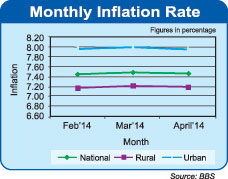
The average rate of inflation declined marginally in April last but it continued to remain above the government's projection for the current fiscal (2013-14).
The point-to-point inflation declined very marginally by 0.02 per cent to 7.46 per cent in April last.
Economists said peaceful political environment now prevailing in the country has contributed to the price stability at the consumers' level.
They, however, said the government's annual average inflation target for the current fiscal year (2013-14) at 7.0 per cent would not be achieved despite the falling consumers' price index.
The economists hinted that inflation might go up in the next couple of months following usual price-hike in the upcoming Ramadan.
The Bangladesh Bureau of Statistics (BBS) unveiled the monthly inflation figure at its headquarters in the city Wednesday.
Dr. Zahid Hussain, lead economist at the Dhaka Office of the World Bank (WB), said the rate of inflation remained stable in the month of April due to peaceful environment in the country's political arena.
"The peaceful political situation helped ensure smooth supplies across the country," Dr. Hussain said.
The WB lead economist said stability in the country's exchange rate and the international food prices also helped the taming of inflation in April last.
"Sluggishness in the overall domestic demand led to a poor demand for goods resulting in lower inflation," the economist noted.
The WB economist said attaining 7.0 per cent inflation target by June next might prove difficult.
"It may decline to some extent, but it will be difficult to attain the target," Dr. Hussain said.
Rather, he said the demand has started picking up with the expansion of the private sector credit and the rise in the volume of remittance inflow.
"In my view, the demand for goods will rise in the next months leading to higher average inflation at the end of June-30 next," he said.
He also said wage hike both in public and private sectors would also affect the inflation adversely in the coming months.
Dr. Zaid Bakht, director (research) at the Bangladesh Institute of Development Studies (BIDS), said there was no cost-push inflation in April last as the tariffs for power, gas and other utilities did not change.
Dr. Bakht said the upcoming Ramadan might push up the prices of essentials and it might help a rise in inflation.
Dr. Bakht also felt that the government's inflation target would hardly be achieved.
Dr. Zaidi Sattar, chairman of Policy Research Institute of Bangladesh (PRI), said the 7.0 per cent inflation target was too high in the context of a substantial number of poor people in the country.
"The poor suffer much following a high inflation target as it erodes their real income," Dr. Sattar said. He said the inflation target should be between 2.0 and 3.0 per cent for the country.
Dr. Sattar said the inflation slightly declined in April as there was an 'automatic money tightening' as a result of slow private sector credit growth.
Dr. AK Enamul Haque, a professor in Economics at the United International University, said the inflation rate would be higher from the end of the current month (May) and it would push up the average inflation.
He said the average annual inflation might cross 7.5 per cent following the rise in prices of goods in May and June next.
Dr. Haque, a senior economist at the Dhaka-based Economic Research Group (ERG), said the prices of all types of crops usually start increasing from the month of May.
However BBS Director General Golam Mostafa Kamal said while unveiling the monthly data that in the last nine months from July to March of the current fiscal the average inflation was recorded at 7.48 per cent.
Mr. Kamal in April had said if the trend continued in the remaining three months, the inflation would fall below 7.0 per cent at the end of the fiscal year.
He said transportation was normal due to a stable political situation in the country. "In my view, that's why the commodities, both imported and produced locally, were transported timely meeting the demand," the BBS chief said.
The point-to-point inflation declined by 0.02 percentage point in April last due to the peaceful political situation that have persisting after the January 05 polls.
The BBS latest data said food inflation was 8.95 per cent in April, a very marginal decline from 8.96 per cent in March in 2014.
The non-food Inflation also declined to 5.23 per cent in April last. It was 5.26 per cent in March last.
However in urban areas, the food inflation rate remained as high as 9.99 per cent in April last against 9.98 per cent in the month of March.