
Inflation swallows wage increments
Low-paid workers in BD feel battered for income-spending mismatch
FHM HUMAYAN KABIR | Saturday, 11 November 2023
Rising inflationary pressure outweighs wage rates in Bangladesh despite month-on-month income growth over 27 months, analysts say, leaving particularly low-paid people in a shambles.
The higher inflation rate than the wage growth as indicated in the Wage Rate Index (WRI) has abraded the income of the low-and unskilled workers, according to them.
Daily living of the country's low-income people has been woeful for the subdued growth in the WRI compared to the higher inflation rate, they have noted-incidentally, at a time when there have been one of the worst labour demonstrations for wage hike in the country's largest industrial sector-readymade garments.
Despite higher wage growth since July 2021, it has remained below the inflation rate for the past 27 months consecutively, an analysis by the FE writer has found out.
Even over the first four months (July-Oct) in the current fiscal year (FY) 2023-24, the high inflation is eating up the wages of the low-and unskilled workers.
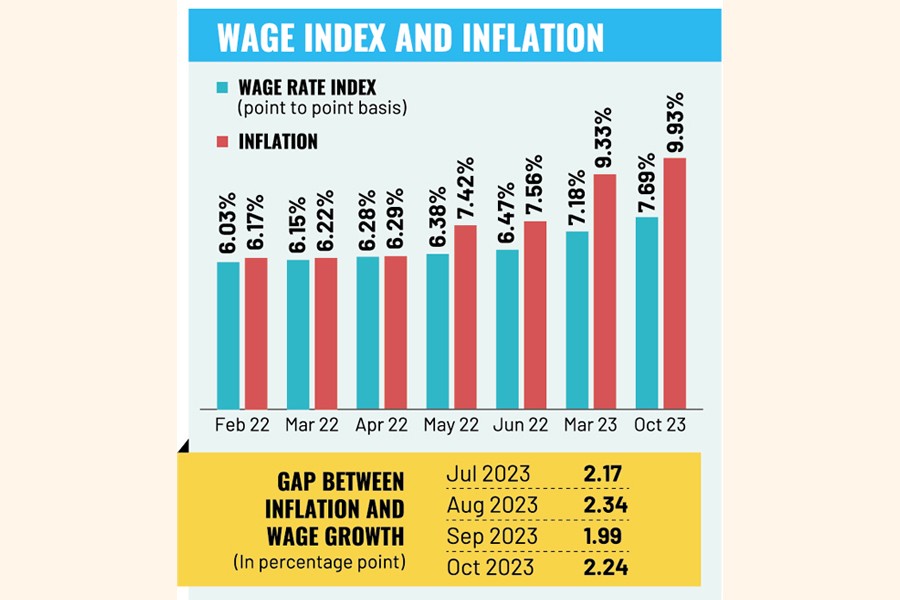
Bangladesh Bureau of Statistics (BBS) data show the WRI in October on a point-to-point basis at 7.69 per cent, which is 2.24-percentage-point lower than the inflation rate at 9.93.
Similarly, the gap between WRI and inflation was 2.17 percentage points in July, 2.34 percentage points in August and 1.99 percentage points in September, according to the official data taken by many as conservative.
Economists say the higher inflation against the lower WRI would severely affect employment, production and consumption in the midterm, and many people would slip down the poverty line.
Over the last few months, the WRI-inflation hiatus has got wider, thereby eating into the real wages of labourers.
The BBS counts WRI through calculating the wages of 63 types of occupations across the 64 districts of Bangladesh.
Inflation in the country suddenly jumped onto "9.0-percent trajectory" in August 2022-in the wake of inordinate price rises.
Although it dropped down to an "8.0-percent club" in the later part of 2022 and stayed there up to February 2022, it again took an upturn to climb to "9.0-percent club" in March of the same year.
The rise in inflation on a point-to-point basis has been continuing over the months, by now nearing a double-digit club, as recorded at 9.93 per cent in October, the FE analysis has found.
Meanwhile, the expansion in month-on-month inflation rate over the last one year was much higher compared to that of WRI, which widened the gap between expenditure and income of people.
According to the BBS counts, the gap between WRI and inflation rates was very thin before May 2022. The WRI in April was recorded at 6.28 per cent, and inflation much the same at 6.29 per cent.
In March that year (2022), WRI was 6.15 per cent while 6.22 per cent, and in February the WRI was 6.03 per cent while inflation 6.17 per cent.
However, the WRI in May 2022 was recorded at 6.38 per cent while the point-to-point inflation swelled to 7.42 per cent. In June, the wage index increased to 6.47 per cent while inflation reached 7.56 per cent.
In March 2023, inflation rose to 9.33 per cent while WRI was 7.18 per cent like a year ago, BBS data showed.
Bangladesh's nearly 87-percent people work in informal sectors, and most of them are daily wage earners.
The WRI is an important indicator of the trend and changes in aggregate wages of the wage earners. It is intended to measure the movement of nominal wages of the low-paid skilled and unskilled labourers over time in different sectors of the economy. It is also used to gauge changes in real wages relative to prices of goods they buy.
Currently, the inflationary pressure has crippled people's life, as prices of almost all essential items at retail level are on the rise, analysts said on Friday.
Executive Director of the Policy Research Institute of Bangladesh (PRI) Dr Ahsan H Mansur says this is due to the "failure" of economic management of the government.
"If your inflationary pressure continues mounting and the gap with WRI maintains, unemployment will be rising, poverty reduction will face setback and the economic growth will be affected," he told the FE.
"Actually, this is the result of the higher unemployment situation in the country," Dr Mansur added.
Quoting the latest Labour Force Survey, the PRI executive director said the migration from urban to rural areas expanded and the labour force in agriculture is rising.
"It means, the country's industrialization will be affected in mid-to long terms," the economist says about the downside of the reverse migration.
kabirhumayan10@gmail.com