
Initial phase of the Language Movement in 1947
Helal Uddin Ahmed | Saturday, 21 February 2026
Following the partition of the Indian subcontinent into two separate entities called India and Pakistan in August 1947, the language movement was the first popular political movement launched by the people of East Bengal that ultimately led to the recognition of Bangla as the state language of Pakistan and also proved to be beginning of the end for that country. However, the demand for making Bangla the state language was made even before the creation of Pakistan. The eminent linguist Dr Muhammad Shahidullah wrote in an article published in the daily Azad in July 1947, "If the English language is abandoned as it is a foreign language, then there exists no logic against making Bangla the state language of Pakistan. If a language is to be considered for acceptance as a state language in addition to Bangla, then it is obligatory to consider the Urdu language for that purpose". 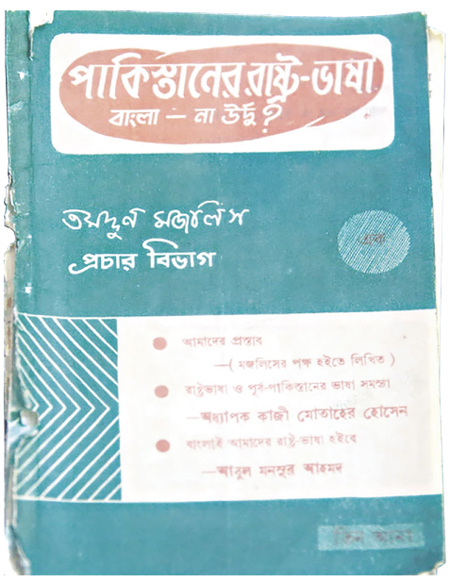 Not only in the cultural arena, there were also notable deliberations on state-language in the political circle even before the establishment of Pakistan. The draft manifesto that was presented by Abul Hashim , the general secretary of Bengal Provincial Muslim League, at a meeting of the provincial council in 1944 also mentioned about the issue of imparting education through mother language. A political group called 'Gano Azadi League' was constituted at Dhaka in July 1947 through the initiative of a few leftist activists of the Muslim League. They included Kamruddin Ahmed, Mohammad Toaha, Tajuddin Ahmad, and Oli Ahad et al. Their manifesto titled 'Immediate Demand, Ideal Programme' stated: "Education has to be imparted with the help of mother language…. Bangla is our language. All types of arrangements will have to be made for making this language suitable for the country. Bangla shall be the state language of East Pakistan". A reason for this demand might have been the indecisiveness of the Muslim League at that juncture regarding the future of East Bengal. Therefore, the members of the Gano Azadi League might have thought there would be complete provincial autonomy in the two parts of Pakistan, as a result of which East Pakistan would get the status of a state-unit.
After the emergence of Pakistan on August 14, a provincial youth workers' conference was held in Dhaka on September 6 and 7 1947. Although it did not adopt any proposal for making Bangla the state language of Pakistan, a resolution adopted on the subject stated: "The East Pakistan Workers' Conference is proposing that Bangla language be made the medium of instruction and language of law-courts in East Pakistan. The responsibility for holding discussion and taking decision on a state language for the whole of Pakistan should be vested on the people, and the decision of the people should be considered as final".
A cultural organisation named 'Tamuddun Majlish' was established on September 2 1947 by some teachers and students of Dhaka University. This organisation waged a campaign in favour of making Bangla the medium of education and the language for offices and courts. On September 15 in the same year, it published a booklet titled 'Pakistan's State-language - Bangla or Urdu'? That booklet spoke about making Bangla the language for imparting education, use in courts and offices as well as by the central government of Pakistan. Regarding the state language, the booklet wrote: "The Lahore Resolution also granted the right of sovereignty and independence to each unit of Pakistan. Therefore, the freedom for determining the provincial state-language should be granted to each of the unit". This proposal was written by Professor Abul Quasem, the chief of Tamuddun Majlish. Besides, language-related articles of the statistics department teacher of Dhaka University Professor Quazi Motahar Hossain and the editor of the daily Ittehad (published from Kolkata) Abul Mansur Ahmad were also published in it.
The last meeting of the working committee of Bengal Provincial Muslim League was held in Dhaka on December 5 1947. That meeting of the working committee decided that Urdu would not be made the official language of East Bengal. The chairman of the committee Moulana Akram Khan was empowered by the committee to release a statement on the subject to the newspapers. As this meeting took place at the official residence 'Bardhaman House' of the Prime Minister Khwaja Nazimuddin, many students as well some teachers demonstrated after arriving at the site in support of the demand for making Bangla the state language of East Pakistan with immediate effect. Moulana Akram Khan assured them that their demand would be considered sympathetically.
Earlier, an education conference was held at the central level in Karachi. After participating in that conference, the provincial ministers of East Pakistan Government told journalists at the airport on their return to Dhaka on December 5 1947 that a resolution was unanimously adopted at that conference for making Urdu the state language of Pakistan. But another news-item circulated by API on the same day and published in the daily Morning News claimed that a decision was unanimously taken to make Urdu the 'lingua franca' of Pakistan, but no decision was taken at the conference to make Urdu the state language. The onus of that decision was vested on the Constituent Assembly of Pakistan.
However, in protest against the resolution of the education conference, a meeting was held at the premises of Dhaka University. It was the first such gathering of general students in support of state-language Bangla on the university compound. The students of Dhaka University, Dhaka Intermediate College, Jagannath Intermediate College, and other educational institutions joined that huge gathering. It was presided over by the physics department professor of Dhaka University and the secretary of Tamuddun Majlis Professor Abul Quasem. Those who spoke at this gathering included Munier Chowdhury, Abdur Rahman, Kalyan Dasgupta, A K M Ahsan, and S. Ahmed. The vice-president of Dhaka University Students Union Farid Ahmad presented the following proposals at the meeting, which were unanimously adopted:
1. Bangla should be made the principal state language of the dominion of Pakistan, and it should be made the official language as well as the medium of instruction.
2. The main motive behind the confusion that is being created centring on state-language and lingua-franca is to hide the real problem and betray the people of East Pakistan.
3. The meeting harshly condemned the conduct of the minister of Pakistan Central Government Fazlur Rahman and the minister of provincial government Habibullah Bahar for supporting the demand in favour of Urdu language.
4. The meeting censured the 'Morning News' for its Anti-Bangali publicity campaign, and warned the daily against ignoring the will of the people.
Following this meeting, the students brought out a procession from the university premises that reached the secretariat building after passing through various roads. From the secretariat, the students went to the residences of the ministers Nurul Amin and Hamidul Huq Chowdhury, and reiterated their demand for state language Bangla. The procession then reached the residence of Prime Minister Khwaja Nazimuddin. But although the provincial ministers Mohammad Afzal and Nurul Amin previously pledged to support the demand for state-language Bangla, Nazimuddin declined to make any such promise. He expressed his inability to meet the students as he was sick at the time; at the same time, he informed the students through a written note that he would not express any opinion on the question of language until he knew the opinions of the Muslim League working committee and the parliamentary committee. On the other hand, Habibullah Bahar protested on 11 December the report published in the newspapers regarding his interview at the airport by claiming his words were distorted; he added that no decision was taken at the conference regarding the state language.
Demonstrations and protest meetings continued to be held at that time inside and outside Dhaka city. However, some dissenting citizens of Sylhet submitted a memorandum to Khwaja Nazimuddin claiming that the opinion of those who were advocating for state-language Bangla did not resemble the views of the general masses. In this context, they referred to the support extended to Urdu by the Sylhet District Muslim Chhatra Federation, the weekly 'Jugobheri' of Sylhet, the then vice-chancellor of Aligarh Muslim University Dr. Ziauddin, and the central minister of Pakistan Fazlur Rahman. According to them, there would be no common thread of unity between the two parts of Pakistan if Bangla was made the state language of Pakistan instead of Urdu; and as a result, Pakistani Nationalism would be destroyed.
The memorandum stated:
"A group of people have started a vicious campaign against Urdu by claiming themselves to be great litterateurs, artistes, and scholars. They are determined to boycott Urdu as an anti-nationalistic foreign language by harbouring the ridiculous idea that the people of East Pakistan are a nation. They are creating commotion all around for making Bangla the state-language of East Pakistan by taking a constricted view after wearing the mask of patriotism. Pretending to be representing the opinion of the masses, they are raising demand for a language like Bangla that does not qualify for the prestige of a national language in a Muslim country. This shameless effort to shun the Urdu language, which embodies the glorious heritage of Muslim culture, is not only destructive, it is also regressive, condemnable, and above all a challenge to the universal Islamic brotherhood".
"By neglecting Urdu, which was inspired by the Holy Quran and Islamic literature, if we move towards Bangla language that got inspiration mainly from the Ramayana, Upanishad, Veda, and other Sanskrit literary pieces, then we shall deny our national identity. The concept of Pakistan was born from the concept of a separate nationhood emanating from distinct culture, history, heritage and outlook of the Indian Muslims. As it is the national language of Indian Muslims and has been enriched by Islamic and modern scientific literature, Urdu is most suited for becoming the state-language of Pakistan".
Anti-government sentiment was, however, widely generated among the middle-class people of East Pakistan centring on the question of state-language from the very inception of Pakistan. This was reflected by various protest movements. As only English and Urdu were used on the money-order forms, postal stamps, coins and currencies after the establishment of Pakistan, this created much anxiety and resentment among the general masses and educated people living in East Pakistan.
The State Language Action Council was therefore constituted through the initiative of the Tamuddun Majlis in October 1947 for giving concrete shape to this viewpoint. This action council was formed in presence of some activists of Tamuddun Majlis and the Muslim Chhatra League. A member of Tamuddun Majlis and professor of Dhaka University Nurul Haque Bhuiyan was elected its convener. This action council initially carried forward the movement through releasing statements and write-ups in periodicals, holding discussion programmes, consultations with government functionaries, as well as meetings and gatherings. Although, a Language Movement Action Council was constituted later on, the first action council formed by Tamuddun Majlis played a vital role in advancing the movement that culminated in the recognition of Bangla as the state language of Pakistan during the 1950s after much blood-letting and sacrifice including those on 21 February 1952.
[REFERENCE: Badruddin Umar, "Bhasha Andolan" in (Sirajul Islam ed.) Bangladesher Itihash, Vol. 1. Asiatic Society of Bangladesh, 1993. ]
Dr Helal Uddin Ahmed is a retired Additional Secretary and former Editor of Bangladesh Quarterly. hahmed1960@gmail.com