
Investment-friendly environ key to making PPP projects successful
Doulot Akter Mala | Friday, 28 April 2017
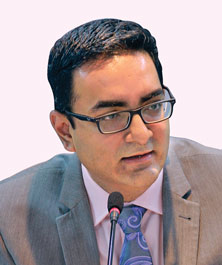
Ensuring investment climate along with smooth financing from banking sector and enhancement of institutional capacities in public sector are key factors to make PPP projects successful, said Syed Afsor H. Uddin, Chief Executive Officer (CEO) of Public-Private Partnership (PPP) Authority.
Investment environment must improve in Bangladesh to encourage private sector's investment in the PPP projects, he said, adding that fair returns from investment in infrastructural development must be ensured.
"PPP projects cannot be completed overnight. Such projects need to conduct feasibility study and market-based analysis," he told the FE in an interview on 'PPP Budget; Success and Way Forward' at his Agargaon office in the city recently.
Mr Afsor has also focused on infrastructure, finance and trade investment for over 15 years.
Syed Afsor H Uddin joined the PPP authority under the Prime Minister's Office (PMO) in January 2012.
He was the Senior Policy Adviser in the PPP team at HM Treasury during Rt Hon Chancellor Gordon Brown's tenure.
Prior to his appointment to the PPP Office, Mr Afsor was with PwC in the UK as a Management Consultant focusing on advising UK government departments on the optimum way for structuring their PPP projects.
Talking to the FE, he said the PPP authority is working as facilitator and regulator to assist other agencies in implementing PPP projects.
Currently, 44 PPP projects worth US$ 14 billion are in the pipeline.
Bangladesh has framed relevant laws and acts to give PPP projects a legal backing. It also formed Bangladesh Infrastructure Finance Fund Limited (BIFFL) to finance the PPP projects.
The PPP CEO said BIFFL has been formed with an initial paid-up capital of Tk 25 billion.
"As of March, the bank has committed to disburse Tk 19 billion to different PPP projects. BIFFL can issue loan under long-term scheme up to 12 years," he said.
Stressing the need for maintaining policy consistency of the government, the PPP CEO said policy consistency is important for investors' comfortability and smooth investment plan.
To ensure smooth financing in PPP projects, the authority has signed agreements with 14 commercial banks.
"Corporate financing of the banks will be expedited due to prior discussion process of the PPP authority with the banks about the upcoming projects," Mr Afsor said.
Sustainable Development Goal (SDG) of the United Nations (UN) has also prioritised PPP.
He said the PPP authority has taken a number of initiatives to build awareness about PPP projects and familiarise them.
Implementing agencies of the PPP projects are empowered to ensure the quality and sustainability of the PPP projects. Feasibility studies are important prior to initiating any of big physical infrastructural projects.
PPP projects can be long-term for 20-30 years' time span.
Partnership with the private sector, tax incentives, training programme to enhance capacity have been focused by the authority.
PPP cell will be established in each of the ministries and those will have focal points too.
"We are building partnership with the Bangladesh Securities and Exchange Commission (BSEC), Bangladesh Investment Development Authority (BIDA), Bangladesh Bank (BB) and other relevant authority to simplify the relevant law," he said.
According to rules of business, government's ministries and departments concerned are empowered to implement the PPP projects. The PPP authority monitors and facilitates the project implementation. It is not the implementing authority.
The PPP authority reports to its board of governors, chaired by the Prime Minister.
The PPP CEO said the PPP concept is not new in Bangladesh as it was practised in a form of build-own-operate (BOO), build-own-transfer (BOT) or joint venture project.
Independent power plants, National Heart Foundation, BIRDEM are examples of PPP initiatives in Bangladesh, Mr Afsor said.
In this subcontinent, Bangladesh's PPP format is considered a robust. The Asian Development Bank (ADB) and the World Bank (WB) also expressed their curiosity to know what Bangladesh is doing in PPP.
Although, India, Nepal, Bhutan, Malaysia, the Philippines and some other Asian countries are progressing in PPP, South Korea is holding leading position among them.
The country needs huge investments in infrastructure development which is difficult for the government to carry out alone.
"Government's role is to deliver public service. It involves the private sector due to its resource constraints, ensuring efficiency of services and long-term quality maintenance of infrastructure," he said.
The PPP authority's iconic project is now 48-kilometre long Dhaka Eastern Bypass with an estimated cost of US$ 330 million.
He said the road will add a new dimension in the regional road connectivity. Some 11 international organisations participated in the tender invited for the project. Of them, the authority short-listed four bidders. The PPP CEO expects to start the project at the beginning of next year.
doulot_akter@yahoo.com