
IRI study finds political instability and corruption as major problems facing Bangladesh
Friday, 14 February 2014
International Republican Institute (IRI) commissioned a public opinion survey in Bangladesh during January 12-27, 2014. The study was conducted by Messrs. Global Strategic Partners (GPS) with the assistance of Neilson. As a snap-shot of the post January 5th polls situation, the study provides important food for thought to our policy makers and political parties. It is one thing to win an election, but winning people's support is a different matter altogether. IRI disseminated the study on January 11 in a local hotel and the media carried the news the next day.
IRI has been a major player for more than a quarter century helping people in strengthening democracy in their lands. It has been an important part of a democratic wave that was once unthinkable. The organisation works in countries important to the U.S. interests focusing on three tasks: helping political parties broaden their appeal, ensuring that they rule justly once elected and aiding civil society in guaranteeing democratic governance.
The survey was conducted through home interview in person covering all 64 districts of the country. The response rate was 60 per cent, meaning out of 4250 people approached, 2550 responded. The margin of error is estimated to be (+ -) 2.0 per cent. Gender balance was maintained at 50: 50 and urban-rural coverage was 24-76 following BBS statistics. The study had two distinct parts: issues and indicators, and elections. Therefore, the study can be taken as fairly unbiased and accurate.
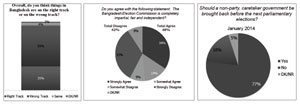
When asked, "do you think things in Bangladesh are on the right track or on the wrong track', 59 per cent chose the latter. When asked why, 86 per cent ascribed it to political instability, 7.0 per cent to poor economy and 6.0 per cent to frequent strikes. 73 per cent of those who chose "right track" ascribed it to improved education. It may be recalled that in December and January some school examinations were held and their results were announced.
Responding to "which problems should the government fix first", 41 per cent mentioned corruption and 33 per cent political instability. It appears that people's perception of corruption and politics are intermingled. 60 per cent respondents think that the country's economy will get worse in the year ahead and 71 per cent think that violence will be worse during the same period. Again political violence as a deterrent to economic growth seems to be the major concern of the people.
Next, the study tackles the 10th parliamentary elections held on January 05. 62 per cent (48 per cent strongly and 14 per cent somewhat dimly) of the respondents opined that the January 05 election should not count. However, 52 per cent respondents did not support boycott of the elections by some political parties. This apparent anomaly can be explained by the fact that although they didn't like the boycott, they also didn't approve of the elections as it was not inclusive.
When asked how soon there should a new election, 61 per cent said within the next 12 months and 34 per cent thought the government should serve the full 5-year term. The opinion about the impartiality of the election commission was split 48-42 in favour of the EC. However 34 per cent strongly agrees and 33 disagreed that the EC is impartial. It may be an indicator that the Bangladesh Election Commission has works to do in order to prove its credibility to the people.
Finally, the study asked the respondents, "should a non-party, caretaker government be brought back before the next parliamentary elections?" 77 of the respondands answered in the affirmative and only 18 per cent in the negative. This re-establishes the fact that the caretaker form of pre-election-time government is a popular and widely accepted notion, negating the impartiality of an interim pre-election-time political government.
The IRI study should be taken seriously not only by the policy makers but all stakeholders including the civil society. It has a number of indicators showing the maturity of the people and a growing trend of tagging together politics and corruption. The public notion that political instability is a deterrent to economic growth is to be taken seriously.
The image of the Election Commission is under the people's scanner as well. Will anyone heed to the opinion of the people of Bangladesh?
akms@e-zonebd.com