
Is Bangladesh a laundry?
Muhammad Munir Chowdhury | Saturday, 15 November 2014
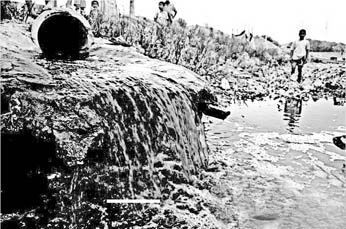
Bangladesh turns 43 years with its sinking like Titanic into an environmental catastrophe. The growing incidents of environmental disasters over the years indicate how dire and disastrous the situation is which was handled by me in two years of enforcement drive from July, 2010 to December, 2012 under the Dept of Environment. In true sense, the mushroom growth of dyeing industries in the capital's immediate periphery and in Savar, Ashulia, Narayanganj, Narsingdi and Gazipur is causing gradual degradation of environment.
It is a huge burden on the economy which can never be compensated. Indiscriminate dumping of toxic materials from the dyeing industries into the rivers of Buriganga, Shitalakkhya, Balu and Turag is largely destroying the whole ecological balance. Using these rivers as a safe haven for the polluters, the immense potentialities of these rivers were destroyed. Dyeing industries need vast areas as dumping areas for releasing their toxic water. Without having the treatment facilities, these industries are increasing day by day for lax enforcement of laws.
This is easily visible and measurable in the dwindling nature and ecology with coloured water and bad odours in the major rivers. These industries are invariably linked with garment sector which has massive export potential. Large areas are being swept under waves of millions of tonnes of untreated red-blue-black-yellowish waters in Savar-Ashulia. This condition is ultimately causing dearth of adequate ground and surface water and is also crucial for the ecosystem. In my observation, Bangladesh has been used as a 'laundry shop' as the western countries have been enjoying the opportunity of dyeing their garments in our soil for buying of clothing from Bangladesh. But rampant pollution by these factories are overlooked by the foreign buyers spoiling Bangladesh as the dumping-yard.
During my 2 years of enforcement drive in the field, I found at least 300 dyeing factories having no perfect wastewater treatment facilities. Either the factories have no ETPs at all or ETPs remain non-functional for saving operating cost. But unfortunately environmental audit teams or inspection teams had no embargo against those polluting industries. Rather, whenever I slapped huge penalties or imposed other punitive measures, the factory owners appeared with aggressiveness proving them as exporters (saviour of the nation!) with humble submission of exempting them from penalties or punishment.
Virtually, the dyeing factories being an integral part of supply chain of garments industries are responsible for desperately flouting the environmental regulations and reaping the benefits in the name of export. In enforcement drives, we experienced that a dyeing industry with the capacity of dyeing 10 tonnes of fabrics per day needs 800 cubic metres of fresh water for its dyeing functions and in reverse, it releases same quantity of waste water on ending of its dyeing operation.
The huge demand for fresh water are being met by extraction from underground and the water depletes from the ground level, which directly pollutes the surface water as well as the agricultural lands and the fisheries. Major fertile areas of Savar-Gazipur-Narayanganj and Narsingdi have now transited into 'retention areas' of harmful industrial waste water which will bring doomsday for us in the near future. For example, Beel Pakuria of Savar has now turned into a big reservoir of poisonous water by unabated release of toxic water from some influential dyeing factory owners who do not care about environment. Most of the local fish stocks have disappeared from there. In an enforcement drive in Savar wetland, we measured the standard of dissolved oxygen which was found at level 1.54 mg/Ltr (beyond the standard level). It also affected the lives and livelihoods of the local people there.
They were badly affected and also frustrated for inaction against the polluters by Dept of Environment for long time. Drives against the environment-killers with heavy imposition of fines, acted as strong deterrent against rampant pollution. In fact, a high expectation was created among the people by this strong move despite so many constraints. But some of the influential businessmen appeared very hostile and repeatedly pressurised the Honourable Environment Minister with threat of resisting the drive and paralysing the garment sector. As the enforcement drive was accelerated, tougher pressures from the high-ups went up more.
But, I was strictly instrumental to enforce the Environment Law and uncompromising with the powerful high-ups. Alas! The bitter truth is that the 'blind' exporters and the investors with the mission of only boosting up their profits took advantage at the cost of our environment. These outrageous profit-hunters are accumulating wealth leading them into lavish life. Eventually, the rich polluters dominate the society and economy with their money-power.
With a series of mounted pressure and constant pushing, at last I was transferred from the Dept of Environment giving relief to the powerful polluters on January, 2013. Thanks to the polluters for saving themselves from the clutches of the Environment Law and rigorous enforcement drives. Had the authority not compromised and continued the drives more rigorously, the polluters could not have proceeded further with their aggressive pollution.
The writer is former Director (Enforcement), Dept of Environment.
E-mail: mmunirc@gmail.com