
Israel desperate to torpedo nuclear deal with Iran
Abdur Rahman Chowdhury from Virginia, USA | Friday, 13 March 2015
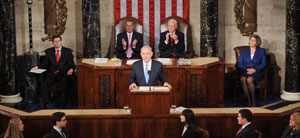
As the talks between the US-led countries and Iran moved to a crucial stage the hawks in US political spectrum and Israel have become desperate to frustrate the process to reach an agreement. Israeli Prime Minister Benjamin Netanyahu, in wanton disregard of the protocol, came to Washington and addressed the Congress. He launched a virulent attack on President Obama for rushing to a deal, which according to him would enable Iran to acquire nuclear capability. Netanyahu considers nuclear-capable Tehran an existential threat for Israel and danger to world peace. He called the foreign ministers of the US-led coalition and tried to dissuade them from making any deal with Iran. US Secretary of State John Kerry time and again assured that negotiators of "Five-plus-one" are not impervious to the security concerns of Israel. John Kerry re-emphasised that Israel is more secured now than before because of the negotiation.
Netanyahu wants Tehran should be stripped off nuclear capability and advocated that no deal is better than any deal that leaves Iran certain amount of enriched uranium and centrifuges. This is simply not possible. Iran would never agree to completely give up a nuclear enrichment programme it considers a point of national pride.
NUCLEAR DEAL: The terms being negotiated include inspection by the IAEA (International Atomic Energy Agency), limits on the number and type of centrifuges needed for enrichment and shipment of unspent uranium to Russia for conservation.
The US asked Iran to limit enrichment programme for ten to fifteen years but Iran insisted on five to ten years. This does not mean Iran would be eligible to pursue nuclear enrichment programme with the aim to make a bomb after ten years. The programme would continue to remain under the scrutiny of the IAEA, the nuclear watchdog. President Obama asked his critics, "On the core issue, how do we prevent Iran from obtaining a nuclear weapon, which would make it far more dangerous and give more scope for even greater action in the region? Israeli prime minister didn't offer any alternatives." The President concluded, "Sanctions won't do it. Even military action would not be as successful as the deal that we have put forward."
Netanyahu offered airstrikes as alternatives and reminded the audience in the UN Congress "If that doesn't work, Israel is prepared to stand alone."
The nuclear deal has not yet been finalised, the process is approaching a self-imposed deadline - end March - to prepare the framework. During the remaining three months the technical details of the agreement would be worked out. The US negotiators have kept the Israeli government fully abreast of the progress during the recent past.
Now that the negotiation has moved to a crucial juncture Netanyahu and the hawks in the US Congress are trying their best to jeopardise the likely deal. In a most unexpected move 47 Republican Senators have written to Iranian government on Monday (March 09) reminding it that the Congress could bulldoze the agreement or the future president could strike it down implying that "the nuclear deal" would be an exercise of presidential executive authority and will be short-lived. Vice President Biden has blasted the letter as "beneath the dignity of an institution I revere." Iran's Foreign Minister Mohammad Zarif has reacted, "It is astonishing that the Republican Senators are not aware of the authority of the president of their country."
ISRAEL'S CLANDESTINE NUCLEAR PROGRAMME: Israeli Prime Minister has never explained why his country, being in possession of over 200 nuclear arsenals, is overly concerned on Iran's acquiring nuclear capability. The Washington Post, in its issue of March 10, narrated how Israel deceived the US in building the nuclear weapons facility in the Negev desert and avoided international inspection. Israel's clandestine programme began in June 1960 and within ten years it acquired the nuclear bomb. In 1961, Ben-Gurion assured President Kennedy that Israel did not have any intention to develop weapons capacity. Two years later Israeli defence minister Shimon Peres reiterated to President Kennedy that "We will not introduce nuclear weapons to the region, and certainly we will not be the first." In January 1968, a memo prepared for President Johnson hinted "The Israeli government is probably determined to preserve its nuclear option." The State Department's memo in April 1969 referred to intelligence reports and confirmed that Israel was rapidly developing a capability to produce nuclear weapons and to deliver them by surface-to-surface missiles or by plane." At a meeting in the White House in September 1969 President Nixon and Israeli Prime Minister Golda Meir agreed that Israel would not test atomic weapons, disclose possession of them or threaten any country with them."
Netanyahu is now trying to fathom Iran by Israeli deception standard.
US-ISRAEL NEXUS: United States was the first country to accord diplomatic recognition to Israel. It became the greatest ally of the new-born country and began providing huge economic and military assistance. Gradually Israel became the darling of the US but at the same time it became isolated and was left with no friends in the region and elsewhere. US on every crisis came to the rescue of Israel militarily, financially and diplomatically. US exercised its veto power as many as 40 times at the Security Council in favour of Israel. This highly biased policy brought indignation for the US in the streets of Muslim world.
Israel is recipient of over US$ 4.0 billion per annum as economic and military assistance. Iron Dome System has been built with US financial assistance to protect the targets from Palestinian rocket attacks. Ammunitions are replenished from US stockpiles maintained in Israel. US opposed Palestinian membership in the UN on behest of Israel. It has opposed Palestinian entry into the Human Rights Organisation and UNESCO. In defiance of US, Palestinian Authority has lodged a case in the International Criminal Court against Israeli soldiers' killing over 2,000 civilians in Gaza in summer 2014.
American love and affection have made Israel not compliant but more and more recalcitrant. Its prime minister has chosen the US Congress to denounce President Obama for reaching out to Iran. Netanyahu lent support to Republican candidate Mitt Romney in the last presidential election. American Israeli Public Action Committee (AIPAC) provides a forum for the Israeli politicians in the soil of US to polarise national institutions in Washington. It doesn't contribute to peace building in the region.
US OPTIONS: Time has come for the US to review its biased policy towards Israel which has received billions of dollars in economic and military assistance, developed internal infrastructure and institutions. It has now one of the most well-equipped army in the Middle East. It's a nuclear country but refused to be a signatory to the Nuclear Non-proliferation Treaty (NPT).
Israel doesn't see the dividend in peace. It continues to grab Palestinian land in the name of settlement making it impossible for a Two-state solution. US failed to exercise any leverage over Israel to withdraw from the occupied land and make peace with its impoverished neighbour. The consequence is Israel has been left with no friend in the region. The possession of nuclear arsenals has not brought the security Israel so badly needs.
A BALANCED POLICY: United States should pursue a balanced policy in the Middle East. It should focus on the promotion of democracy, democratic institutions, good governance and strengthen bilateral trade and commerce in the region.
Tunisia, despite having setbacks, rolled back to democratic trajectory and installed an elected government.
Egypt has so far failed and the junta has returned to power with all its brutality. US should mount pressure on the Egyptian government to set free thousands of political prisoners, allow the media to play its role and let the authority develop a roadmap to return to pluralism. The status-quo is not an option. Under totalitarian regime the violence would be widespread and more vicious. The combined efforts of the US and EU would bring the Egyptian rules to their sense. Turkey, Jordan and UAE are providing much needed support to defeat ISIS. Iran is a valuable partner in combating ISIS, so are the Gulf States.
United States' cooperation with the countries in the region is bound to create a momentum that would thwart extremism and promote peace and development. It's no longer prudent to ignore 700 million people in the region for the appeasement of seven million people in Israel.
The writer is a former official of the United Nations.
darahman.chowdhury@hotmail.com