
Japan\\\'s lower house dissolved for snap poll
Saturday, 22 November 2014
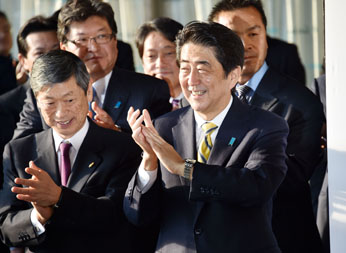
TOKYO, Nov 21 (agencies): Prime Minister Shinzo Abe dissolved the lower house of Japan's parliament Friday, forcing a snap election in an apparent bid to shore up support for his scandal-plagued government so that he can pursue his policy goals.
His ruling Liberal Democratic Party, which has been in power for most of the post-World War II era, may lose some seats but is likely to retain a solid majority with its coalition partner in the 480-seat lower house.
He is portraying the election as a referendum on his economic revitalization policies, known as Abenomics, and the postponement of the tax hike - from the current 8 percent to 10 percent - that had been planned for next October.
Following the dissolution, the premier's cabinet confirmed the election will be held Sunday, December 14, said Chief Cabinet Secretary Yoshihide Suga, Tokyo's top spokesman.
"Finally, the fight will begin," Abe told fellow politicians who cheered in response to the remarks.
"Let's fulfill our responsiblity to make Japan a country that once again shines at the centre of the world.
"I promise to take the lead so that all of you here will be elected. Let's grab a win together."
Abe, who is going to the polls less than half way through a four-year term, said earlier this week that he wanted voters' endorsement for his decision to postpone a sales tax rise slated for next year, after data this week showed an earlier levy hike knocked the economy into recession.
"I'm fully aware that it's going to be a tough election," Abe told a business audience in Tokyo on Thursday.
"Through the election campaign, I want to clarify if the growth strategy we are pushing is right or wrong," he said.
The last 24 months have seen two of the so-called "three arrows" of the premier's Abenomics policy blitz fired-massive fiscal stimulus and a flood of easy money.
A third "arrow" of structural reforms has inched along as it faced resistance from the vested interests, including a politically powerful farm lobby, that it is intended to undermine.
"The third arrow has never flown at all because it faces resistance" even from Abe's own conservative Liberal Democratic Party (LDP), Kenji Eda, co-leader of the opposition Japan Restoration Party, said Thursday.
Banri Kaieda, head of the main opposition Democratic Party of Japan, also Thursday, said: "We can't have the (rich-poor) gap widen. We can't give him a blank cheque for another four years."
According to opinion polls conducted by the Asahi newspaper this week, the Abe cabinet's approval rate fell to 39 percent from 42 percent earlier this month.
Its disapproval rate rose to 40 percent from 36 percent, pushing it above his approval rate for the first time since he took office in December 2012, the survey showed.
Abe has tried to cast the election as a referendum on his decision to delay the sales tax hike to 10 percent, after the first jump to 8.0 percent from 5.0 percent on April 1 sent consumers scurrying for cover and took a huge bite out of the world's number three economy.
But the Asahi survey said 65 percent of voters were not convinced by his reasoning to call a snap election.
Most commentators agree that the election is a fig leaf to cover Abe's attempt to consolidate his own position within his fractious LDP, and to fend off challengers in a party leadership election scheduled for September next year.
However, Abe runs the risk of undermining his authority if his coalition's majority is reduced too much.
Meanwhile, a new mandate would bolster the premier's case for pushing ahead with the re-starting of nuclear reactors-an unpopular idea in a nation scarred by the 2011 Fukushima disaster, the worst atomic crisis in a generation.
It would also strengthen Abe's hand on pet issues such reforming Japan's view of its 20th century military aggression which he and other nationalists say is masochistic.
The main opposition Democratic Party of Japan, which led the country for three years until September 2012, deeply disappointed voters with their failure to achieve promised goals and perceived lack of leadership. While Abe isn't wildly popular among public, voters appear to be more willing to trust him and the LDP, which led Japan for decades, including through its high-growth era in the 1960s and into the booming 1980s.
In the first half of next year, Abe plans to tackle contentious issues that could erode support for his government, namely legislation to expand Japan's military role and restart nuclear power plants.
"It's like pushing a reset button," said Koichi Nakano, an international politics professor at Sophia University in Tokyo.
Abe got a rare second term as prime minister after stepping down just a year into his rocky first term in office in 2006-2007. His support ratings started out high as share prices surged in early 2013. But they have fallen recently as parliament got bogged down in squabbles over campaign finance scandals that forced out two of his Cabinet ministers within weeks of an early September reshuffle.