
Jul-Apr trade deficit widens to $22.2b
JASIM UDDIN HAROON | Tuesday, 9 June 2026
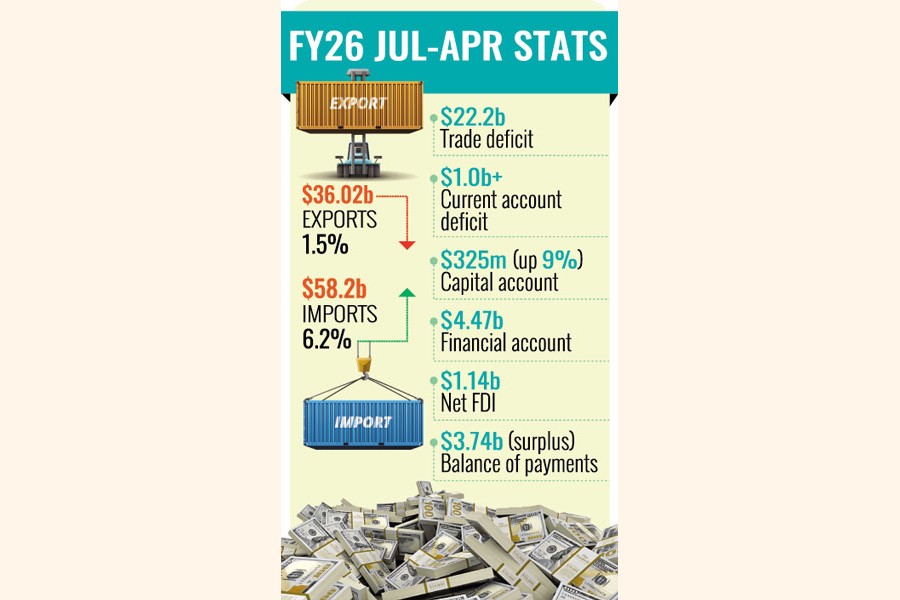
Bangladesh's trade deficit widened significantly during the first 10 months of the current fiscal year as import growth outpaced exports despite the fact that robust financial inflows helped keep the overall balance of payments (BoP) in surplus.
The trade deficit rose to $22.2 billion during the July-April period of FY26.
Exports fell by 1.5 per cent year on year to $36.02 billion, while imports spiked by 6.2 per cent to $58.2 billion, during the period under review.
The rise in imports was largely driven by higher purchases of fuel and food grains.
The imports of petroleum products climbed 72 per cent to $7.64 billion, while wheat imports surged by 49 per cent to $1.96 billion.
The increased fuel imports reflected higher domestic demand as well as elevated global energy prices amid the ongoing geopolitical tensions in the Middle East over the US-Israel attack on Tehran, now on a ceasefire.
The current account deficit, another key component of the BoP, widened to more than $1.0 billion during the July-April period from $586 million in the July-March period of this fiscal year.
The capital account, however, posted modest growth, increasing by more than 9.0 per cent year-on-year to $325 million.
The financial account recorded a sharp improvement as it rose to $4.47 billion during the period from $1.13 billion in the corresponding period a year earlier.
Net foreign direct investment (FDI) inflows stood at $1.14 billion, down more than 20 per cent from a year earlier.
Portfolio investment, which reflects foreign investment in capital market instruments, remained negative, recording a net outflow of $132 million during the period under review.
Data also showed that medium- and long-term (MLT) loan disbursements declined by around 20 per cent, while MLT loan amortisation payments increased by more than 19 per cent.
Despite the wider current account deficit, the overall balance of payments remained in surplus at $3.74 billion, indicating that foreign currency inflows exceeded outflows during the period.
The surplus helped the Bangladesh Bank strengthen its foreign exchange reserve position amid huge import payments.
Dr Zahid Hussain, an independent economist, says the country's external sector remained in a favourable position despite the widening current account deficit mainly due to strong inflows through both financial account and remittances.
"The positive development is that the imports of capital machinery increased by 6.1 per cent during the period, suggesting continued expansion of manufacturing activities and investment in productive sectors," he said.
jasimharoon@yahoo.com