
Korea eyes trade pact with Bangladesh amid investment hurdles
Envoy urges reforms in customs, visa and dollar payment systems to unlock potential
FE REPORT | Monday, 20 October 2025
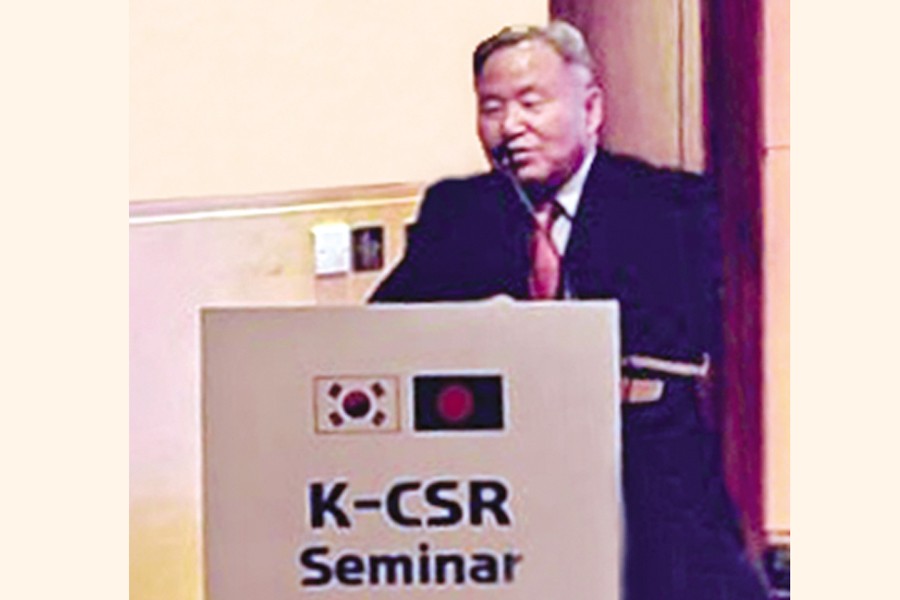
South Korea is pushing for early conclusion of a Comprehensive Economic Partnership Agreement (CEPA) with Bangladesh, as both countries seek to elevate a five-decade-long relationship to a new level of trade and investment cooperation.
Speaking at a seminar on Korean investors' CSR activities at the Westin Dhaka on Sunday, South Korean Ambassador Park Young-sik said the CEPA would provide "another opportunity to take our close relationship a step further." However, he cautioned that significant barriers-ranging from slow visa issuance and customs delays to high import tariffs and dollar payment bottlenecks-continue to impede investment flows.
"Bangladesh remains a promising destination for Korean investors," Mr Park said, pointing to its growing economy, strategic location, and young labour force. "But to fully realise its potential, the country must improve the business environment by ensuring timely visa issuance, seamless customs clearance, and the resolution of overdue dollar payments after project completion."
He also urged the government to allow easier repatriation of profits and lower tariffs on raw materials and intermediate goods-issues that Korean firms say erode competitiveness.
Bangladesh's exports to Korea have been rising steadily, though Ambassador Park described the figures as "not yet satisfactory." The country could diversify its export basket beyond garments, he said, by promoting footwear, ICT products, leather goods, light industrial items, and pharmaceuticals. A bilateral CEPA, he argued, would give a strong push to these emerging sectors while expanding Bangladesh's presence in the Korean market.
The envoy highlighted infrastructure development as another pillar of cooperation. "Korea aspires to become a vital partner in Bangladesh's infrastructure development, just as we have done in the RMG sector," he said. Since 1973, 144 Korean companies have joined in 257 infrastructure projects in Bangladesh worth a cumulative USD 8.82 billion.
He cited the Korean Export Processing Zone (KEPZ) in Chattogram as a model of long-term partnership. Developed by Youngone Corporation, the KEPZ employs more than 70,000 workers and generates USD 1.25 billion in exports annually. "It remains a symbol of our shared industrial success," the ambassador said.
Development cooperation, too, forms a cornerstone of the partnership. Bangladesh is now Korea's third-largest recipient of official development assistance (ODA), covering education, health, sanitation, and transport. The Korea International Cooperation Agency (KOICA) is focusing on upgrading technical and vocational education to bridge skills and technology gaps.
In his address, Park also spotlighted Korean companies' corporate social responsibility (CSR) work in Bangladesh. "CSR is not just a buzzword; it's a commitment to giving back to the communities where we operate," he said.
LG Electronics' "Ambassador Challenge" and IT Academy with JAAGO Foundation, Samsung's coding and software training initiatives for students, Woori Bank's healthcare and scholarship programmes, Dowha Engineering's technical training for engineering students, and Youngone's "Blue & Green Initiative" in KEPZ were among the examples cited.
Youngone's Chattogram project, Park noted, had turned barren land into a "thriving green ecosystem" with three million trees and Bangladesh's largest rooftop solar installation, generating 37 megawatts of renewable power.
Reflecting on the broader partnership, the envoy drew parallels between Bangladesh's current development trajectory and Korea's own transformation from aid recipient to donor. "Korea built its economy in just a few decades with international support," he said. "We now wish to share that experience with other developing nations."
Since establishing diplomatic ties in 1973, Korea and Bangladesh have maintained robust cooperation in trade, investment, and people-to-people exchange, with the RMG sector serving as a cornerstone.
"Korea does not pursue strategic interests beyond our economic cooperation," Park said in conclusion. "Building on the achievements of the past 50 years, our two nations are committed to forging a brighter and more prosperous future together."
mirmostafiz@yahoo.com