
Korean EPZ wins National First Prize for Plantation 2025 for outstanding environmental conservation
Saturday, 11 July 2026
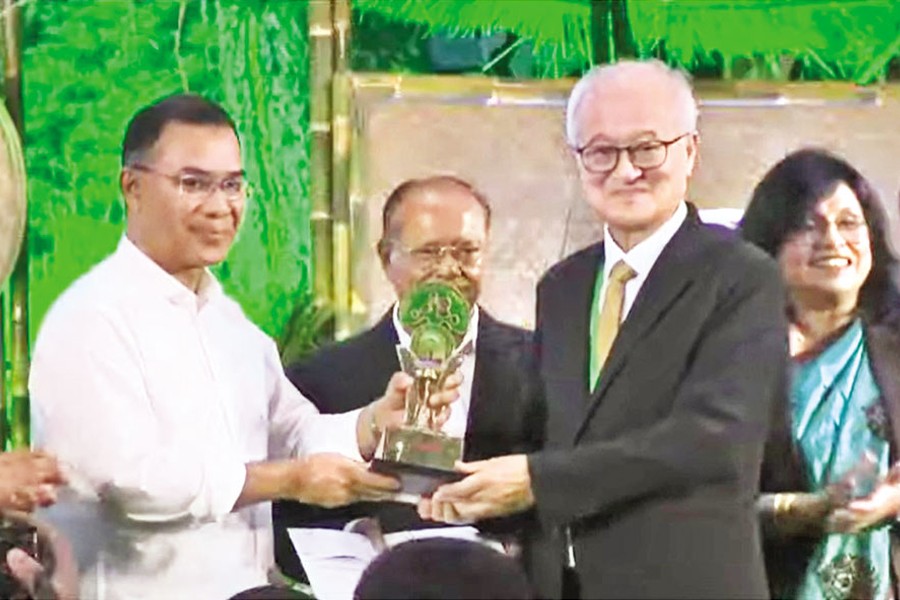
In recognition of its unwavering commitment to environmental sustainability and exemplary contributions to afforestation, Korean EPZ (KEPZ) has been awarded the National First Prize for Plantation 2025, one of Bangladesh's highest national honours for environmental conservation, says a press release.
The award was presented by Prime Minister Tarique Rahman on Thursday and received by Kihak Sung, Chairman and CEO of Youngone Corporation and KEPZ.
The prestigious recognition underlines KEPZ's visionary leadership in transforming once a barren stretch of land along the Karnaphuli River into one of Bangladesh's largest privately developed eco-friendly industrial zones. Through decades of sustained afforestation, ecosystem restoration, and environmentally responsible industrial development, KEPZ has created a model where economic progress and environmental stewardship are seamlessly integrated. The award underscores KEPZ's enduring commitment to building a greener future while setting a national benchmark for sustainable industrial development.
KEPZ sets benchmark for sustainable industrial development
The Korean Export Processing Zone (KEPZ), established under Bangladesh's Private Export Processing Zone Act,1996 has emerged as a leading example of sustainable industrial development by combining economic growth with environmental conservation.
Located on 2,492 acres of barren land in Karnaphuli, Chattogram, KEPZ has preserved 52 per cent of its land as forests, botanical gardens, lakes, wetlands and open green spaces, while the remaining 48 per-cent has been allocated for industrial and infrastructure development.
Since taking possession of the land in 1999, KEPZ has planted more than 3 million trees in the zone and continues to add around 200,000 trees annually. Researchers from the University of Chittagong have recorded more than 400 plant species within the zone.
KEPZ also established a 60-acre botanical garden within its green area, now home to around 1,400 plant species, including rare and endangered native plants. The authority aims to preserve 1,850 species by 2027, making it Bangladesh's largest protected botanical garden and a hub for researchers, students, teachers and tree lovers.
As part of its water conservation programme, KEPZ has developed 37 water bodies capable of storing more than 600 million gallons of rainwater, with plans to increase capacity to one billion gallons. The restored ecosystem has also attracted 292 species of fauna which includes 11 species of mammals,159 species of birds,9 species of reptiles,7 species of amphibians,86 species of butterflies and 20 species of dragon flies and damselflies.
The zone has planned to install 60 MW of rooftop solar power, of which 40 MW is already installed and in operation. All factories operate waste water treatment facilities and Effluent Treatment Plants (ETPs) to meet environmental standards.