
Labour welfare beyond 2015
Mojibur Rahnnan Bhuiyan | Friday, 1 May 2015
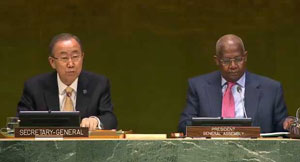
For workers, 2015 is very important. In the post-2015 era, the sustainable development agenda currently being formulated is premised on the reality that the present model of development is not working, given the worsening inequalities. The UN Secretary General's synthesis report on the post-2015 agenda, The Road to Dignity by 2030: Ending Poverty, Transforming All Lives and Protecting the Planet, was released on December 04, 2014. The report has introduced 'Six Essential Elements' in a transformational approach.
The Millennium Development Goals (MDGs) have failed to ensure the trade union movement that the workers and their families will get the rights necessary to realise the vision of a fair and just world. Unfortunately, the ILO's (International Labour Organisation) Decent Work also could not help workers in a desirable manner. [According to the ILO, Decent Work involves opportunities for work that is productive and delivers a fair income, security in the workplace and social protection for families, better prospects for personal development and social integration, freedom for people to express their concerns, organise and participate in the decisions that affect their lives and equality of opportunity and treatment for all women and men.]
The message of trade union is very simple and old. All workers and their families should have access to decent work in a healthy environment. We have asked the government and employers to ensure productive employment and decent work for all, including universal social protection. We have demanded for commitments regarding free quality education and health, gender and economic equality. Trade unions over decades have advocated environmental protection, access to healthcare and nutritious food, water and sanitation. Only healthy workers can ensure the highest production. But these are far from being materialsed.
The experience of the last 25 years shows that high level of inequality limits the progress in reducing poverty while growing inequality increases poverty. Furthermore, high levels of inequality tend to push large segments of the population into the low-wage groups, contracting domestic demand and hindering structural change, says the ILO. It is well known that high levels of inequality create polarised societies with a high crime rate, lower life expectancy and social tensions.
Inequality also tends to push the younger generation into poverty as social mobility is limited. Inequality is increasing both inside the country and also among countries. At present, the richest 1.0 per cent of the world population owns 40 per cent of the global assets while the 50 per cent of the world population owns as little as just 1.0 per cent. So, it is evident that inequality has become the major development challenge in today's world. As a trade union activist, this scribe firmly believes that the present global economic system has miserably failed to deliver the desired goods. This system is not working for the six billion world population.
Driven by neo-liberalism and its flexible labour market policies, labour market has shown a surge in works in the informal sector, where a significant portion of the works are of hazardous nature with little or no compliance to rights entitled to workers. 87.5 per cent workers are involved in the informal economy in Bangladesh, while in India it is 92 per cent. These workers are deprived of the benefits enjoyed by permanent workers. Unwholesome workplaces, recurrent violation of human and labour rights, widespread gender inequality, decline in real wages are the key features that define their lifestyle. Due to the lack of adequate jobs people migrate abroad to seek livelihood, without any guarantee of workers' rights and social protection.
There is no denying the fact that remarkable economic development has taken place in our region in the past decades, but workers did not get their due share of economic growth. Working men and women are hardly benefited by the economic and financial policies. Rather, the number of working poor has increased at an alarming rate. So, trade unions, nationally and globally, have a big challenge to improve the working and living conditions of the working people.
A very fundamental change in present economic, financial and social policies is needed to ensure economic growth with fair and just distribution of benefits to all people including the working women and men. And to that end, rights-based approach should be adopted in keeping with the internationally-agreed principles and conventions.
Minimum wage and other appropriate labour welfare-related policies should be implemented by the government in order to address the decreasing share of the labour force in the national income and consequently the increasing inequality. Particular attention should be paid to the gender wage gap that increases vulnerability and poverty of women and girls.
Multinational enterprises that talk of various benefits, including cheap labour, must make sure that the core labour standards and environmental integrity are respected. Legally branding instruments should be developed in consultation with trade unions to hold multinational companies (MNCs) accountable for shortcomings. Compliance with the UN Guiding Principles on Business and Human Rights, the OECD Guidelines for MNCs and the ILO Tripartite Declaration on Multinational Enterprises should be integrated and be fully enforced in all trade and economic cooperation agreements.
Trade unions should be engaged in eradicating the worst form of child labour and improve the living and working conditions of women workers. The priority area of work will be to mobilise public opinion to protect and realise the rights of domestic workers. Trade unions in Bangladesh will continue to exert pressure on the government to ratify Convention-189 (Domestic Workers Convention, 2011). Trade unions need to go to the workers in all the employment arenas to create awareness and form unions. Organising them in a befitting manner should be the number one priority of trade unions in the post-2015.
The writer is general secretary of Bangladesh Mukto Sramik Federation.
mojiburbhuiyan1950@gmail.com