
Lack of awareness holds back seeking protection under WTO
Saturday, 7 March 2015
FE Report
Lack of knowledge and awareness, along with technical complexity, holds back the local producers and businessmen to seek protection through trade remedial measures under the WTO (World Trade Organisation) rules.
Mr Monjur Ahmed, an adviser to the Federation of Bangladesh Chambers of Commerce and Industry (FBCCI), said that the local producers and manufacturers had almost no knowledge about the trade remedial measures.
"Businesspeople have no clear idea about safeguard or anti-dumping duties," he told the FE.
"The procedures are also very technical and complex. Moreover, all these involve a time-consuming process."
Take the case of a leading toiletry company of Bangladesh. Once, the company urged the BTC to impose anti-dumping duty on a certain product on the plea that the product was being imported at a lower price than the domestic price.
The tariff commission, however, found that the problem was related to a raw material used for a certain finished toiletry product and nothing like dumping.
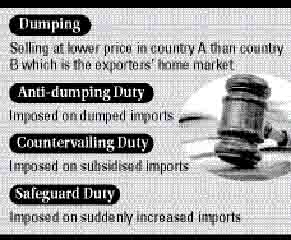
In fact, the anti-dumping duty can be imposed only on proper investigation and on finding a causal linkage of dumping with the damage to local manufacturers. To be precise, dumping means selling a product to one country at a price less than that prevailing in the country of origin.
Mr Ahmed also pointed out that there was no legal protection to keep the information, furnished by the producers for investigation, secret. "If tax authority or any other government agency has got the information from the tariff commission, they may harass the firm or industry concerned," he added.
"A legal provision must be there to keep any information, acquired for investigation, secret and non-transferable to any other authority."
In this regard, BTC chairman Dr Rahman told the FE that they were working on revising the tariff commission act and such a legal provision would be included there.
As it takes six to nine months for investigating damage caused by abnormal import hike, dumping or subsidised import, local firms and companies find it easier to lobby with the NBR for imposing or increasing regulatory and supplementary duties on the products.
"But, neither supplementary nor regulatory duty can be a long-term protection for local industries," said Mr Ahmed. "On the other hand, no trade remedial measure will be effective as long as mis-pricing and fraudulence in imports are there."
According to WTO statistics, some 2,966 anti-dumping measures have taken by 98 member countries as of June 30, 2014 China, Japan, South Korea, USA, Indonesia and India are the major countries take these measures.
asjadulk@gmail.com