
Lack of preventive measures worsening dengue situation
Tuesday, 4 July 2023
SAIF UDDIN
Dengue situation is worsening in the capital as elsewhere in the country - mainly due to absence of time-befitting preventive measures by the authorities concerned.
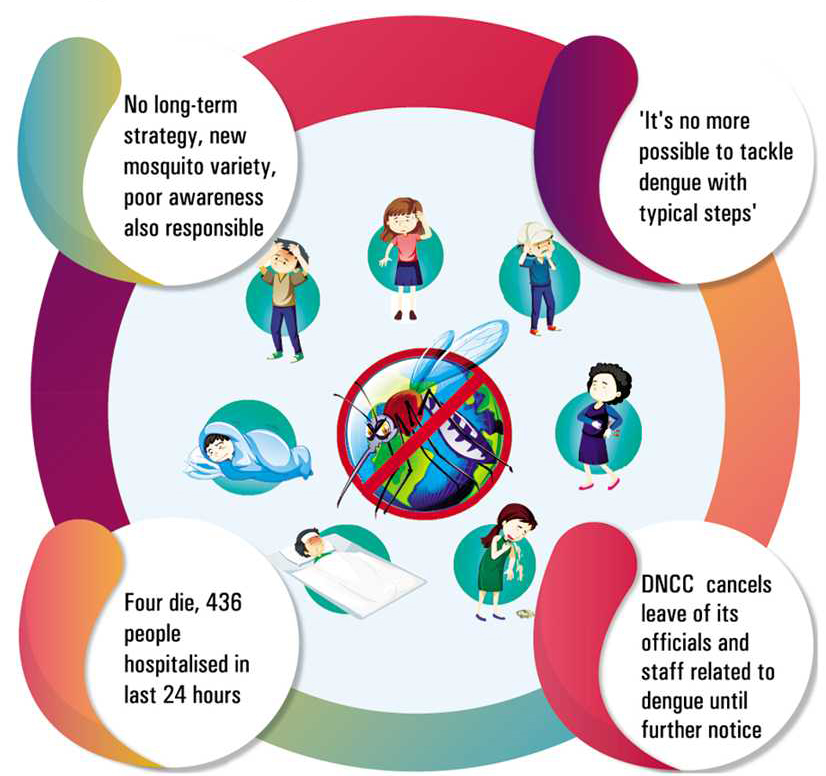
Besides, lack of a long-term comprehensive strategy, emergence of new mosquito variety, and poor awareness among mass people are also responsible for the situation, experts have said.
According to them, with the peak of monsoon following the recent heavy rainfall - which usually creates more mosquito breeding grounds, the number of infections could rise further in the coming days.
Four dengue patients died and 436 people were hospitalised with the mosquito-borne disease in the last 24 hours until Monday morning.
With the latest daily counts, the number of death toll and dengue-positive patients reached 56 and 9,193 respectively in this calendar year.
Of the new patients, 174 were reported in Dhaka city and 262 outside the capital, indicating prevalence of the disease in other districts also.
Dhaka division - excluding the capital city - reported 64 patients, Chattogram 101, Barishal 50, Khulna 19, Mymensingh 10, Rangpur 10, Sylhet seven, and Rajshahi one patient in the last 24 hours.
In last week - until Monday morning, 11 people died of the disease, while nine people died in the previous week.
According to officials, both the Dhaka city corporations are implementing a wide range of programmes including fogging, conducting drives against people responsible for larvae breeding, and launching anti-mosquito awareness campaigns to help check mosquito menace.
As a special measure, the Dhaka North City Corporation (DNCC) on Monday cancelled leave of its officials and staff related with dengue and water-logging prevention until further notice. The DNCC issued an office circular following a meeting on the day, a statement said.
DNCC Mayor Atiqul Islam said along with the authority, the city dwellers have to play their respective role to check the dengue outbreak.
"Aedes develops in stagnant water. It must be ensured that no water gets accumulated in any container inside the house, on the roof, and on the balcony," he told the meeting.
Dr. Mohammad Mushtuq Husain, Adviser to the Institute of Epidemiology Disease Control and Research (IEDCR), said it is no more possible to tackle the dengue situation with the typical measures of using mosquito repellent, as the disease has widely spread across the country.
"The city authorities have to take novel measures, making the best use of their resources to tackle the mosquito menace." Due to lesser cold in winter and additional heat in summer, Aedes spread across the country, while a new variant is playing a part in the outbreak. People not only in the cities but also in the rural areas should be aware of the disease, he also said.
"There are huge sources of stagnated clean water in residences and construction sites, which are ideal mosquito breeding grounds."
The impact of recent downpour and people's movement to various destinations across the country would be perceived later, opined the public health expert.
He suggested taking long-term measures to contain dengue outbreak, as the disease is occurring more frequently than ever. As an immediate measure, the government could establish field hospitals and testing facilities in every ward of the city, like community clinics in rural areas.
"Keeping an infected patient within a mosquito-net in a field hospital can significantly reduce the chances of new infection," he added.
Experts suggested rapid testing and hospitalisation of the patients, who expose symptoms of the disease, to help reduce their risk.
saif.febd@gmail.com