
Learning at primary level has to be humane
Syed Fattahul Alim | Monday, 11 May 2026
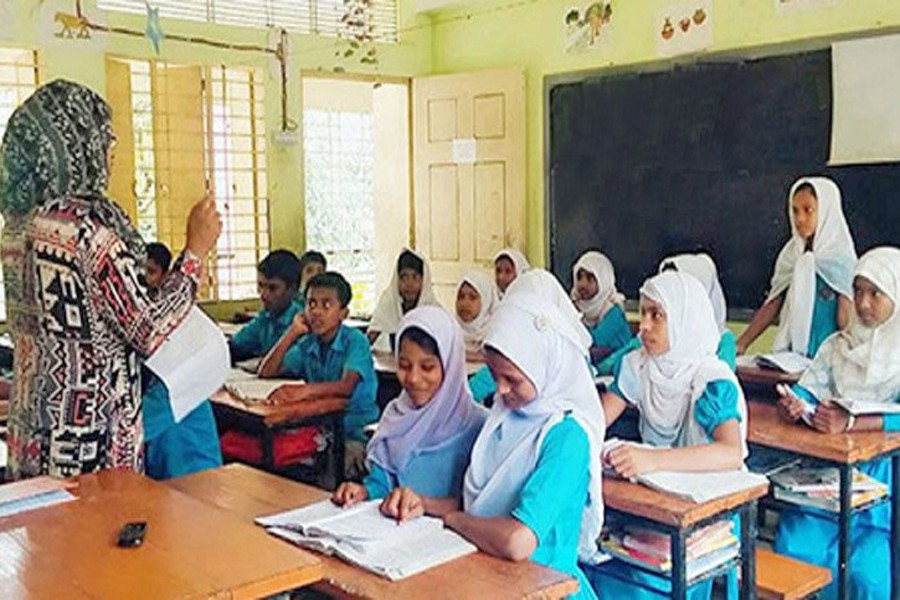
The results of a study conducted by UNICEF Bangladesh and UNICEF Office of Research -- Innocenti, on classroom learning in Bangladesh unveiled last week in the city showed that students from the primary level entering the secondary education in schools lack basic foundational skills. In other words, 91 per cent of the primary level (Grade 5) students graduating to secondary level could not correctly answer half of the Garde 5-level mathematics questions. Similarly, 65 per cent of those students did equally badly in Bangla. Numerous studies including the one started in early 2024 styled, 'Learners Enhancement Strategy (LES) by the UNICEF Bangladesh' in partnership with the Directorate of Secondary and Higher Education applied the LES at pilot level in selected schools to identify the severe foundational learning gaps among students at the start of the secondary schools (Grade 6).
But this is all about detecting the learning gaps among Grade 5 students. In fact, teachers at schools already knew that. Now, from the result of expensive studies we come to know the same truth though with some quantitative dimensions. That no doubt sheds some fresh light on the issue. But the question is: how are the policymakers going to reduce the learning gaps of Grade 5 students drastically? Education minister, ANM Ehsanul Hoque Milon, who spoke at the unveiling event of UNICEF findings also echoed a similar view of addressing the dismal performance of Grade 5 students entering secondary level. He rightly stressed that the responsibility of addressing the issue lies, alongside teachers, also with the policymakers, field administration and education administration and assured that the government would be making record investment in the Fifth Primary Education Development Programme for the purpose. So far so good. There is no question that investing sufficient amount of fund for education at the primary level is the imperative. At the same time, it is also important to home in on the real problem ailing education at the primary level at the government-run schools.
The overall system as well as environment of learning at the public primary schools in Bangladesh is not student-friendly. And such state of learning at the basic level in this part of the world is also not something of recent origin. True, successive governments increased the number of schools, added infrastructures and increased funds but the quality of education never improved. How do we quantify improvement when talking about education in general and, in the present case, at the primary level in particular? Obviously, it is from the performance of students, first, in the school final examinations at the primary level and then from the public examinations at the end of the secondary level education. Notably, there was also a system of Primary Education Completion (PEC) test that was in force between 2009 and 2021(the PEC exams for 2020 and 2021were not held due to Covid-19 pandemic). It was a centralized national public exam held at the end of the fifth year to assess competence of students, but was scrapped in 2022 amid criticism of the system for the enormous pressure it put on students at such a tender age. But the very basis of summative tests to assess competency of a student at the end of a certain period of her/his schooling is inherently flawed. For if a student fails to perform well even in a single test on a particular subject for any reason -- health-related, familial or any other reason that is beyond the particular examinee's control -- her/his overall assessment for the entire period of learning is negatively affected. For examinees who completed the summative tests smoothly, in their case, too their result may not reflect their actual level of competency.
Many factors come in the way to prejudice their final assessment, the most important among those being anonymity -- both the examinee and examiner remain anonymous to each other. It is argued that anonymity can avoid bias and thereby ensure impartiality of the system. But can it do justice to a learner's competency level gained, say, in a particular subject, over a number of years' classroom instructions? While assessing the competence of students, such summative tests fail to take into considerations the individual needs or situations of learners. But such needs of a learners can be well addressed by teachers who know students intimately from their performance in the classroom during the entire period of their teaching experience at schools. So, the emphasis should be on classroom learning and the assessments based on that through tests held from time to time in classes. In that case, the teachers have to be dedicated, qualified and well-paid. But none of these conditions are met in our schools. As a result, classroom instructions are gradually losing their relevance particularly in case of primary education. The general assumption is that pre-primary and primary school teachers need not be well qualified.
As a consequence, they are also not well-paid. But learners need their best attention during the formative years and that is only possible if a teachers is well trained to meet such needs which involve a combination of knowledge, method of teaching and child psychology. The question may arise if it is not a tall order to achieve for schools at primary level, especially in the poverty-stricken areas in both the rural and urban contexts where the students coming from underprivileged backgrounds have special needs including financial, nutritional as well as other ones to meet. That is important if those students are to be retained in their classes over the long haul. No doubt that is an enormous challenge and the government have to find ways to address that. For instance, the government has huge amounts of funds (14.78 per cent of the budget) to support the old and other vulnerable segments of the population, whereas for primary and mass education, the allocation is only 4.48 per cent of the budget in FY26. Shouldn't the government, in that case, dedicate a still larger portion of the national budget, if necessary, through doing some adjustment and readjustments, to invest in the future of the nation? For setting the nation's priorities right is urgent when allocating public resources. It is not being said here that the fiscal resources should not serve the vulnerable section of the population. Not in the least. On the contrary, the point being stressed here is that the educational needs of the children from the poor families in the primary schools at least demand an equal, if not more, attention from policymakers.
However, not less important than the fund is the need for an appropriate education policy at the pre-primary and primary level where the curriculum and teaching methodology must undergo a qualitative change. The education system at the primary level should come out of the culture of age-old rote learning and grammar-based language learning introduced in British India since mid-nineteenth century (since 1830s to be specific). Essentially, our education system, especially at the primary and secondary levels has still remained there as though frozen in time. The system is boring and punishing for learners. Small wonder that in some cases, corporeal punishment exists as a way of keeping schoolchildren attentive to their classes.
So, the task before policymakers and educationists is to change the system of education lock, stock and barrel in order to make it more humane and sensitive to the individual needs of students.
sfalim.ds@gmail.com