
Learning how to effectively manage landslides
Farid Hasan Ahmed | Tuesday, 25 August 2015
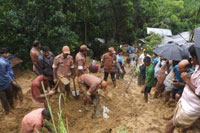
Landslide is a geological hazard in Bangladesh, particularly in the South-eastern part of the country. The Bay of Bengal part of southwest monsoon flows over the Bay heading towards northeast India and Bengal, picking up more moisture from the Bay of Bengal from June through September. The winds arrive at the Eastern Himalayas with large amounts of rain. Bangladesh and certain regions of India frequently experience heavy rains during this season. Most of the landslides happen after heavy rainfall. In recent times landslides have increased both in frequency and intensity, causing widespread loss and damage to life, infrastructure, asset and property and posing serious challenges to existing development process. This increase has been prompted by a blend of several elements (morphometric, climatic and anthropogenic) that primarily or secondarily cause slope instability, most of which are human induced. The landslide of 11 June 2007 caused death to 135 people, affecting 1.5 million people of the region.
In 2015, heavy floods and landslides occurred during the last week of June in the districts of Chittagong, Bandarban and Cox's Bazar of Bangladesh. A second period of heavy rain followed from 22-27 July and caused new floods, landslides and further displacements. The secondary effect of cyclone "Komen" was again heavy rainfall, causing additional landslides and flooding, which extended to all the coastal regions. Comprehensive action is very much needed to reduce the risks of landslide through better knowledge and enhanced levels of understanding of the hazards and its management.
In Chittagong region, many aspects of vulnerability to landslide hazards are observed, arising from various physical, social, economic, political and environmental factors. Vulnerability varies significantly within a community and over time. Comprehensive and well-coordinated state-led actions are needed for a sustainable landslide hazard management for Bangladesh and its people.
This hazard could be managed by controlling the grabbing of government owned lands and by understanding the rainfall pattern and its exact relationship with landslide in the region. Detailed land use planning of the vulnerable areas, a landslide database, landslide mapping and geophysical analysis of the region is essential to minimize landslides and its impacts in the region. Bangladesh with her huge population, are bound to live in hills. So it is obligatory upon authorities to orient people on how to live in the hills. There should be proper attention to manage hills, secure hills against land slide, control land slide through proper drainage, protection, soil conservation, watershed management, etc. The vulnerable people and their associate service providers need to be encouraged to learn how to live and provide services in the hills without risk.
Early warning system should be strengthened, with active participation of community leaders. Proper linkage among Bangladesh Metrological Department, community-based organisations, civil defence wing and local government authority should get regular data relevant to the area, as soon as the rain/monsoon sets in; selected and interested persons of vulnerable community might be involved in sharing the same with the community at large to assist in their alertness and over-all preparation. The local NGOs' direct intervention in conjunction with local government might be encouraged in this respect. Existing cross-departmental coordination and cooperation on landslide management should be reviewed and strengthened with necessary resources.
Contingency planning at different levels for emergency response should be developed and updated at least once a year, focusing on (i) risk area and vulnerability status and (ii) availability of resources and capacity, apart from other requisite elements that feature in such a plan.
Capacity building courses on Landslide Hazard Management is needed after a proper gap analysis and planning for volunteers, managers, workers, government officials, local government representatives and media personnel of vulnerable districts, of whom 50 per cent should be women. Specialised training sessions is needed for relevant personnel on the respective areas.
Landslide mitigation refers to lessening the effect of landslides by taking various projects at vulnerable slopes. Appropriate feasibility study, along with assessment of risk, uncertainty, possible consequences, constructability, environmental impacts and cost-benefit analysis by independent authorities is very much needed for any mitigation measures. A public hearing and consultation is important in this regard. The maintenance requirements associated with each risk-lessening option should be considered to understand the potential long-term effects and costs.
The Disaster Management Act and the Standing Orders on Disasters (SOD) of the Government of Bangladesh should be understood and implemented by all concerned with appropriate resources, planning, and monitoring and accountability mechanism.
The risks of landslides is one of the consequences of the incapability of political and administrative authorities to manage urban expansion. Consequently, the risks facing the urban poor remain unaddressed or partially addressed by relevant agencies. Measures to reduce landslide risks need to be integrated into area planning. In this regard, actors, including the government and local government authorities, private sector, NGOs and individuals have particular roles to play for ensuring compliance with land use and relevant policies and procedures, so that landslide risks are addressed when infrastructure projects are constructed on hillsides.
It has been observed that mainly the poor people, who cannot afford an alternative safer place to stay, live in the landslide-prone areas. Therefore, addressing poverty of the people should be considered as a priority for reducing their landslide-related risk and vulnerability.
Integrating landslide risk reduction in existing development works and future initiatives of different government departments and others working in the area is a must. Concerned authorities should develop database which is very important to carry out detailed study and planning. Government organisations and NGOs need to redesign their development programmes with the active participation of the most vulnerable communities to ensure that they maximise hazard mitigation potential and incorporate traditional community coping practices. Proper resources from the central government and development partners should be ensured by authorities and policy makers.
Special laws and regulations are required to protect the hills. Well-defined rules and conditions need to be followed during construction of any structure and any other development work. Politically and socially empowered people of society in conjunction with corrupt officials are involved with hill grabbing and cutting in Bangladesh, violating existing rules and regulations. Legal instruments should be in place and the enforcement of the existing rules should be ensured to keep hill risk-free.
China, Philippines, India, Indonesia, Nepal, Japan and USA manage incidents of landslide frequently. Sharing knowledge and cooperation with these countries could enhance the capacity of Bangladesh to manage landslides risks and related crises.
The writer is a Disaster Risk Reduction/ Climate Change Adaptation Expert, a development lawyer and a fellow of EPFL, Switzerland
farid.hasan2008@gmail.com