
Learning how to speak English
Amin Rahman | Sunday, 6 April 2014
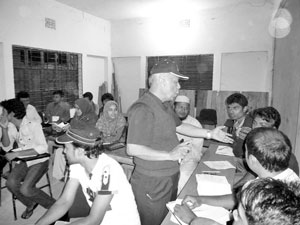
In October 2012, my wife and I went to Ghorashal where I was to teach English pronunciation to about 50 senior students of Janata Jute Mills Bidyapith, two hours daily, for 10 days. The course was organised by Mr. Obaidur Rahman, then Senior English Teacher of Ghorashal Pilot High School.
On my arrival at Janata Jute Mills I was received by the Manager of the Mill, the school's Head Teacher, the English Teacher, and Obaidur Rahman. The latter told me that in his village he had organised and had been managing a youth club, called Tarunno. The club was formed to teach its members English and other skills like using computers. He requested me to teach the club members, Spoken English in the evenings. The members comprised high school, undergraduate and post graduate students, as well as some technicians, and teachers working in Ghorashal. Their age ranged from 16 to 30.
As I was to be in Ghorashal for two weeks only I told Obaidur Rahman that my teaching Spoken English for such a short time would have little effect. However, I finally agreed to spend two hours each evening at Tarunno. Obaid organised the venue in a room in a Higher Secondary College through the college's English teacher, Professor Anisur Rahman.
On the very first meeting I told the 10 youths, Obaidur Rahman, and Professor Anisur Rhaman, that I WAS NOT A MAGICIAN and had no Aladdin's lamp. I could not teach them what they could not learn in 12 to 16 years of their student life. I would spend two hours each evening to chat, sing and discuss with them anything and everything, all in English, as if we were in an English speaking country where people did not understand and speak any other language. I also told them that everybody had to be an active participant. One should not come to these sessions just to listen and sit through the two hours. If anybody did not like the sessions they could stop coming.
I started by first trying to assess each individual's current skill level in Spoken English. I asked them questions in English, which they had to answer in English. Then, one by one, I asked each person to come to the front and say a few words in English. I told them that they did not have to speak grammatically correct English.
As expected, it took people time to get used to first answering in English and then talking before others. When a person's turn came to give a mini-speech he/she was not allowed to go back to the seat until he/she had uttered at least one English word! I did not expect a hundred percent success rate and I was right. One person simply would not open his mouth. He did not turn up the next day. This loss was compensated by more people, friends of the original attendees, joining in the following days. The final number was 16.
During the daily question and answer sessions, once I happened to casually ask someone what languages he knew. He said Bangla and Hindi/Urdu. That took me by surprise. I asked the rest of the participants how many knew Hindi/Urdu. Everyone raised their hands. My curiosity grew. I asked them how they had learned this foreign language. Was it part of their curriculum at school? They said that they learned it by watching Hindi and Urdu films. I was further intrigued. My next question to them was how many such films they had seen. Was it about 50 or a few hundred? They said that the number would be several thousand!
That made me wonder and ponder. I started thinking how and when I had started speaking English. Digging deep into my archival memory it came to me that while at university, my friends and I watched English movies every Sunday morning. We also saw English movies at mid day (1:15 pm) shows. These were mainly in the three cinema houses-Gulistan, Naz and Balaka, near our university dorms. Sometimes we also went to distant halls like Madhumita, Azad, Rupmahal, when they were screening English movies. So, in a year, we saw approximately 100 movies. In four years we had seen about 400 and when the TV transmission started in Dhaka we saw plenty of good English serials like Dr. Kildare, Dr. Who etc. Ureka! I had solved the puzzle. That is how we became fluent English speakers.
At the cinemans, we sat in the "rear stall", which cost Tk 1.15 per ticket. Adding to that the cost of some snacks we purchased, during the intermission, for four annas (25 paisas) each, we spent about Tk 1.50 per visit to the cinemas or Taka 150 to 200 in a year or Taka 600 to Taka 800 in four years and learned to speak English. Think of it, now it was money very well spent, whatever our guardians thought of it at the time.
For the rest of the sessions, I told the participants to watch at least one English film or TV programme each night and talk about it the next evening. These sessions were a lot of fun. After the last session the participants invited my wife and me to a farewell function. In this session, each and every member gave a mini speech in English. They also sang some English songs as well as the regional translation, which they had jointly done, of the famous duet "There is a hole in the bucket, Dear Liza", which was hilarious. The males took the part of Henry and the three females acted the part of Liza!
So my advice to all, students, professionals and technicians who want to learn how to speak in English, is to follow this simple and inexpensive technique. Learn English while having a good time and without struggling or bringing tears to your eyes. See as many good English films as you can and watch good English programmes on TV. If you do this regularly, i.e., watch five to ten movies a week, after one year both you and others are bound to note some changes in you. You will understand English easily. English words and phrases will come out of you automatically. If you like a particular movie, watch it more than once. You will soon notice that you know by heart some interesting and favourite dialogues. During your conversations with others, unknowingly you will be using many of the new English words, phrases, that you will come across and learn while watching English films and programmes on the TV.
However, to learn English this way you will need to be determined and disciplined, particularly in the beginning. Soon you will feel close to this language and enjoy hearing English speech even if you do not understand all the words and phrases. A time may come when you will start dreaming in English. That is when your new journey to the vast land of knowledge will start. In this journey you will use "English as a vehicle" to take you to many new distant places where you will learn many things and subjects and meet many people. This journey is never ending. The interesting thing about undertaking this journey is that it will be free and the vehicle with which you will move around in this journey will never run out of fuel!
The writer, a BUET graduate, has a working background in Demography, ICT and Management. He retired in 2003 and since 2010 has been researching independently in Applied Linguistics from Melbourne, Australia, where he lives. He can be contacted by email at aminrahman43@gmail.com