
Legal reforms, subsidies vital for climate risk insurance
Says IDRA chairman
FE REPORT | Tuesday, 23 December 2025
Bangladesh faces significant challenges in introducing climate risk insurance despite being one of the world's most climate-vulnerable countries, speakers said at a workshop in the capital on Monday.
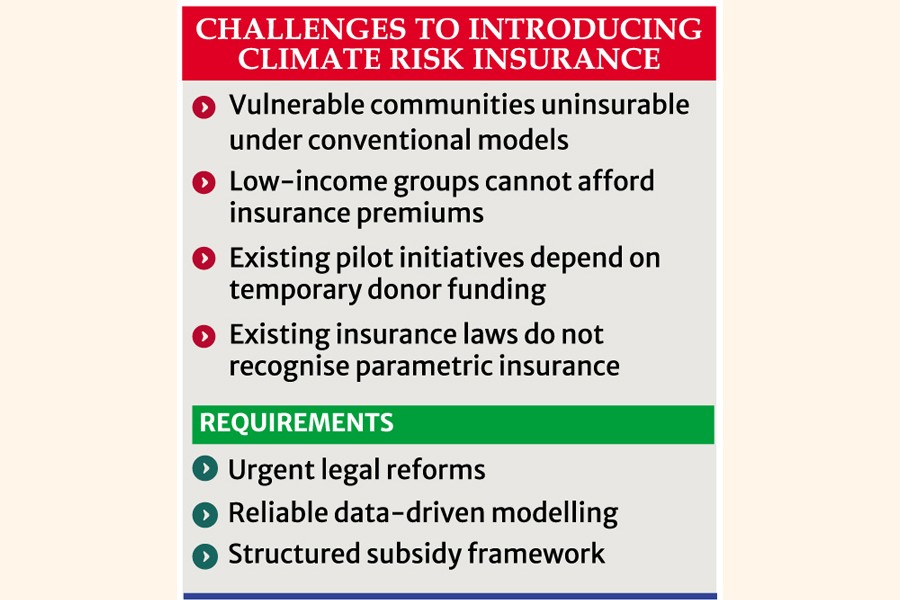
Chairman of the Insurance Development and Regulatory Authority (IDRA) Dr M Aslam Alam said the sustainable implementation of climate risk insurance required urgent legal reforms, reliable data-driven modelling, and a structured subsidy framework.
He made the remarks while speaking as the chief guest at the workshop titled "Enhancing Media Capacity on Climate Risk Insurance".
The event was jointly organised by the Economic Reporters Forum (ERF), Oxfam Bangladesh, and the World Food Programme (WFP) at the ERF Auditorium.
Dr Alam said rising temperatures and the near-disappearance of winter - now lasting barely two weeks - were having severe impacts on agriculture, livelihoods, and public health, creating multiple climate-related risks.
He described climate risk insurance as a key tool for reducing these risks, particularly for vulnerable communities, but noted that the sector faced serious structural and operational barriers.
One major challenge, he said, was the "insurability" of communities living outside embankments or on riverine chars and facing disasters almost every year, making them uninsurable under conventional insurance models.
"If a family or household is affected every year, they become uninsurable, as insurance companies cannot sustain continuous payouts without becoming insolvent," he said, adding that such high-risk groups were better supported through government-led social protection and safety net programmes rather than commercial insurance.
Another key issue was affordability. While middle- and high-income groups could afford insurance premiums, low-income households, most vulnerable to climate shocks, could not, he also said.
Dr Alam noted that existing pilot initiatives, including the Jamuna River Sustainable Management Project, largely depended on temporary donor funding from agencies such as the World Bank and the WFP.
"Once foreign funding ends, pilot projects often collapse," he warned, stressing the need for long-term government subsidies to make climate risk insurance sustainable.
However, he acknowledged resistance from some ministries, particularly agriculture, which preferred direct input subsidies, such as seeds, fertilisers, and electricity, over premium support for insurance schemes.
He said traditional insurance models relied on historical data, whereas climate risks were forward-looking and constantly evolving, making actuarial assessments difficult.
To address issues such as moral hazard, the global insurance industry was increasingly shifting towards parametric or weather index-based insurance, where payouts were triggered automatically when predefined thresholds, such as river water levels or wind speeds, were exceeded.
"However, our existing insurance laws do not formally recognise parametric insurance. Comprehensive legal reforms are needed to give these products official status," Dr Alam said.
He said the IDRA had initiated steps to address these gaps, including amending the Insurance Act to include parametric insurance, developing a micro-insurance regulatory framework with the United Nations Development Programme (UNDP), and preparing climate risk insurance guidelines with the WFP.
The IDRA was also working on building a nationwide climate data system in collaboration with the Bangladesh Meteorological Department (BMD), Flood Forecasting and Warning Centre (FFWC), and the Institute of Water Modelling (IWM), while strengthening insurers' technical capacity and reinsurance mechanisms with Sadharan Bima Corporation, he further said.
Dr Alam stressed that effective climate risk insurance required coordinated action among multiple ministries and agencies, including those responsible for agriculture, disaster management, fisheries, and livestock.
Executive Director of the Bangladesh Bank Husne Ara Shikha said the central bank was implementing three projects to enhance climate resilience, including a requirement that 35 per cent of green financing be allocated for climate-resilient projects, with 5 per cent reserved for women entrepreneurs.
Dr Mohammad Emran Hasan, head of climate justice at Oxfam Bangladesh, said Bangladesh could mobilise resources from the Climate Trust Fund to finance climate insurance.
He cautioned that reinsurance arrangements should involve local entities to prevent excessive outflows of insurance funds abroad.
Norul Amin, programme policy officer for climate risk insurance at WFP Bangladesh, said the WFP had introduced cash support under disaster risk reduction and recovery assistance to mitigate losses and ensure food security.
"Insurance can play a critical role in early recovery after disasters," he said, adding that index-based climate insurance had been piloted in two unions of the Kurigram district, while agricultural climate insurance introduced in 2022 had shown encouraging results.
Nafisa Tasnim Khan, senior programme officer at Oxfam Bangladesh, said cooperative-based insurance models might be more effective in disaster-prone areas, as conventional insurance struggled under repeated shocks.
She also pointed out that a 15 per cent VAT on insurance premiums further increased costs for low-income households.
ERF President Doulot Akter Mala; ERF Secretary Abul Kashem; Prothom Alo special correspondent Fakhrul Islam; and Head of Influencing, Communications, Advocacy, and Media at Oxfam Bangladesh Md Sariful Islam also spoke at the event.
newsmanjasi@gmail.com