
Let women\\\'s inhibition of driving fade
Kritika Kumary | Sunday, 7 December 2014
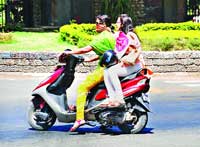
How often do you spot a woman in a driving seat, amidst a myriad of vehicles plying in Dhaka City? Only rarely does one get to see a woman driving. Does it not surprise you that only 12,455 driving licences are being issued to women against half a million (500,000) for men? To sound wailing alarms in feminists' minds, only 300 professional women drivers are present against 2.4 million males estimated by 2012.
Unlike Saudi Arabia, women in Bangladesh are not legally prohibited from driving, yet driving for women here, largely remained a "forbidden territory." Even Women from upper class families, who are able to afford a private car and are educated, have been slow to undertake driving as a routine. That the commoners in the fair sex are driving cars hardly arise at all. Even getting used to a cheap and convenient two-wheeler is a rare phenomenon.
In the 21st century, while living in a country where the public transportation is in moribund state, it is imperative to be well acquainted with driving skills. Inability to drive makes anyone --men or women --dependent but being a woman and deciding not to drive make her twice as more dependent on others than her male counterpart. A woman who knows how to drive makes her independent of availability or not of a driver or a male counterpart. A woman's familiarity with driving gives her self-confidence and reiterates that a woman is capable of steering herself not only on the roads, but if needed, in life. It further affirms public places are not "For Men Only". Besides more cohort women drivers will blur the stereotypical line between what women can do and what they cannot. Women acquiring driving skills will be an answer to the prejudice held that they can't drive and are bad drivers. Scientific studies have already proved women to be prudent drivers and less likely to run into accidents than men. Regular driving in and out of the city keeps women abreast with the world around and helps in personal development. Importantly, driving better equips a woman for emergency situation when she doesn't have anyone to assist her, but herself. Alacrity of women to act in such a situation is evidence enough of women's independence and courage.
In many parts of South Asia where women's independence and confidence still induce fear and insecurity, it is not a surprise that in Bangladesh women are somewhat stigmatized for driving. The active presence of women in public sphere is dealt with the label of a taboo, and women hold back themselves with the intention of preserving whims and values of the family or accepting driving is not their cup of tea. Women in Bangladesh, however, have actively come up in public and private sphere. This is appreciable. Yet women's absence in driving culture gives us insights into the deeper issues of gender gap which do not come up readily. It reveals the prevalent mindset of society, which is yet to gain conviction that 'women are equal to men', even when significant numbers of women are engaged in gainful employment. A grave mistrust prevails to the effect, no matter how successful a woman is, that she needs to be taken care of. This perception has to be surpassed and actively fought. The media have an inevitable role in normalizing women driving. Today, most of the entertainment sources and advertisement for vehicles mostly romanticize men in the driving seats. The media have to change the men-centric approach to its consumers to further expanding the automobile market to women and mobilising social awareness for a change in favour of women.
Secondly, the government and non-profit organisations can catalyse women driving culture by running campaigns and supporting women to learn how to drive. The BRTA and the BRAC since 2012 have introduced programmes to help women become professional drivers. By 2013 around 600 women were said to have qualified and some of them moved on to have job. Concurrently, the government introduced 15 per cent jobs for professional female drivers, which sadly remains unfulfilled.
More women in driving seats will also form another strong interest group for pressuring the government to treat the miserable condition of infrastructure and road.
Yet, change has to start from each one of the citizens. Women should get over their fears and take to driving. Even if they don't have a private vehicle, taking lessons wouldn't harm. It is a skill and what is learnt is never wasted. Families should actively encourage female members to drive. Sure enough, the safety issues that concern dear parents matter but even walking on a road or sitting at the back of the car do not insulate anyone from accidents. Risks and threats are omnipresent; all one needs is to fight and win over those, not run away. More women habituated to driving will normalize women's active presence in public spaces that further reduces the perceptible disparity between the genders. Helping women drive can be a tool to bring the secluded byways of female independence and freedom by amplifying self-esteem and boosting individuality. Importantly, this will help to shatter the perception of society that women always need to be taken care of by men in the public domains. At the same time it will elevate the cosmopolitan image of strong women.
email :kumary.kritika@auw.edu.bd