
Light engineering sector needs skilled manpower, adequate funds to grow
Mohammad Wazed Ali | Saturday, 1 April 2017
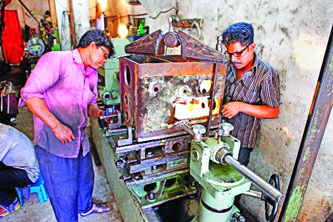
Several factors including lack of state-of-the-art technology, shortage of skilled manpower and inadequate funds are holding back the growth of the country's light engineering sector, insiders have said.
Besides, lack of required government policy support, separate industrial parks and necessary infrastructures are responsible for slow growth of the sector despite having immense potential in both local and international market, according to them.
"We believe the sector can make a significant contribution to the country's economic growth if required facilities and government's policy support can be ensured as the demand for light engineering products has been increasing," said Md Abdur Razzak, president of Bangladesh Engineering Industry Owners Association (BEIOA).
He said there are more than 40,000 small light engineering enterprises in the country which produce various items including a wide range of spare parts, castings, moulds and dice, oil and gas pipeline fittings, light machinery, small tools, toys, consumer items, and paper products.
After meeting local demand, he said, they can export light engineering products if they get technological and financial support, trained manpower and planned industrial parks.
"We have been seeking such facilities for a long time, but we have got very trivial support from the government," he added.
Mr Razzak said the government has recently allocated 25 acres of land for them in Munshiganj district to build an industrial park for such enterprises.
"Though we need more space, it will be a starting process to promote the sector," he added.
As shortage of skilled manpower the sector is facing, he said, the government in cooperation with Asian Development Bank (ADB) and Switzerland government took up a project in 2015 to impart training to 9,240 youths of the country on light engineering.
Mr Razzak said the project will be completed this year where trainees are given monthly allowance and job guarantee after successful completion of training course. It will help meet the demand for skilled manpower in future, he added.
According to an internal survey of the industry, around 400,000 workers are involved with the sector and most of them lack skills.
Mr Razzak also urged the government to ensure easy access of finance to such small-scale entrepreneurs, mainly long-term collateral-free loan and flexibility in interest rate.
Its export receipt has been fluctuating over the years, according to a statement of the country's export promotion agency.
According to Export Promotion Bureau (EPB), the sector fetched US$ 365.70 million in the fiscal year (FY) 2015-16 while $ 447.04 million in FY 2014-15.
Export receipts of the sector were $ 376 million, $ 367. 47 million and $ 366.63 million in FY 2011-12, 2012-13 and FY 2013-14 respectively, EPB data shows.
On the other hand, domestic market did not expand as expected because many now depend on import of the same products mainly from China, Japan, India and Taiwan, sectors insiders have said.
Mr Razzak said the government should form a panel with all stakeholders now importing such products from abroad and people involved with light engineering industry to produce specified products and reduce dependency on import.
"I think such an initiative will help produce high-value products and fast-moving replacement parts in the country," he added.
Talking to the FE, Mohammad Masum Talukder, working as a consultant for the sector, said potentials of the sector still remain fully untapped but it should be nurtured for manufacturing import substitute products for local market and export-oriented products as well.
He said local companies are importing various products which can be produced in the country if required supports can be provided.
"Apart from the government, I think importers of such products should give their hand to the country's enterprises to produce quality products," he added.
He said the global market of light engineering products is around US$ 1.0 trillion where Bangladesh has an insignificant share.
"Policy support and necessary initiatives can boost exports and help hold a share in the lucrative global market," he added.
Around Tk 2000 crore (US$ 285 million) investment has been made in the sector. Currently, about 10,000 types of quality machinery, spares and accessories are being manufactured in the sector. The sector contributes around 2.0 per cent to the country's Gross Domestic Product (GDP), according to a statement of BEIOA.
wazeddu@yahoo.com