
THE EPIC OF AN ELEVATED
Lofty goal of leapfrogging Dhaka's nagging traffic jam goes unfulfilled
MUNIMA SULTANA | Friday, 3 April 2026
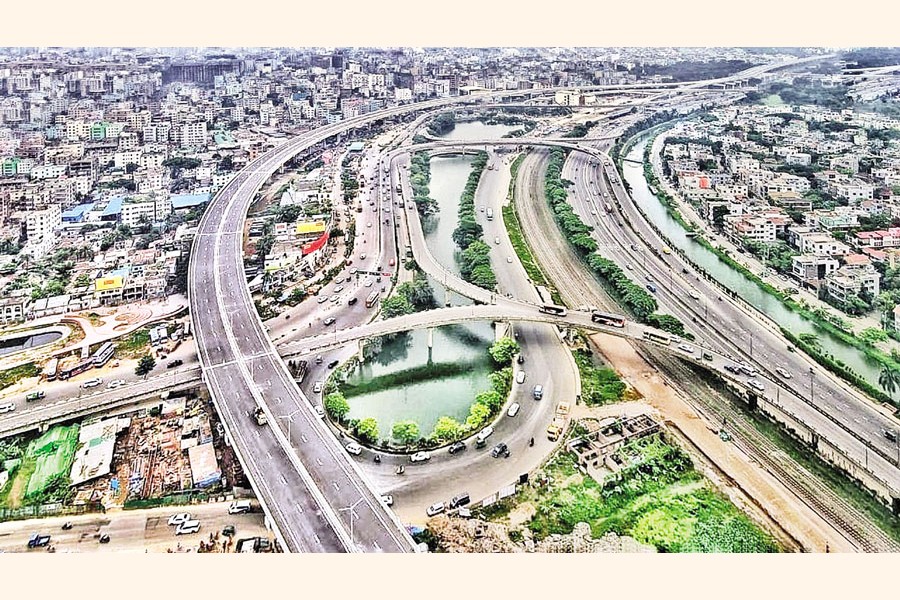
Fifteen years have elapsed since the launch of its works but Dhaka Elevated Expressway (DEE) still lies incomplete and eventually fails the mission of Bangladesh's maiden infrastructure megaproject under public-private partnership (PPP) meant to mitigate the crammed city's traffic congestion.
Analysts concerned also say the PPP model to construct, operate, manage and hand over the communications infrastructure to the government also takes a knock as the foreign private partner of the project earns revenue partially while ending one-fifth of the 25-year concessionaire period for failure to ready the entire 19.7-kilometre elevated and access-control highway across the capital city. Two Chinese companies now own the company named Dhaka First Elevated Expressway Company Limited after buying 99-percent share from the project's original Thai partner. The two compatriots get, on average, 60,000 vehicles with an earning of Tk 150 million a month.
The private partners have been enjoying partial tolls during the last two and a half years after the Awami League government "forcibly" opened an 11.5-km patch from Hazrat Shahjalal International Airport (HSIA) to Farmgate in breach of the financial model of 25 years.
Although the project's early challenges, particularly those related to securing reliable investors and adequate funding, were resolved more than five years ago, sources say, "uncertainty still looms in the project over completing 8.2km elevated infrastructure for a lack of confidence by the investors as well as implementing agencies".
Sources have said the Chinese companies have yet to gain the confidence to accelerate its work on the remaining infrastructure as legal complications centering around developing structure in Hatirjheel and Panthokunjo were not all over.
Besides, they are yet to understand the new government's stand on the PPP project as the DEE was totally stalled during the interim government's tenure because of its ownership by the Awami League government as a priority project.
Bangladesh Bridges Authority (BBA) signed the initial concession agreement with a Thai company in January 2011. Under the deal, the investor was supposed to construct the 19.7- kilometre expressway within three and a half years under its 25 years of ownership.
However, due to revision of the contract for change in DEE alignment end of 2013 as well as failure of the Thai company -- Italian-Thai Development Public Company Limited (ITD) -- to manage funds for investment afterwards, the concessionary period of the PPP project eventually began on January 1, 2020.
The ITD futurities sold almost half its shares to China Shandong International Economic & Technical Cooperation Group Ltd (CSI) and Sinohydro Corporation Limited having failed to mobilise the required construction cost of around US$1.2 billion till 2019.
The two Chinese companies later acquired 99-percent stake from the ITD as it failed to pay interest on its loan borrowed from Chinese banks.
However, the BBA's project office claims that the work is progressing at full pace, with a target to complete the remaining section by December next.
According to BBA data, overall construction progress is 79 per cent.
"We want to complete the rest of the works by December and have been directing the concessionaire accordingly, as there are no major problems in the project," Project Director AHMS Akhtar told the FE.
He also said the Chinese companies have resumed work on both sides of Hatirjheel at Moghbazar and Panthokunjo after the status quo given by the High Court on its writ.
But insiders say the BBA has been pressuring the private partners to complete the works, as the tenure of the Tk 3.4-billion DEE Support Project is set to expire next December and it is still uncertain its further extension revision so far two times.
They say the BBA is also in doubt about the project's extension by observing overall situation though its extension is needed to continue the rest of the construction which may take more than a year.
The BBA began the DEE Support project soon after the signing of the initial concession agreement in 2011 as to carry out land acquisition- and utility- relocation works.
"So far, no such observation from the new government came over the DEE project though its need is felt by all users now after partly using the corridor," said one project insider about the epic of an expressway.
"The government's stand needs to be clear from now to take forward the PPP model successfully and give a positive message to other foreign companies," he added.
Although the Chinese companies have been generating partial revenue since the premature opening of 11.5 kms out of total 19.7-km corridor by the Awami League government before the 2024 election, sources said, the original 25-year concession period has been reduced to around 20 years without generating expected traffic from the project.
The partial opening of the DEE has reduced travel time almost by one and a half hours as vehicles, mostly small cars, can avoid heavy city traffic by crossing it in 11 minutes at an 80-km-per-hour speed.
However, its potential major earnings from heavy vehicles remain untapped for not completing entire infrastructure.
The DEE was designed to facilitate heavy goods-laden worries or passenger buses to avoid congested at-grade roads in the city from all sides of the metropolis.
smunima@yahoo.com