
Logistics policy gaps threaten trade competitiveness
Experts call for stronger coordination, private investment and faster reforms
FE Report | Thursday, 5 February 2026
As Bangladesh pushes to strengthen its trade and supply chains, long-standing weaknesses in how goods move across the country are coming under sharper scrutiny.
From crowded ports to fragmented decision-making, logistics is increasingly seen as a quiet constraint on economic growth - just as the country prepares for tougher global competition and LDC graduation.
At a discussion in Dhaka on Tuesday, business leaders and policy experts warned that government monopolies in rail and air cargo, weak coordination among ministries and the absence of a central logistics authority are slowing the implementation of the National Logistics Policy.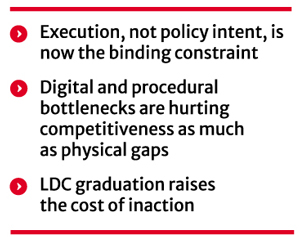 They stressed that structural bottlenecks, combined with heavy dependence on the Dhaka-Chattogram trade corridor, could undermine trade competitiveness unless reforms accelerate.
They also highlighted emerging infrastructure projects and growing private sector participation as critical opportunities to strengthen the country's long-term logistics capacity.
Speakers also pointed to upcoming projects such as the Matarbari Deep Sea Port, Bay Container Terminal and the third terminal of Hazrat Shahjalal International Airport as key opportunities to build long-term logistics capacity.
Policy Exchange Bangladesh Chairman M Masrur Reaz highlighted key challenges and opportunities in Bangladesh's logistics sector, affirming its critical role in improving trade competitiveness through cost reduction, faster delivery and efficiency gains, according to a statement.
The American Chamber of Commerce in Bangladesh (AmCham) organised the focus group discussion titled "Framing the Logistics Sector Landscape: Challenges, Opportunities, and the Way Forward".
US Embassy Dhaka Commercial Counsellor Paul Frost and Agricultural Attaché Erin Covert, along with AmCham's logistics sector members and key stakeholders across the logistics ecosystem, including representatives from the RMG sector, freight forwarding, inland container depots, shipping lines, airlines, courier services and development partners, were present at the session.
Mr Reaz contrasted traditional cargo terminals with the cargo village concept and highlighted a significant regional knowledge gap in supply chain and logistics management.
Referring to the Chattogram port labour strike, he illustrated how logistics disruptions can severely impact the national economy.
He noted that logistics infrastructure and port capacity expansion will be crucial to supporting the projected GDP of US$760 billion by 2030, while a 1.0 per cent reduction in logistics costs could increase exports by around 7.0 per cent, particularly as Bangladesh approaches LDC graduation.
In his opening remarks, AmCham President Syed Ershad Ahmed underscored the fundamental role of logistics in sustaining supply chains, economic activity and everyday life.
While Bangladesh's logistics sector has evolved, it continues to lag behind regional competitors and remains poorly understood domestically, he said.
He also emphasised that the global logistics landscape is being rapidly reshaped by forces such as AI and automation, decarbonisation and fuel transitions, geopolitics, regionalisation and supply chain resilience.
He stressed the need to bridge existing knowledge and capacity gaps to better support the country's growing trade and investment needs.
Mahbubul Anam, Managing Director of CF Global, outlined key challenges in air logistics and express courier operations, emphasising the need for stronger public-private coordination, supportive policy frameworks, stakeholder-informed infrastructure planning and adequate equipment.
He stressed the importance of cost rationalisation, capacity expansion, efficient courier services and robust contingency arrangements to support time-sensitive shipments, particularly as e-commerce-driven demand for express logistics continues to grow.
Munni_fe@yahoo.com