
Low expectations mark WTO MC14
Asjadul Kibria | Sunday, 29 March 2026
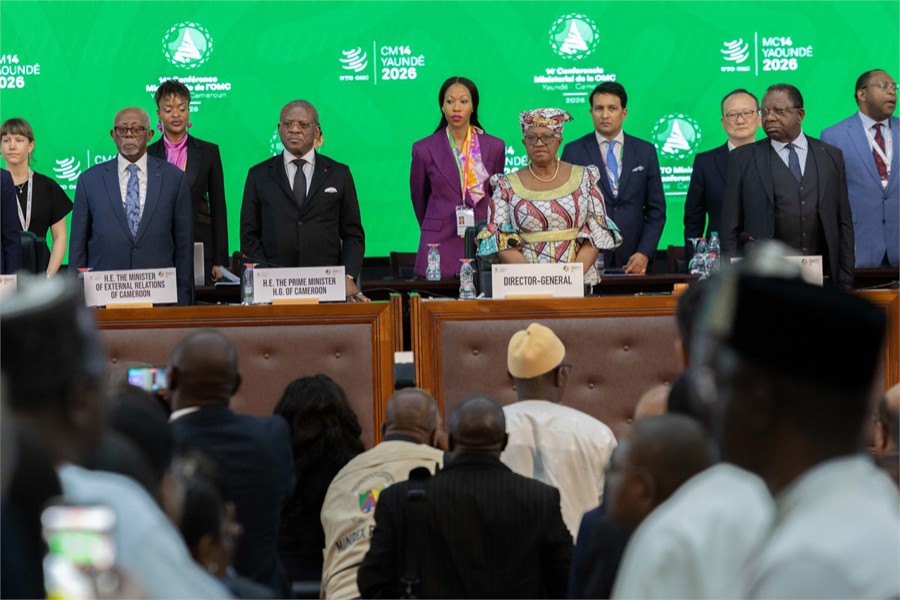
For the second time in three decades of World Trade Organization (WTO)'s history, the ministerial conference is taking place in Africa. More than a decade ago, the 10th ministerial conference (MC10) was held in Kenya, the first African nation to host the meeting of the highest decision-making body of the multilateral trade and rule-making organisation. This year, the 14th conference, MC14, started on Thursday in Yaoundé, the capital of Cameroon, the second African country to host the ministerial conference. Although the meeting is scheduled to conclude today (Sunday, March 29), it may be extended for a day, as has happened in past ministerial conferences. So, it is difficult to make conclusive comments on the possible outcome of MC14 while this piece goes to press late Saturday evening in Dhaka. Nevertheless, some observations can be made based on developments so far.
MC14 is taking place amid intensified geopolitical conflicts, primarily due to the war in the Middle East. The United States (US) and Israel's joint assault on Iran forced the latter to retaliate, turning it into a full-blown war that has continued for four weeks. As a result, global energy supply is under serious threat, risking global trade and economic growth. The WTO Secretariat's latest Global Trade Outlook and Statistics 2026, released in the third week of this month, noted that world trade in 2026 will be shaped by two powerful and opposite forces. First, strong investment in artificial intelligence (AI) continues to drive global demand for high-tech products and digitally delivered services. Second, the conflict in the Middle East and the resultant spike in energy and transport costs are likely to weigh heavily on global trade and output. The report projected that global merchandise trade growth would slow to 1.9 per cent this year from 4.6 per cent in 2025 by volume. It is also projected to grow by 2.6 per cent next year. Trade in commercial services will grow by 4.8 per cent in 2026 after a 5.3 per cent rise last year, and is projected to rise again to 5.1 per cent in 2027. Together, goods and services trade will grow 2.7 per cent in 2026 compared with 4.7 per cent in 2025. The global economy, measured by gross domestic product (GDP), is also projected to grow moderately to 2.8 per cent in both 2026 and 2027, the same as last year.
If the war in the Middle East drags on, as the Russia-Ukraine war has, it will be a disaster for the global economy because trade will be severely hampered. UN Trade and Development (UNCTAD) rapid analysis showed that disruption to maritime traffic in the Hormuz Strait, mainly controlled by Iran, has already raised concerns of ripple effects across global markets. The strait carries about one quarter of global seaborne oil trade, as well as significant volumes of liquefied natural gas and fertilisers. Global oil prices have already jumped, crossing $100 per barrel, and freight rates for oil tankers and war risk insurance premiums have surged. As a result, higher shipping costs across supply chains put weak economies like Bangladesh in trouble as they face a supply crunch in energy.
The war is primarily driven by Zionist Israel's aggressive attitude to weaken Iran, coupled with US President Donald Trump's policy to unsettle the eight decades of international order. He believes that global gunboat diplomacy means launching military operations or repeatedly threatening military conquest. In his first year of office, Trump has ordered strikes on at least seven countries: Yemen, Somalia, Nigeria, Syria, Iraq, Iran, and Venezuela. Trump also believes in using economic policy with the declared purpose of harming others, as reflected in his unilateral imposition of so-called reciprocal tariffs. Through these actions, the Trump administration sends a clear message to the rest of the world: the international order carries little value to them, and they will not abide by international rules and regulations in trade and geopolitics.
Against this backdrop, it becomes difficult for other countries to maintain international order in global trade through the WTO. That is why US trade partners are forced to pursue bilateral settlements with the US to reduce high tariffs, rather than use the WTO platform. In his first term, Trump blocked the appointment of juries at the Appellate Body of the WTO's Dispute Settlement Body. As the block continues, the appellate system becomes dysfunctional due to the absence of a minimum number of juries. Now, the US is pushing for WTO reforms that would abolish consensus-based decision-making and introduce a plurilateral approach, under which a select number of WTO members can adopt a deal. In MC14, reform has become a key agenda, and the US has already submitted a comprehensive proposal titled 'Further perspectives on WTO reform.' It has been crafted so that no one can disagree with all of the points. Moreover, United States Trade Representative (USTR) Jamieson Greer, in his formal statement at MC14, made it clear that the future of global trade lies in bilateral and plurilateral deals, not multilateral ones. He said that over the past few months, the US has outlined several reform priorities. "One of them is exploring a pathway to incorporate plurilaterals into the WTO architecture. The future of trade negotiations is likely to be plurilateral. If the pathway to incorporation is blocked, countries will still negotiate with their trade partners, but it won't be at the WTO," he asserted.
A plurilateral approach is not new at the WTO and is generally considered an alternative route for trade negotiations. Currently, different members are negotiating 18 plurilateral agreements and joint statement initiatives. However, most members are not ready to replace the current multilateral approach with a plurilateral one, which would abolish the consensus-based decision-making system. For example, the Least Developed Countries (LDCs) group has asserted that it stands for consensus-based decision-making, the core of the WTO, supports the continuation of special and differential treatment (S&DT), and demands a level playing field in negotiations.
Trade negotiators in Yaoundé spent all of Friday discussing and debating WTO reform, though no clear consensus has emerged from the intense sessions. It appears that some progress has been made in other key areas, even as leading countries remain steadfast in their positions.If the deadlock continues, there will be no deal at the MC14, and delegations will return to their respective countries without a fruitful outcome. However, nobody will be unhappy, as they had arrived at the Conference with low expectations. To know what ultimately happens, one will have to wait until today (Sunday) evening.
asjadulk@gmail.com