
Maheshkhali betel leaf enjoys global acclaim
But unfortunately farmers are deprived of the deserving prices locally due to week marketing system and lack of govt support
Tuesday, 28 April 2026
OUR CORRESPONDENT
COX'S BAZAR, Apr 27: The famed sweet betel leaf of Maheshkhali, Bangladesh's only hilly island, is gaining recognition beyond national borders, but local farmers say they are struggling to secure fair prices locally due to weak marketing system and lack of government support.
Known for its distinct taste, aroma and natural sweetness, Maheshkhali's betel leaf has become a key contributor to the local economy. Yet growers say rising production costs and falling market prices are pushing many into losses.
According to the Department of Agricultural Extension (DAE), Cox's Bazar, about 1,600 hectares of land have been cultivated with betel leaf in Maheshkhali upazila this season, producing nearly 40,000 tonnes.
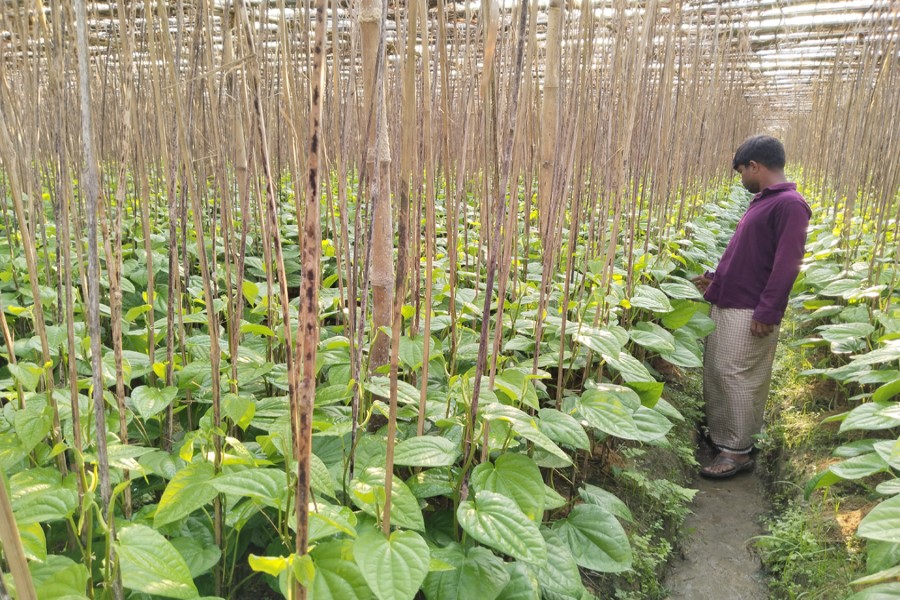
The upazila has around 38,100 gardens and traditional bamboo-made and thatched enclosures for betel leaf cultivation.
During a recent visit to Hoanak union, farmers were seen busy tending their betel leaf gardens, but expressed frustration over a sharp decline in prices.
Two months ago, each bundle (bira) of betel leaf sold for Tk400-500. Now it has dropped to Tk200-250,said farmer Alaul Hossain.
Trader Jaber Ahmed said prices of large-sized betel leaf have fallen by Tk 150-200 per bundle during the peak February-April season, making it difficult for farmers to recover production costs.
Farmers say expenses for building gardens, along with fertiliser, pesticide and labour cost, have increased significantly, but market prices of the crop have not increased accordingly.
Although Maheshkhali's betel leaf is sold for Tk 500-600 per bundle in Dhaka and other major markets, farmers receive only Tk 200-300 locally, highlighting a gap caused by middlemen.
Betel leaf is cultivated year-round in areas including Choto Maheshkhali, Shaplapur, Boro Maheshkhali, Hoanak and Kalarmarchhara. On hilly land, the plants last up to three years, while in plains cultivation is seasonal.
Farmers attribute the leaf's unique sweetness to the island's hilly soil, while locals say the tradition dates back at least 200 years and remains deeply embedded in cultural and social practices.
"This is not just a crop but a part of our heritage," said local resident Abul Hasan.
Farmers are now calling for better storage facilities, modern marketing systems and easier access to agricultural loans.
Experts say improved packaging, cold-chain facilities and geographical indication (GI) recognition could boost export potential and ensure better returns.
Dr Bimal Kumar Pramanik, deputy director of the DAE, Cox's Bazar, said steps are being taken to support marginal farmers, including facilitating their access to credit and other services.
tahjibulanam18@gmail.com