
Maintaining growth momentum needed to pare back poverty
Ziaur Rahman | Saturday, 1 November 2014
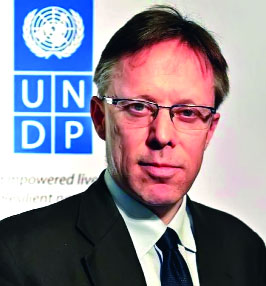
A top UN official praised Bangladesh's substantial progress in achieving the Millennium Development Goals (MDGs) under its drive for higher economic growth and also in disaster-preparedness aimed at mitigating the country's vulnerability to natural calamity.
UNDP Assistant Secretary-General Michael O'Neill, who recently visited Bangladesh, also lauded resilience to climate change and urban poverty-reduction efforts of the country.
He commended people's resilience especially in adapting to climate change and fighting urban poverty.
The UNDP executive, also Director at the Bureau of External Relations and Advocacy, made his maiden official visit to Bangladesh to see for himself the UN development agency's interventions in climate resilience and public service delivery.
In an exclusive interview with The Financial Express thereafter, he made the appraisal and also spelt some more vital tasks for the country's uplift on a higher trajectory of advances.
During his three-day stay in Bangladesh, Mr O'Neill visited a number of projects in Dhaka and countryside, talked with beneficiaries and witnessed the changes in their lives. He met with senior officials of the government, development partners and members of the civil society.
Last Sunday, he visited the 'Forest, Fruit and Fish' plant in Barguna, a big successful pilot of UNDP's coastal afforestation programme which has now been chosen by the Bangladesh government for replicating in nine more districts.
The 3Fs scheme presents innovative approaches in turning climate-change challenges into economic opportunities for poor women and men. Mr O'Neill was inspired to see how this innovative model promoted green economic development, climate-change adaptation and mitigation while providing the local communities with diversified livelihood options.
He also witnessed a cyclone-preparedness demonstration in Naltona union and visited the Naltona Union Information Centre - a one-stop service facility set up by the UNDP. The government is providing transparent and accountable public services for the poor and the underserved.
Volunteers at the cyclone centre demonstrated the early warning system and other preparations to face disasters.
"Bangladesh has strengthened its disaster preparedness greatly," said the UN executive, adding that some 110 million people of the country have access to an early warning dissemination system. "It's a great achievement."
He appreciated the use of ICT in Union Information and Services Centres that serve as the hubs of information and services at the doorsteps of local people. He highlighted the urgency of using these information technologies for disaster management and early warning and monitoring extreme weather events.
Situated between the Himalayas and the Bay of Bengal, Bangladesh, mostly a low-lying country with high population density, suffers from various natural disasters like cyclones and floods.
"But the country has strengthened its disaster-preparedness activities substantially…," said the UN executive.
He found considerable progress made by Bangladesh in achieving the Millennium Development Goals (MDGs), particularly in poverty alleviation.
The goal was to reduce the incidence of poverty by half or 29 per cent in the case of Bangladesh by the year 2015. Two years ahead of time, as of 2013, it was possible to bring the rate down to an estimated 26.2 per cent.
He said Bangladesh has made remarkable progress in poverty reduction, cutting child and maternal mortality rates, increasing enrolment at primary schools, reducing the prevalence of underweight children, increasing enrolment at primary schools, improving immunisation coverage and curbing the incidence of communicable diseases.
Attaining gender parity at primary and secondary education, moving towards gender equality and empowerment of women also came in for appreciation.
O'Neill, also a former British ambassador to Qatar, Afghanistan and Sudan, highlighted Bangladesh's important contributions to key global policy processes such as the negotiation of the Post-2015 Framework, as well as the country's status as a top troop contributor to UN peacekeeping operations.
In this context, he mentioned the victory of Bangladeshi candidates in recent elections to the Commonwealth Parliamentary Association (CPA) and the Inter-Parliamentary Union (IPU) - two international parliamentary forums.
O'Neill suggested some priority tasks for Bangladesh to graduate from the least-developed-country status.
Besides improving basic infrastructures, he said, the government has to invest in ICT and work continuously to improve the disaster-management system, reduce the country's vulnerability to climate change and concentrate more on human resource development to achieve the status of a middle-income country by the year 2021.
Bangladesh is on the right track in this respect, he noted.
He appreciated the country's robust economic growth--above six per cent per annum over the last few years. He stressed the need for maintaining the growth rate with sustainable development for lifting people out of poverty. Democratic governance, he said, is also an essential factor for sustainable economic growth and equally important for all countries.
To attain middle-income status, the country has to strike a balance maintaining its success towards achieving the millennium development goals, further improving nutrition, education services, and healthcare, reducing environmental degradation, development of human resources and improvement of the overall infrastructure.
mzrbd@yahoo.com