
MULTIMODAL TRANSPORT PLAN FINALISED
Major shift from roads to rail, water targeted by 2040
MUNIMA SULTANA | Tuesday, 10 February 2026
A multimodal transportation plan has been finalised at the fag end of the interim government's term to guide all related agencies in implementing future infrastructure development projects aimed at improved connectivity for both passengers and freight.
However, experts say the obligation to abide by the plan by all concerned remains absent due to finalising it at this stage.
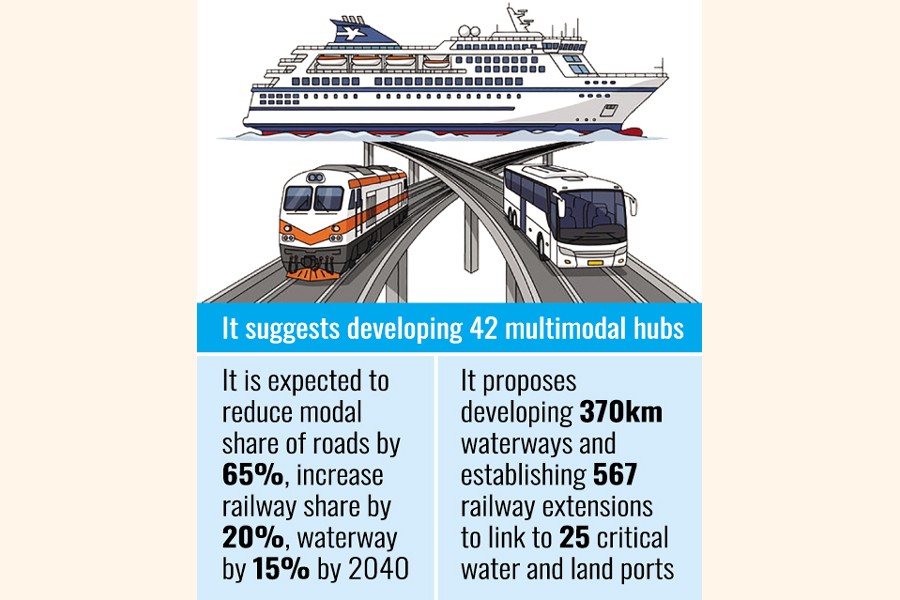
The plan suggests developing 42 multimodal hubs in the country. Developing 370km waterways and establishing 567 railway extensions to link to 25 critical water and land ports have been proposed.
This is expected to reduce the modal share of roads by 65 per cent, as well as increase the railway share by 20 per cent and waterway by 15 per cent, by 2040.
The Ministry of Road Transport and Bridges has formulated the National Integrated Multimodal Transport Sector Master Plan by targeting to shift the modal share from the overburdened road network to rails, waterways, and airways.
Officials say the plan has been prepared as a strategic national asset that is essential for achieving an efficient, sustainable, and economically competitive multimodal transport system.
The system will integrate the development of rails, roads, waterways, and airways for smoother connectivity and improved future network performance.
"For the first time, a plan has been formulated with extensive data, studies, and following transport models without help from development partners," says an official.
The Roads and Highways Department (RHD) has played a major role in developing the plan with its planning and data systems.
The plan needs institutional collaboration among RHD, Bangladesh Inland Water Transport Authority (BIWTA), Bangladesh Railway (BR), Civil Aviation Authority of Bangladesh (CAAB), Local Government Engineering Department (LGED), and other agencies for long-term sustainability.
The proposed 42 multimodal hubs, planned as per the travel demand model, will integrate railways, roadways, and waterways within a 5km radius for freight and passenger transfers.
They will improve connectivity with ports, economic zones, land ports, agri heat zones, and tourist areas with reliable access to infrastructure.
The plan also proposes forming a body under the Prime Minister's Office. The body will coordinate all transport-related projects to be implemented under the plan.
Sheikh Moinuddin, special assistant to the chief adviser on rail and road transport, says it is a macro-level plan that agencies can follow for future development schemes.
He says the plan will include details of the proposed routes, infrastructure, and facilities.
Dr Md Shamsul Hoque, a civil engineering professor at the Bangladesh University of Engineering and Technology (BUET), prioritises institutional reforms to execute the plan, saying bureaucracy has always played a negative role in the implementation of the policies and plans accepted previously.
"We had a multimodal transport policy, but it was not implemented," he told The Financial Express.
Echoing him, Moinuddin, who played a role in formulating the plan, stresses the importance of adopting it by the next government and making all the related agencies follow it in their future development projects.
"If the plan is not followed by all concerned, the country's connectivity, which is already poor, will continue to be weaker," he told The Financial Express.
Officials say the proposals in the plan were made as per the integrated multimodal travel demand model for the first time to eliminate national bottlenecks.
smunima@yahoo.com