
'Make America Produce Again'
Restoring sovereignty through strategic production
Abdullah A Dewan | Tuesday, 21 October 2025
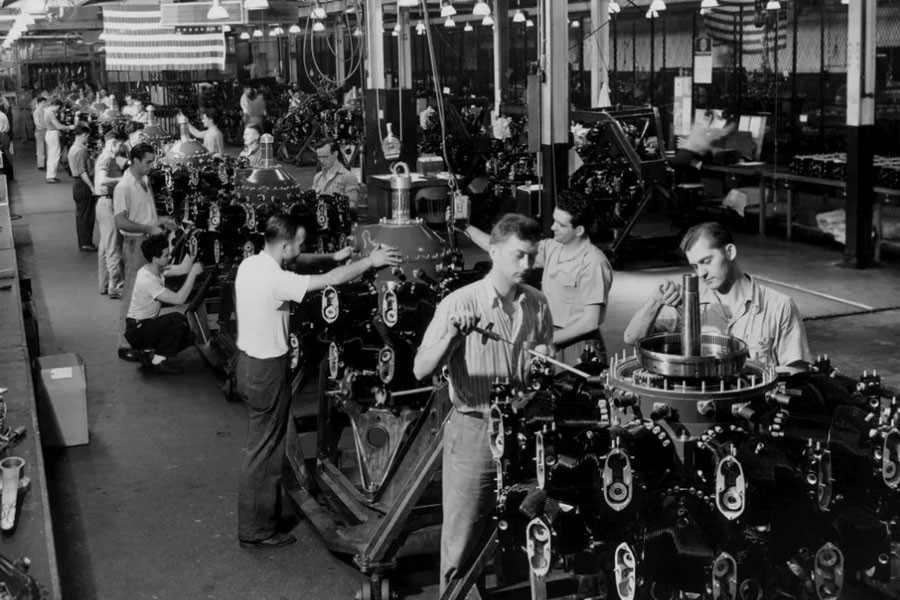
For four decades, the United States (US) embraced free trade, globalization, and lean supply chains. Offshoring was justified as a path to lower consumer prices while American firms concentrated on so-called “high-value” innovation. That approach delivered short-term gains but left behind deeper structural costs: a weakened manufacturing base, dependence on foreign suppliers, and growing worker insecurity. Policymakers have since realized that America can no longer afford fragile supply chains and chronic trade deficits.
This article introduces a new framework — Make America Produce Again (MAPA) — an acronym I created to combine fair trade, selective tariffs, and technological investment to restore manufacturing strength, rebuild the middle class, and secure national independence.
Production is not merely about making goods; it sustains innovation, national security, and middle-class prosperity. When industries migrate abroad, the ecosystems that support them — skills, suppliers, and research— erode. The United States once led in steel, textiles, electronics, and semiconductors; today it relies heavily on imports for critical minerals, antibiotics, and microchips. The COVID-19 pandemic exposed this vulnerability when the nation struggled to produce masks and medical equipment. The war in Ukraine and tensions across the Taiwan Strait have since demonstrated how energy and semiconductors can become tools of geopolitical leverage. A nation that cannot produce what it needs is a nation at risk.
MAPA differs sharply from political slogans like “Make America Great Again.” It is not nostalgia but strategy — rooted in economic reasoning, opportunity cost, and comparative advantage. It aligns with World Trade Organization (WTO) principles by promoting fair competition, not blanket protectionism. The premise is simple: the United States should produce strategically where it holds, or can build, advantage, while minimizing exposure to coercion in essentials. That means anchoring supply chains at home where security requires it and cooperating abroad where efficiency allows it. This is not isolation but strategic participation in the global economy.
Tariffs illustrate this approach. Long dismissed as protectionist relics, they were in fact central to the rise of every industrial power. Alexander Hamilton’s 1791 Report on Manufactures argued for protecting “infant industries,” and 19th-century tariffs helped American firms mature into global leaders. Today, tariffs can again serve a purpose — not broadly but selectively: to counter unfair subsidies, environmental dumping, and exploitative labour practices, and to encourage production within the US or allied nations rather than hostile states. But tariffs must be paired with public investment in infrastructure, research, and training. Rejecting them outright ignores their historic role in nation-building.
Under MAPA, tariffs are not instruments of crude protectionism but components of a deliberate economic strategy with clear objectives. They aim to restore fair trade by discouraging persistent surpluses that distort global markets; reduce dependency on vulnerable foreign supply chains in critical goods; spur domestic job creation and industrial renewal by levelling the field for US producers; and strengthen national security by ensuring production capacity aligns with strategic priorities. These aims distinguish MAPA tariffs from the blunt protectionist barriers of the past. They are designed to modernize and secure the economy — not wall it off.
MAPA is about more than factories; it is about restoring dignity to work. Manufacturing once anchored the American middle class, offering stable wages and upward mobility. Its erosion hollowed out communities, from the Rust Belt to small-town America. Reviving production means reviving that ladder to security — opening opportunities in advanced batteries, medical devices, and clean-energy components. Critics argue that “the jobs are gone and won’t come back.” But history tells a different story. America once shifted from agriculture to industry, then from industry to services. It can shift again. New technologies — robotics, additive manufacturing, and AI-driven logistics — are narrowing the cost gap with overseas production. The next industrial revolution will reward nations that can produce smartly, not merely cheaply.
Some critics see MAPA as inward-looking. In some respects, it is — and rightly so. It ensures that U.S. jobs and security are not hostage to sanctions or supply shocks. Consider China’s recent export restrictions on rare-earth materials, or the hypothetical threat of cutting off antibiotics or semiconductors during a crisis. When vital goods are concentrated abroad, adversaries gain leverage. By rebuilding capacity at home, MAPA strengthens resilience — creating a secure industrial base that supports defence, sustains communities, and protects the middle class. Resilience is not retreat; it is insurance against coercion.
MAPA does not propose that the United States produce everything, only enough in critical areas to guarantee resilience. Pharmaceuticals, semiconductors, clean energy, aerospace, and defence equipment are obvious priorities. The pandemic revealed that even basic items — baby formula, masks, and medical gloves — can become choke points when supply chains break down. Strategic resilience requires mapping vulnerabilities and ensuring domestic capacity where it matters most. The CHIPS and Science Act, which invests in semiconductor manufacturing, is an encouraging step. Similar initiatives are needed for rare earths, essential medicines, and energy storage systems.
Domestic production can indeed cost more than imports, but cheap goods lose their appeal when they destroy secure jobs, erode independence, and leave a nation exposed in emergencies. Moreover, technology is rewriting cost equations. Automation and AI-enabled logistics are boosting productivity and narrowing the lab or cost gap. Consumers are not merely shoppers; they are citizens. They care about more than low prices — they care about livelihoods, community stability, and national security. Paying a little more for strategic goods is not a burden; it is an investment in America’s future.
Some fear that MAPA will trigger trade wars. But MAPA is not isolationist. The United States will continue to trade, invest, and innovate with partners. What changes is the balance of power within that exchange. Cheap imports should not dictate the nation’s destiny. MAPA promotes strategic globalization — resilient supply chains with allies, trade agreements built on reciprocity and shared security, and reduced dependence on adversaries for essentials. This new framework replaces blind globalization with purposeful interdependence.
MAPA also clarifies the proper roles of government and the private sector. Government should set standards, define security priorities, and create incentives for production in strategic sectors. Private enterprise should deploy capital, know-how, and efficiency to meet those goals. Public investment must target infrastructure, research, and workforce training, while private capital scales up production in priority industries. The objective is not to replace markets but to guide them — where national risks are highest and social returns greatest.
Finally, MAPA links national security with environmental responsibility. Competing with state-subsidized, high-pollution producers by importing their emissions merely exports environmental damage. Building cleaner domestic industries — from low-carbon steel to next-generation batteries — reduces both supply risk and global emissions. Through environmental standards and carbon-border adjustments, MAPA aligns security, competitiveness, and climate goals. Economic sovereignty and sustainability are not rivals; they are twins.
MAPA is not protectionism reborn but resilience refined. Protectionism shields incumbents indefinitely; MAPA builds capacity for future competition. Protectionism treats tariffs as ends in themselves; MAPA treats them as means — temporary, targeted, and strategic. It welcomes competition from trusted partners while limiting dependence on adversaries. The lesson is clear: supply chains are fragile, rivals are rising, and sovereignty depends on industrial capability. A nation that cannot make its own steel, chips, or medicines is not fully sovereign. MAPA offers a path to restore that capability through investment, selective tariffs, and disciplined industrial policy.
America’s rise was built on production — from the mills of the Industrial Revolution to the assembly lines of World War II. Making and innovating once defined this nation’s identity. The decline of manufacturing was not inevitable; it was the consequence of policy choices. Different choices can reverse it. Make America Produce Again is not a slogan but a strategic program — to restore security, rebuild the middle class, and protect national independence. In an uncertain era, nations that can produce will endure. The United States must be one of them.
Dr Abdullah A Dewan is a former physicist and nuclear engineer at the BAEC and professor emeritus of economics at Eastern Michigan University, USA. aadeone@gmail.com