
Managing disasters efficiently
Farid Hasan Ahmed | Monday, 27 April 2015
Natural and human induced hazards such as floods, cyclones, draughts, tidal surges, tornadoes, earthquakes, river erosion, fire, infrastructure collapse, high arsenic contents in ground water, water logging, water and soil salinity, epidemic and various forms of pollution are quite common these days. Over the last three decades, Bangladesh invested substantially in disaster management. As a result, the country has now gained considerable ability to manage natural disasters, in particular, floods and cyclones in better way.
However, the capacity of Bangladesh for facing earthquake consequences is not yet tested. Bangladesh and the northeastern Indian states have long been one of the seismically active regions of the world, and have experienced numerous large earthquakes during the past 200 years.
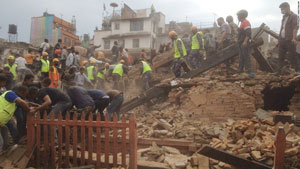
At least three people were killed in Tangail, Bogra and Pabna after an earthquake, followed by a shockwave on April 25, 2015.The jolt was felt shortly after a 7.9 magnitude earthquake struck an area between the capital Kathmandu and the city of Pokhara in Nepal. Nearly 1,000 people are known (as on 10 pm of April 25) to have died in an earthquake in Nepal, with many more feared trapped under the rubble.The government of Nepal is seeking help from various international agencies equipped to handle the kind of emergency the country is facing at this moment.
In Bangladesh, it has been reported that cracks developed in four buildings in old Dhaka, Tejgaon and Shewrapara of the capital. The administrative building of Islamic University and general hospital in Kushtia, two other buildings in Natore and a 10-storey building in Feni showed cracks. Over 200 people were injured across the country when they were rushing out of houses. A woman died of stroke in Pabna while two others in Tangail and Bogra during the earthquake.
In April 24, 2013, the collapse of Rana Plaza, an eight-story building was the worst industrial disaster in the history of Bangladesh, killing over 1,100 garment workers and injuring over 1,600 others. Since 2006, over 1800 people have been killed as a result of substandard safety conditions in Bangladesh factories. The Rana Plaza disaster was preceded by a fire at the Tazreen Fashion factory and Smart Fabrics on the periphery of Dhaka on November 24, 2012, leaving at least 117 dead and around 200 injured.
Management of the incidents in Rana Plaza and fires in factories have shown the strengths, weaknesses, limitations and challenges of key organisations and communities involved in responding to unexpected occurrences. Taking into account the vulnerability of Bangladesh to earthquake, accidents in garments factories and the inadequacy of the existing emergency practices, the following points are placed before relevant agencies/authorities for appropriate strategies and actions in improving the emergency performances:
EMERGENCY RESPONSE OPERATIONS: This means activities taken up immediately before, during or after an event which help to reduce loss of life, illness or injury to humans, property loss or damage, or damage to the environment. It may include, for example, planning, co-ordination and implementation of measures to lessen the effects of a disaster upon members of the public or to protect any property of the state. (Source: National Plan for Disaster Management 2010-2015).
Emergency support operations may contain (a) rapid assessment of the situation and identification of the needs, (b) coverage of basic needs by providing drinking water, emergency medical assistance and shelter for victims and (c) strengthening the coordination of search & rescue and relief efforts.
READINESS FOR EMERGENCY RESPONSE: a) It includes the formulation of workable emergency plans, development of warning systems, maintenance of inventories and training of workforce. It may also grip search and rescue measures as well as evacuation plans for areas that may be at risk from a disaster.
b) Readiness encompasses those measures taken before a disaster event which are aimed at minimising loss of life, interference of critical services and harm when the disaster occurs.
c) Prior to any emergency situation, the contingency plan provides the basis for identifying and further developing the response capacity. The contingency plan is the basis of readiness and covers :1)analysis of the context, risk mapping and identification of likely emergency scenarios; 2) mapping of capacity, vulnerabilities, constraint and resources, tangible/intangible assets; 3) identification of other external organisations' capacity, constraint and resources in the department/ministry/area/country/region.
WHEN AN EMERGENCY OCCURS, THE FOLLOWING ACTIONS ARE REQUIRED: a) Activating the contingency plan as quickly as possible with proper commitment, resources and strength;
B) Doing a quick preliminary analysis of the circumstances and available skills and resources (internal and external);
c) Leading a first assessment and sketch what could be done at different levels;
d) External and internal networking, collaboration, coordination with effective management and leadership.
General fundamentals to be considered in all emergencies include pre-emergency groundwork and provisions for alerting, rescuing and evacuating the affected people. Political and administrative determination, effective policy formulation and its coordinated implementation and stakeholders' participation are of great importance for avoiding risk and also for running speedy emergency operations effectively and competently.
farid.hasan2008@gmail.com