
Manikganj printing presses suffer loss amid election-time ban on posters
OUR CORRESPONDENT | Thursday, 5 February 2026
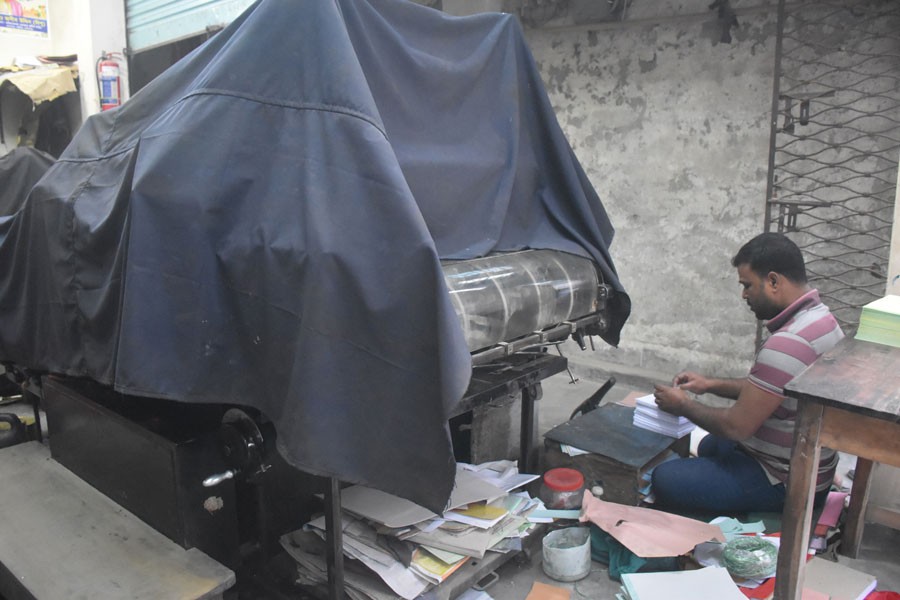
MANIKGANJ, Feb 04: Owners and workers of printing presses in Manikganj said they have lost a huge amount of income due to the ban on election related posters and if the ban prevails small presses will not survive.
After the Election Commission directed printing presses across the country not to print any posters for the 13th parliamentary election a week ago, Manikganj's printing presses lost a large volume of seasonal work. The free fall of seasonal income could not be prevented with only leaflets, handbills, and a limited number of festoons allowed, owners and workers say.
Visits to several printing presses in Manikganj Sadar show rows of machines and stacks of paper lying idle. During previous elections, workers had to work 16 to 18 hours a day just to keep up with the demand. This year, most of their time is spent waiting. Workers voice their uncertainty, while owners worry about what lies ahead.
In past elections, printing work would surge immediately after election symbols were allotted. It was common for small and large presses to receive orders for 500,000 to 800,000 posters. Many owners had to hire extra workers to handle the rush. This time, the situation is exactly opposite.
Md. Farhad Hossain of Mahim Printing Press says they have no objection to the rules, but the impact on their livelihood is severe. "Election season brings us the highest earnings of the year. Many small presses survive on this income. If things continue like this, many presses won't be able to survive," he said.
Shafikul Islam Suman, owner of Rongdhonu Printing Press, said this is the first national election without posters. "The ban has put us in real trouble. The presses are idle and we're having to pay staff without any work. It's becoming harder to manage," he added.
At Rupa Art Press, worker Suruz Molla shared a similar experience. "During election season, we used to work 16 to 18 hours a day. Now there's no work at all. The owner is incurring losses, and our income has stopped. In this season alone, we used to do work worth six to seven lakh Taka (Tk 600,000- Tk 700,000). Without it, many presses will shut down," he said.
Around 20 printing presses in the district are reportedly going through the same crisis. Workers who usually depended on overtime now have no work at all. Owners say candidates are shifting to digital campaigning due to the changed rules. With social media becoming a major campaigning tool, the need for posters and banners has fallen sharply. As a result, the seasonal economy built around printing is under serious strain.
Many believe the ban on posters is helpful for controlling campaign activities and reducing waste, but it has affected a long-established industry. Owners argue that while an eco-friendly campaign is important, the authorities should also consider support measures for the affected sector.
Subhash Dutta, owner of Sharot Press and a representative of press owners, urged authorities to review the policy in future elections.
"If printing posters remains banned, many small presses in Manikganj will not survive. Many families depend on this seasonal income. This sudden blow is difficult to absorb," he said.
Owners and workers say they respect the election's rule, but the industry needs some flexibility or, at the very least, a realistic solution. Without it, many small presses and the workers who depend on them may face an uncertain future.
asadlimon@gmail.com